Interested in my new Hybrid Woodworking book? Sign up and be the first to know when pre-orders are open!

7 – How to Make a Butcher Block End Grain Cutting Board

Subscribe (iTunes/RSS)

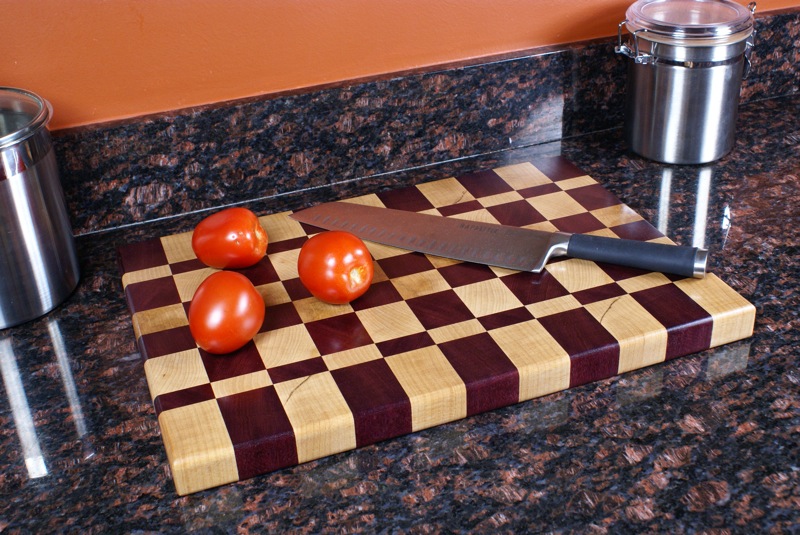
Butcher Block End Grain Cutting BoardOne of my favorite woodworking projects is a butcher block end-grain cutting board. Im not sure if its the “back to basics” simplicity or just the fact that it is one of the most useful projects a woodworker can make, but something keeps bringing me back for more. A custom cutting board makes a great gift and many woodworkers make them in batches every Holiday Season. And if you are relatively new to woodworking, this is a great project to hone your milling, glue-up and tablesaw skills. I’ll cover the preparation and construction of the board itself, as well as the various finishing options available. I’ll also discuss how to maintain the board and keep it looking fresh for years to come!

Update (9/25/10)
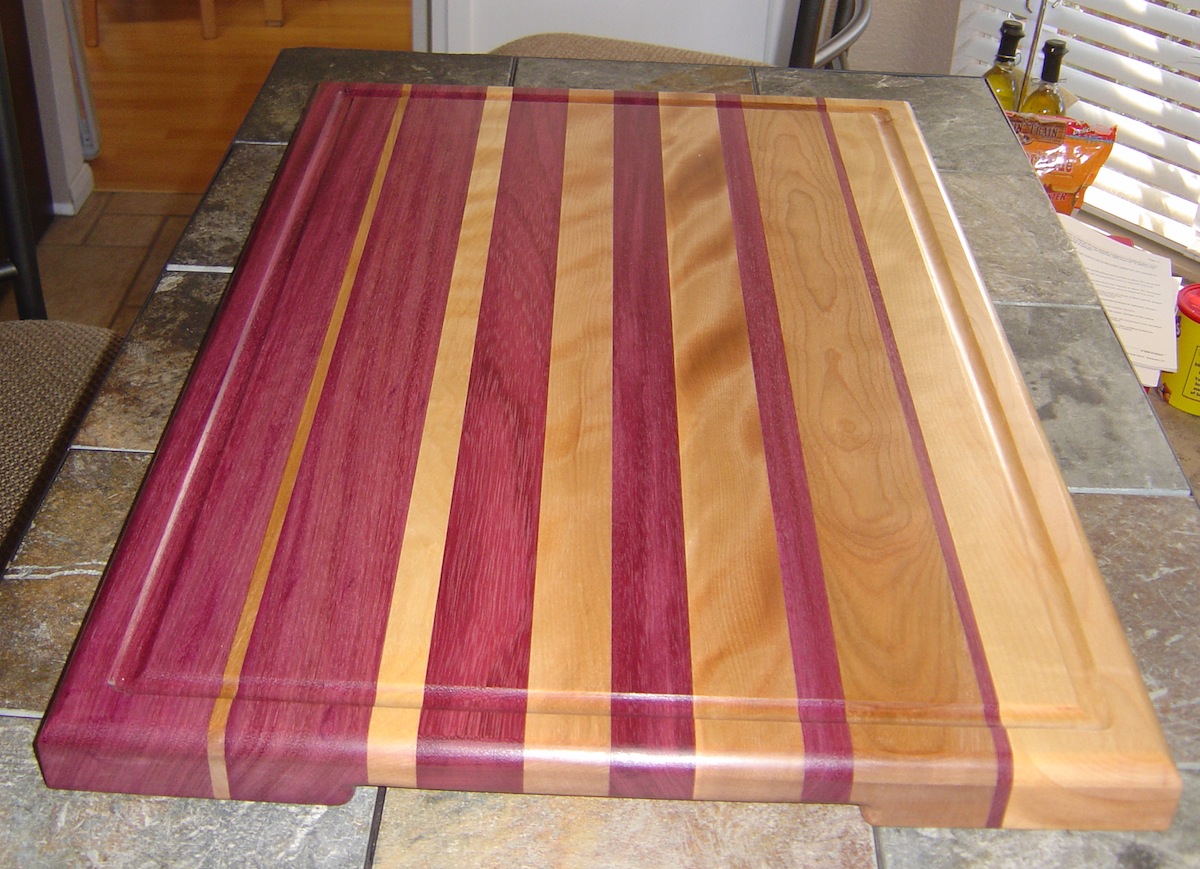
Big Purpleheart and Maple Cutting BoardI never thought when I made this video that so many folks would find the plan useful and make their own. I think its safe to say this is the video that launched a thousand cutting boards! So you may already be very familiar with this design. But what you may not know is the fact that this design came about almost by accident. Once of my first cutting boards was a very large board made of purpleheart and birch (left). It turned out to be far too large for our kitchen. Nicole asked that I cut it down. So instead of just cutting trimming the length and width and calling it a day, I decided to have some fun with it. I sliced it into pieces, flipped the pieces 90 degrees, alternated their direction and glued them back together. The end result is the cutting board you see in this video. Quite a transformation! And I am so glad that so many of you were inspired to make your own, and even make some amazing variations on the concept.

Categories: Finishing, Projects

Comments

  1. davey r (0sd1 in chat) May 31, 2013

    as usual superb demonstration. what i like most about your demonstrations is your so humble and willing to share information.

    what i was wondering is my step son wants a chessboard, and im gonna build it into the coffee table im building for our living room. can i use the steps you took in this video (but modified wood dimensions) to build that chessboard? i notice that this cutting board is in a somewhat chessboard pattern.

    thanks !

    •  

      thanks for the kind words. And yes, you can use this method to make a chess board. Just remember that the board will expand and contract so you don’t want to surround it with any kind of a frame. It needs to move.

  2. Mike May 18, 2013

    Just a quick question–what is the best way to deal with gaps in the top surface of the cutting board? I was thinking about coating the whole board in wood glue so its gets into all the crack, wiping away the excess, then sanding it throughly as it cures so that the saw dust combines with the glue in the gaps. Should I do that or just depend on the finish to close the gaps?

    •  

      Hey Mike. It really depends on the nature of the gaps. Are they due to milling issues or is the wood splitting? Gaps can be a sign of future issues and just filling them won’t really prevent anything.

      The trouble with gaps on a food prep surface is just about anything we do will be in contact with food. So standard fillers will most likely just pop out over time. Glue and sawdust probably won’t do much for you either. And lots of folks are gun-shy about using something like epoxy to fill the gaps.

      So what you use really depends on the nature of the gaps but I can tell you straight off, there’s no great solution. They all have negatives associated with them due to the food contact and repeated moisture exposure.

  3. SD Spearfisher May 7, 2013

    Damn thorough video. Nice job!

  4. Jenn C May 4, 2013

    Most entertaining cutting board demonstration I’ve seen. Thank you. Will be coming back for more!

  5. DieterM April 13, 2013

    Hi Marc,

    First of all, thanks for your great Videos!!!
    I have a endgrain board made of oak that works very well, its just a little small, so I think to make a bigger one.
    What do you think of using beech as material?
    I like the color, it fits well in my kitchen and I have easy access to it here.
    Maple is available here too, but to make a board 100% out of marple its too “white”, I prefer darker colors.

    Thanks!

    Dieter

  6. JF April 12, 2013

    Hi!

    I’m almost done making the cutting board and I was thinking about adding an epoxy inlay signature. My question is : will the salad bowl varnish / mineral spirit mixture affect the epoxy in any way (such as absorbing/spreading it in the wood pores affecting the cosmetic appeal of the original inlay)? Second, do you think their is a health issue relating to this (I’d be inclined to say no since it will be small and not in the middle of the cutting area, but then again, if will get mixed with the varnish mixture, it could spread withing the board)?

    What do you think?

    Thanks Marc!
    J-F

  7. Brittnie March 30, 2013

    Hi Marc, Great video! I’m going to attempt to build a butcher block top to attach to the top of a dresser turned kitchen island, with demensions of 2″x35″x20″. Hopefully this technique will work for something of this size. Two questions for you, First if I were to do the entire butcher block in hard maple, would it still be necessary to use the staggering sizes of wood, or is that purely for the look of it? and second, is staining okay to do to a butcher block that I will be prepping food on? and if so when in the process should it be stained? Thank you!

    Brittnie

    •  

      Hi Brittnie. The varied widths is something we do purely for looks. If you are using one wood and increasing the overall size, you’ll have a much easier time if you simply use one size. The bigger the block gets, the more that pattern becomes hard on the eyes anyway.

      As for stain, I don’t recommend it. As a general rule of thumb, I don’t stain anything that touches food. I just don’t want to take any chances of it transferring to the food.

  8. roger March 16, 2013

    Tis a really nice cuttin board Marc.

  9. James March 4, 2013

    So I am doing this as my first wood working project. It all seems simple enough, but I have run into a slight problem: I bought an old table saw off craigslist and it works great but the rip fence doesn’t seem to Rip square. I did the first run of cuts and put the hard maple and purple heart together. They fit close enough, but I had to sand some off to get it all smooth after the glue up. Should I try to do the last 1-1/4″ cuts with the fence or should I try using my circular saw and an edge guide? Really don’t want to spend a lot more money on a new table saw right now. Also, what would you suggest for a good entry level table saw?(400 and under) Thanks for any help.

    •  

      Hi James. I can’t really help you with the tablesaw purchase. I don’t follow saws in the price range so my advice would be to read some reviews and possibly ask in a forum. Gather some opinions and go from there.

      I have heard of someone using a circular saw for this project but that’s a tough way to go. These cuts do need to be pretty accurate and a tablesaw is really the only way I would recommend doing it. So I’d try to calibrate and sure up the tablesaw fence somehow since it really is the ideal tool for the job.

  10. Dustin March 2, 2013

    Hi Marc,

    I have a few questions about the build. I see you plane the bock once complete. Is that the recommended finishing technique over sanding? I hear the horror stories of planing end grain and wonder. I sand my blocks with a belt, RO, then palm sander down to 220 and can’t se to make them perfectly smooth. You can always feel the seams where the glue is. I’ve even tried taking one down to 600 with no change. Any tips on the finishing touch?

    Thanks!

    •  

      I don’t recommend planing. Sanding only. I didn’t plane the blocks in the video either. You might be confusing the drum sander for a planer. Planing end grain is just a bad idea.

      And honestly, concerning the glue lines, I usually don’t worry about them. A cutting board is going to get beat up and have water exposure on a daily bases. You will almost always have glue lines to contend with. Just the nature of the beast. So sand it well enough that it looks good and feels smooth overall, and call it done.

      • Dustin March 2, 2013

        Makes sense now, I did think your drum sander was a planer. Thanks for clearing it up!

  11. Kelly February 27, 2013

    Hi Marc,

    Can I put the varnish mix overtop of a mineral oil finish on a end grain cutting board.
    Thanks Kelly

    •  

      Only if the mineral oil has completely dissipated. Problem is mineral oil never dries, so if you apply a varnish on top of it the varnish will remain wet and tacky for a very long time. So once a board is coated with mineral oil, it can be hard to change it over to varnish. The mineral oil needs to essentially absorb into the fibers and wear off with regular use and cleanings. Only thing that will help that is time. In general, whenever I get this question, i usually recommend the person just stick with mineral oil.

  12. Frank February 17, 2013

    Marc,
    This a great walk through on how to make a butcher block cutting board. I am thinking of making one on a larger scale. I have a piece of furniture that is 40 inches long and 19 inches wide that I am going to be using as a small island in my kitchen. I would like to make a butcher block top for it. Would you recommend just following these steps to make it? How much wood do you think I will need to make a top that is 40×19? Any other suggestions are appreciated. I am a beginner.
    Thanks,
    Frank

    •  

      Hey Frank. Hard to say for sure how much material you’ll need. Frankly, I never really did any calculations for this particular board, lol. I guess you could always consider the final dimensions of the board you’re making and add 25% as a very rough estimate for the material.

      This method of construction is fine for a larger board. Where it gets a little hairy is when someone wants to do an entire countertop. Not only is it tricky to build but the design becomes overwhelming at that point. But I think you’re still in a range where it shouldn’t look too bad. But sketch it out first to make sure you’re happy with the overall effect the pattern creates.

Leave a reply

XHTML: You can use these tags: <a href="" title=""> <abbr title=""> <acronym title=""> <b> <blockquote cite=""> <cite> <code> <del datetime=""> <em> <i> <q cite=""> <strike> <strong>

*

Online project based woodworking education.

3 Membership types

  • A la Carte
    Starting at $25/project
  • Subscription
    $129/year
  • Superfan Subscription
    $299/year
Learn more →

Simple Varnish Finish DVD

Coming Up


  • Review Show #16

    June 18, 2013
  • Wood Talk Live

    June 19, 2013 - 4:00 pm MT
  • Top & Assembly - Video

    June 21, 2013
  • Finish - Video

    June 25, 2013
  • Post Alternatives - Video

    June 28, 2013
clearvue-200x200

Pressure Treated Wood Utility Poles for building structures, distribution or transmission.

bellforest200x200-tww10