This week’s question comes from Matt. He writes:
After reading much debate on this issue, I thought I might like to hear your input. What does the Wood Whisperer think about running end-grain through the planer? Im SOOOOOOOO tempted to try it because it would be so easy to clear up some high spots, but Ive read that this can cause serious kickback, possibly turning the planer into a large grenade. (At least my portable anyway). I’ve read where people have done this their whole life with no issues other than tear-out at the end, which can be prevented by rounding over the end first. Others state stories of boards flying through neighbors windows, planer blades causing decapitation, and planers actually being knocked over from this process. At this point I think its safe to say that Im not going to try it but, what do you think about it? ?But, I was only taking off like 1/128,000th at a time.”
And here was my reply:
Hey Matt. I know that many people have done that procedure many times without a problem. I also know many folks who have done it and experienced disaster. That’s enough to scare me into NOT doing it. My biggest woodworking injury occured early on in my career when I tried to run the end grain of a board over the jointer. Big mistake! The board snagged and exploded in my hand. No MAJOR injury other than a huge blood blister and some numbness. But enough to make me almost poop my pants! The principal is the same with the planer, and as a result, I never do it. So…….. the final choice is up to you. But its an operation I do not recommend.
I would love to hear everyone’s experience with this technique, good or bad.
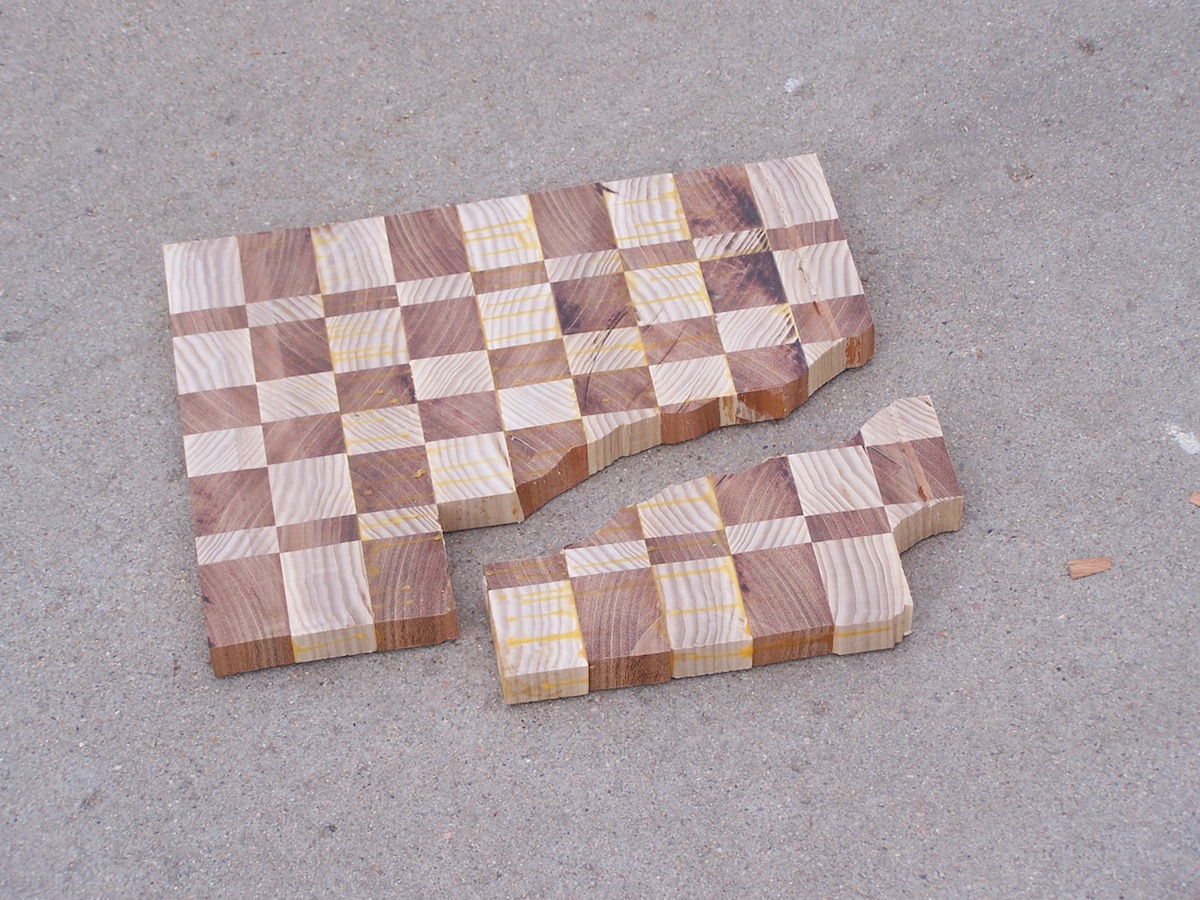
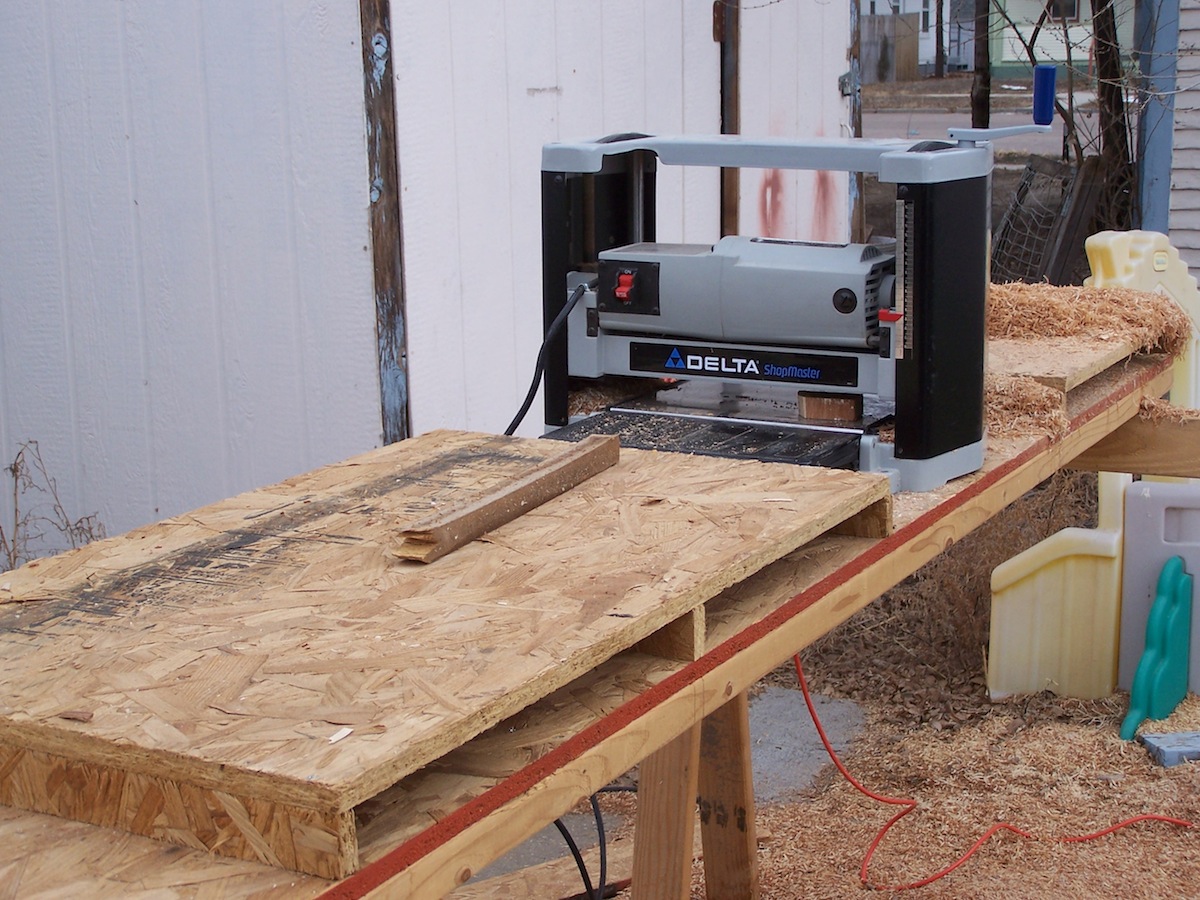
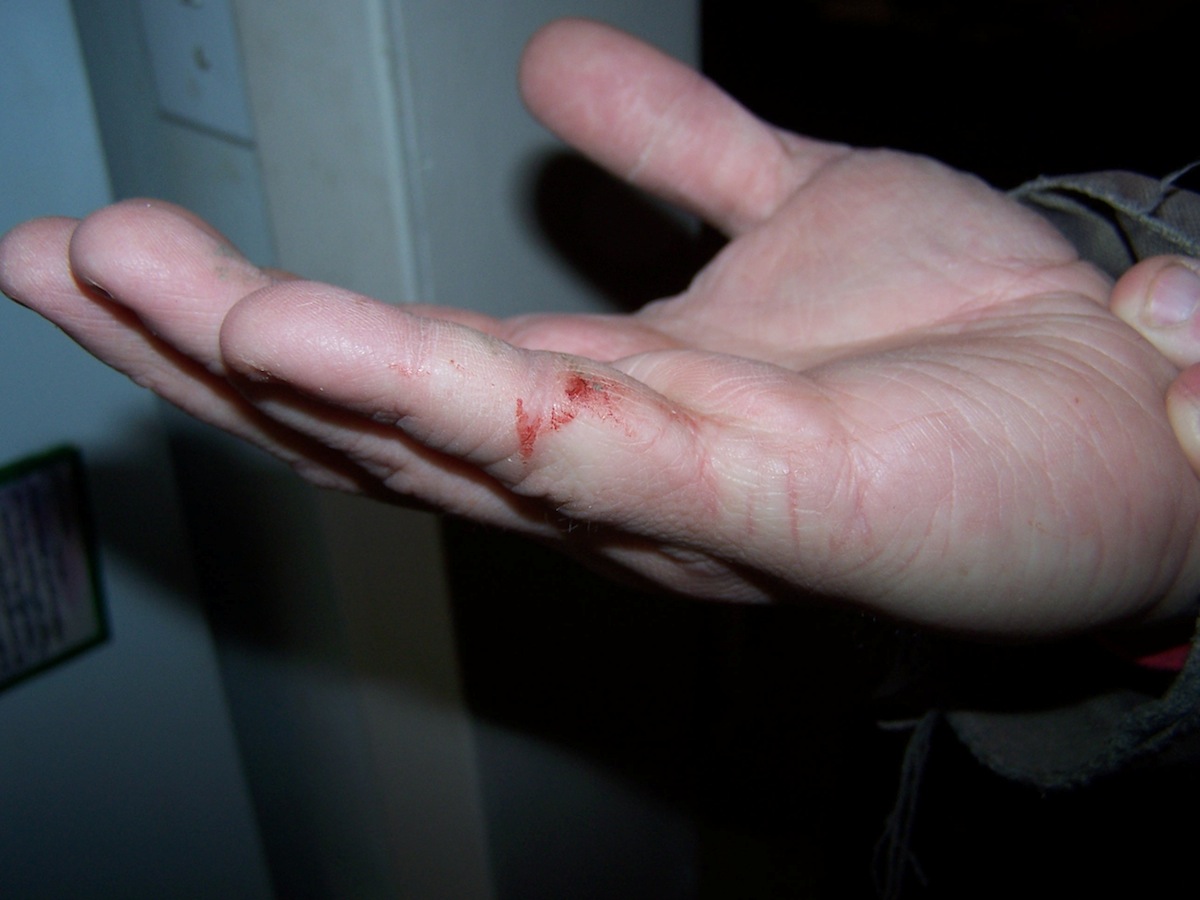
***Edit*** Here are a few pictures of what can happen when you send an end grain cutting board through a planer. Thanks to Matthew Thomas for sharing these pictures with us.




Mark,
Great video on the end grain cutting board. I plan on making a dozen boards for Christmas gifts.
After reading your comments on planing end grain, not an option for me.
What about planing each stick to its final dimension instead of ripping each on a table saw?
Will that make a difference in glue adhesion? (Smooth planer vs saw blade)
Lastly, why stock size is 20″ and cross cutting is 15 1/2″? I can get five 18″ pcs (and cut to 15 1/5″) from an 8′ eight quarter board. Am I missing something?
Thanks for your help!!
Robert
Hey Robert. Unfortunately, the details on a project his old can be a little hazy in my mind, especially when it comes to the math, lol. So if you come up with a measurement for something that works better for your stock, just go ahead and use it. What I used in this video was what worked for me at the time.
As for the planer, the only time you can use the planer on the pieces is before the first glueup. After that point, the pieces are all short grain or end grain. To pass through the planer safely, the grain needs to run in the same direction as the feed direction of the planer.
Hi
First project I made was your cutting board, I tried planning the entire board, either the pressure from the roller or a not so perfectly glued joint gave way and shot a chunk of wood out of the planner, smashing into the wall, thankfully I was standing beside it because it would have been painful. The planner was jolted out of alignment and doesn’t work very well anymore, (Sears Craftsman). Highly not recommended.
Enjoy the insight your site provides, thank you
Sorry you didn’t see this first. Very glad you weren’t hurt.
Hi,
What a fun site! I tried my first project from this site and did the long grain cutting board. I ran it through my 15″ grizzle planer and it snagged bad enough to break off about 2″ from my board. Wont be doing that again. Was able to salvage he board… Its just a bit smaller. Turned out great otherwise!
wow…good thing i read this post. i just made an end grain cutting board and ran it thru my dewalt lunchbox planer with no problems,….but i’ll never do that again. i have some high spots on the board that i’m fixing with a LA jack plane.
Thanks for the great resource Mark, it’s greatly appreciated by novice woodworkers trying to learn, get better, and BE SAFE.
-Craig
After reading all your posts and having the same problem to fix, I have decided against the planer and opted to fix my end grain cutting board by use of a router and a sled! Wish me luck! Right now, I’m trying decide which router bit needs to be added to my collection to accomplish the trick! Then the task of preparing flat, straight boards to aid in this process so the sled can slide on them! Good thing I just bought winding sticks from Woodcraft so I can probably use my planes to get that done if my old table saw, which caused the problem in the first place, can’t be made to cut ninety degrees! I have to work on that too, but it is an old Craftsman that is difficult to get the blade straight! I’m planning on using plexiglass for the actual sled so I can see my work below!
I have planed several end grain cutting boards, it has went rather smooth. But on my last attempt I got a violent kick back. It cracked the board and pretty well ruined a good piece of maple. I have come up with a way to prevent the chipping on the end. When you glue the end grain togather, add a piece of pine cut the same width as the cutting board at each end. The when you plane it the pine piece takes the chipping and not your board. Then when the board is planed and ready for sanding simply run the board through the table saw and cut the pine pieces off. No damage to the board will be seen. Believe me it works well, I have protected several cutting board projects this way. But if you do this, I have found that all the pieces must be the same height or the planner will kick it back. Hope this is a helpful tip.
Yesterday I was planing a white oak board where the grain curved at the end 75 degrees bringing end grain right on the top of the board. I didn’t noticed it at first as it was only in the first 1″, it kicked so bad I miss a chunk on my index finger and my wrist is all wrapped up and out of use for a while…
I then make research and found this website…End grain is sure a no for me…
I’m newer to the planing world and I won’t plane endgrain after the stories I heard. However, is it safe to plane pieces less than 12″ in length? I’m making some smaller boards and have done the first glue up. The lengths are around 11″. I’ve read that you shouldn’t plane pieces that are less than 12″ in length… Any thoughts? Thanks…
Generally speaking, anything under 12″ could be dangerous. Most manual specify the lower limits of what the planer can handle. So consult your manual first. I will confess though that I have planed pieces around 8-10″ long without incident. If you routinely have to plane pieces of that size, you might try using a planer sled designed for such a task: http://www.woodworkingtips.com...../05/26/wb/
I have made a few end grain cutting boards. The first few I ran through the planer with no problem, other than a little tear out. My latest ended in disaster with a big kickback and shattering the board into 4 pieces. Fortunately, I was not in the path of the flying wood and my planer is okay.
Just tried to run an end grain cutting board through my brand new planer. After it kicked the board back across the garage and broke in half, I went to the interwebs to see why a planer would kickback. Alas, I find this article and it’s the first time I’ve heard of such a thing. Fortunately I was not behind it.
I cheat, I use a second hand cnc router that I got with a 1/2″ cutter. no muss no fuss and very little sanding
I like the way you think Bo!
I was in the process of making a cutting board, just as I had seen Mark do in his youtube clips. After taking the piece out of the bar clamps and seeing the end grain a little uneaven in spots, I figured the planer would be just the tool. Big mistake. After inserting the piece I recieved a nice blow to the hip bone, and half my cutting board was eaten by my General 16″ planer. I’ve spent long enough sanding it now, that I’ll pay closer attention when clamping I guess.
Can’t see why anyone would want to take the risk after reading all about these incidents that didn’t turn out very good.
I should have read up before i made the same mistake today turned a 12×18 end grain cutting board in to 12×12,no damage to me or planer luckly.
On a very large countertop, I once used one of those heavy, square, orbital floor sanders. It worked very well.
Man…I am glad I came across this article. I literally was just about to do this for the end grain board I was making. The funny thing was I was looking for some advice on sanding techniques and just happened to see this post I was browsing :P
Just goes to show, do your research before you decide to go in a direction. You may have just saved me quite a bit of dough and maybe even a finger or two.
At first when i tried putting chopping board through i have to admit i was causious however timber went through no problem just chipping at the end.I have done lots of chopping boards this way without any problems.the trick is to use a heavy duty thicknesser I use a 20″ wide 3 horse model and use light passes and sacrifice the end however rounding of the end seems to be the trick .Good luck damm sight easier than sanding.
While I believe in playing/working safe, kickback is mostly an avoidable hazard. I’m sure we’ve all experienced kickback with a tablesaw but we still use them..right? The rule here (I believe) is to minimize the hazard; ex; 1)don’t put any part of your body behind the machine, 2)use push sticks where possible. These rules are used for tablesaws but are missed with planers. Another tip I don’t hear is sharpening the thickness planer knives. I believe with end grain, sharp edges not only improve the finish but safety as well.
While a student at Berea College studying woodworking, I shot a piece of 4/4 cherry through a 3/4 plywood door that was about 25 feet behind the planer. Never tried the “end-grain thru the planer” idea again!
m
I’ve only made 2 boards but I was lucky enough to have access to a drum sander. I was advised against the thicknesser because of chipping. Using the drum sander was slow but it worked well.
Wow! I run my end grain cutting boards through my Ridgid 13″ planer all the time and have never had a problem. I take the absolute smallest bite possible, however.
After reading all of these responses though, I have to say that I don’t recommend the procedure. It’s a dang shame because it saves me a ton of time. I don’t even scrape the glue off before planning!
But here’s how I do it:
I run the board through, (end chamfered to avoid tear out), with the planer set so the rollers just grab the board and send it through. I then lower the knives in tiny, almost imperceivable increments. Usually the knives don’t even bite the glue the first couple of passes.
I take such tiny bites that it takes 4-5 passes, just to get the majority of the glue drips off.
In the end, I get a flat, relatively smooth surface to start sanding.
I’m making some end grain butcher blocks (walnut), and I wish I had checked here yesterday before attempting to plane them. I went a little high on the first pass for safety, then dropped the blades 1/64″ of an inch. The boards were pretty smooth to begin with. On the first board of the second pass it grabbed, kicked back, and hit me in the left thigh, knocking me down. The speed and force was amazing. Luckily it’s just a bruise, and thank God it didn’t hit a little to the right. :-) Count me as another “Don’t do this”. Take your time during glue-up and the surface will be easy to smooth by hand using either a plane or ROS if you don’t have a drum sander. For me it’s not worth the risk!
I’ve ran several end grain boards through my planer with no problem. Last Christmas I was running a 12.5 by 18 inch Jatoba board through when I had a kickback. It hit me in my left hand and knocked a chunk out of my index finger. It also tore the ligaments in my finger. I still can’t close it all the way, and it gets stiff if I use it a lot. I won’t be running anymore end grain boards through the planer.
It also trashed the knives and bent the retaining bar.
Just wanted to say, I’m making several of these Purple Heart and hard Maple end grain boards for my parents 50th Wedding Anniversary. Of course, the 50th is “Purple and Gold” so I’m excited to present this cutting board to my parents for their special day!
Thanks for your talent and this website!
Jay
Hi Susan,
I have done it many times without incident but I have taken several precautions which I believe attributes to my success (hopefully not luck). First I want to say I would not want to recommend a potentially hazardous procedure but then we all use table saws?don?t we??
First, read the manual. Most bench top planer manuals warn against running short pieces through the planer, ie: cutting boards. Secondly, bench planers require the bottom of the board to be flat. Most of these end grain glue-ups have uneven faces. Thirdly, make sure your knives are sharp. Many of us assume power tools will mash through anything regardless of the quality of the cutting edges.
To solve the first two problems, I glue long sacrificial rails (thicker than the board) to the sides of the board which eliminates the board rocking through the planer and as a bonus it eliminates snipe on the board section. Just make sure the rails are coplaner! I don’t have indexed knives so it’s easy for me to sharpen the knives before using on end grain.
Finally, I try to even out any really high spots on the end grain faces with a #80 scraper before that scary first pass through the planer. Pay attention on setting the height on that first pass. Sneek up on it until you hear the knives touch the board. Hope these steps help. Good Luck!
I had no clue that running an end grain cutting board was dangerous, until I read it here. After reading this warning, I made a flat grain cutting board instead which I ran through my planer.
Had this not been posted, I most likely would have ran an end grain cutting board through my planer with possibly disastrous results.
Thank you so much for this warning. I was on the verge of attempting it.
Add me to the “don’t try it” list. I didn’t get the disasters others have written about above, but even taking 1/32″, I got some bad gouges in the wood, and I’m now thinking in my planer knives too….so not harmful, but expensive and I still have a bunch of sanding to do.
I think the “don’t ever try it’s” rule this vote…
I would like to add a vote for thicknessing.
I did a batch of 6 cutting boards last christmas, (presents for the family!!) and had no problems planing endgrain, I was using a 15″ Hafco 2HP. I
http://www.machineryhouse.com......kCode=W835
I was apprehensive at first , the first one chipped out badly on the trailing edge, rounding the edges over fixed that.
My conclusions:-
1. Route the edges with a roundover bit before starting, (you have
to round over again after thicknessing)
2. Take light cuts, I was taking about 0.1mm at a time.
3. Make sure that the bottom is “relatively flat” to start with. So that
the board runs smoothly through the machine.
The planed endgrain was much cleaner and flatter than I think
I would have gotten with just sanding alone.
I think i’m going to take the advice of the author Isac Asimov on this one. He said “Any fool can learn by his own mistakes, but a wise man lets the snake bite the other fellow!”
I was thinking, perhaps the spiral cutter head vs. the regular knives will make a difference. The spirals are more than likely much more friendly and will play together with the end grain because of the way they remove material. Perhaps one day when I have the luxury of spiral cutters……..nah, I’m still not going to try it. :)
Hi Mark,I read the question of running end grain thru your planer and tell you that I did with many cutting boards till my last one exploded,that makes you a believer that its not a smart choice.I did find out my glue joints were very good though,the wood broke in between the joints and my planer did a fancy dance as it sprung it so it couldn’t be fixed and I had to buy a new one.My new planer with never see an end grain coming thru it ever.Now my small scraps go into my woodburner to keep me warm.Now I take the high spots off with my router and sandpaper.I hope this helps you Matt.Just a tidbit from Dusty Corners,Dave Bruggeman
I had read about disasters when running end-grain through a planer. Although I’m typically a stickler for safety in my shop, I decided to try it anyway. When I add up the multiple passes I’ve made with multiple cutting boards, it’s probably over a hundred times that I’ve done it without incident.
When I do run end-grain through my planer I make sure to stand beside it. I set the cutting heads to the same height as the board for the initial pass, then make very fine adjustments to bring them down. Also, since I take a lot of care with glue-up, my boards are pretty smooth before they go into the planer.
Based on the experiences shared here and elsewhere, I suppose it’s possible disaster could strike at any time. Therefore, I wouldn’t recommend it for anyone else. Marc’s cautions may prevent me from doing it again.
I recommend using Drum/Thickness Sander. This is much safer. I am not sure if I had been just lucky, but had never experience a major kick back with the drum sander. Anyway step away from the line fire is always good idea :-)
I’m with Claude. I never even knew this was an issue. Pretty timely, too. Today I’m doing the second glue-up of my Spagnola Special end-grain cutting board. ["Let's get ready to make ... cuttiiiiiing boards!"] I had definitely planned on using the planer on it tomorrow. My recollection is that Marc suggests that as one possibility. Well, I do have a back-up. I have a Veritas bevel-up smoother (wood show impulse buy — I am such a sucker for those) and I’ve never really used it. Maybe now’s the time. Bevel-up smoother on end-grain? I guess I can use my ROS but I HATE sanding. I also have a nice sharp #3 that I can use. No way I can afford a thickness sander. Well, maybe if they have a special at the Portland WW show in October and my wife doesn’t notice it in the back.
I thought that part of being safe was to think things through. The physics of end-grain through a planer or a jointer is simply against the safety of the proposition. Just because someone managed once or twice doesn’t make it safe, just lucky.
I’ve tried taking infinitesimal amounts off the endgrain with my Dewalt 13″ planer, but even that left scars on the wood. I would never run it through my jointer-planer. I wish I had a nice drum sander, but they cost too much for my meager budget.
I have performed this maneuver on several end grain cutting boards that I’ve made and another that I was refinishing. The trick as I saw it was to micro plane not gouge. As long as I was willing to be patient and make several more runs thru the planer using a very tiny measurement I was fortunately successful. I was able to move the pieces thru by listening to the blades as the piece progressed and only allow the blades to just touch the piece (1/32″) with each pass and observe the cutting action till I had the piece completed. Somewhat tense work and not highly recommended, but… I know I am so far just lucky! Oh, I used my Powermatic 15″ planer.
I tried running a cutting board once. Luckey for me, it got almost all of the way through before it shredded the edge. Careful sanding with a belt sander is what I do for the initial pass now. Not recommended at all.
Dean
Wow, well I’ve have never tried that and I guess I never will. I’ve never even thought about it before. Never tried end grain on a jointer either so I guess I’m just lucking I haven’t an occasion to ponder it. I’m glad the question came up here first. claude
Same here! So glad it was mentioned. I don’t know that I would have thought to not do it if the occasion had come up
Disaster. Tried planing end grain while making a cutting board. Took a series of huge gouges out of the board and my thickness planer made some horrible noises I hope never to experience again. Needless to say I was back at the wood store the next day buying what I had destroyed the day before. I still have the first board lying around the shop as a constant reminder to NEVER run end grain through the thickness planer. I’ll fix it one day, when I have about a week with nothing to do cause that’s about how long it’ll take to sand out the valleys. It’ll make a nice cutting board someday, albeit about 3/8′s thinner than the second one I DIDN’T run through the planer after glue up. Well, ya live ya learn. For me, it’s usually the hard way.
I did this with cutting boards many times without incident on my Delta lunchbox planer. One time, however, I got major kickback, ruined the board, and ruined the infeed rollers on the planer. This gave me a good excuse to buy a new planer, so I bought a Powermatic 15 inch with Shelix spiral cutterhead. Think I learned my lesson? No way…… I couldn’t resist trying it on the Powermatic. I’ve done it a few times with no problem except tear out on the trailing edge because I didn’t round over the edge first.
The next cutting board I do will be flattened starting with 36 grit on my belt sander then to my Performax drum sander, working up the grits, and finished with a hand plane.
Bottom line: Use power sanding and hand planes. Don’t ruin your planer.
My two pence: thickness your end-grain with a router & sled rig, a hand plane, etc.
I had a nasty kickback while planing some end-grain cutting boards just before Xmas–1/128,000 at a time, like Marc says. I sprained both my thumbs, shattered a set of planer blades, warped a blade retention plate, was forced to drink a really nice bottle of wine I’d been saving, and suffered a nasty hangover the next morning.