Seems like cutting boards are on everyone’s minds these days. Probably because we are all making holiday gifts. Either way, this is the time of year you can expect almost one forum post a day asking a question about cutting board finishes or “food safe” finishes. And the responses to these posts are nearly always the same:
Person 1- The best finish for a butcher block is mineral oil.
Person 2- NEVER use varnish or salad bowl finish on a cutting board! What are you, stupid?!?!
Person 3- Mineral oil and wax are the best!
Person 4- This person usually provides a bunch of extra information that you didn’t ask for.
Ok so I am generalizing here for fun, but you get the picture. I have noticed as well that many of the people posing these questions may be doing so because of my advice from Episode 7- A Cut Above. To sum up, I said that my favorite finish for end grain butcher blocks is salad bowl finish (aka varnish). But remember my caveat. I said we are NOT trying to build a film. And that’s exactly what the folks in the forums are trying to say. If you build a film, the film will then be cut by a knife. The cut will allow moisture to seep under the finish and become a wonderful home for all kinds of bacteria. I can’t disagree there. But with my method, you never actually build an appreciable film.
I recommend diluting the finish sufficiently so that it immediately gets absorbed into the wood’s wide open pores. Think of it like a vertical bunch of straws that you are filling up with finish. Within a minute or two, you will notice that finish is actually seeping out of the bottom of the board. This is exactly what we want. At this point, I usually set board on its side and allow it to dry overnight. I do this 3-4 times with a light sanding in between each session. By the final coat, you should start noticing that the finish doesn’t really absorb any more. You are now starting to develop a film. One last wipe with a clean cloth and call it DONE.
So how does a board like this fare in the kitchen? There are two main concerns here: safety and maintenance. A butcher block treated this way will resist water all day long. In fact, on my boards, water tends to evaporate faster than it absorbs. Mineral oil boards will actually take on moisture much more readily. Adding wax to your mineral oil can certainly help in this area if thats the route you want to go. Now the fact that it is so water resistant is a major plus in terms of sanitation. Remember that the bacteria like the moisture. So the less moisture in the board, the better.
So how about knife marks? Well like with any board, knife marks will happen. If they don’t, you must not be using your board properly. So what happens to my boards? They get knicked up. They get dulled a little more in the middle where the most action occurs. But after about 18 straight months of usage, my cutting board looks pretty darn good. Check out the pics below. Now if there were a thick film on that board and that film were to crack, the moisture would certainly seep in and create problems. In fact after 18 months of that type of abuse you would probably expect the finish to start flaking off or exhibit more physical damage than what you see. But when a knife produces a deep cut on my board, it just cuts into varnish-filled pores. There is nothing to flake off.
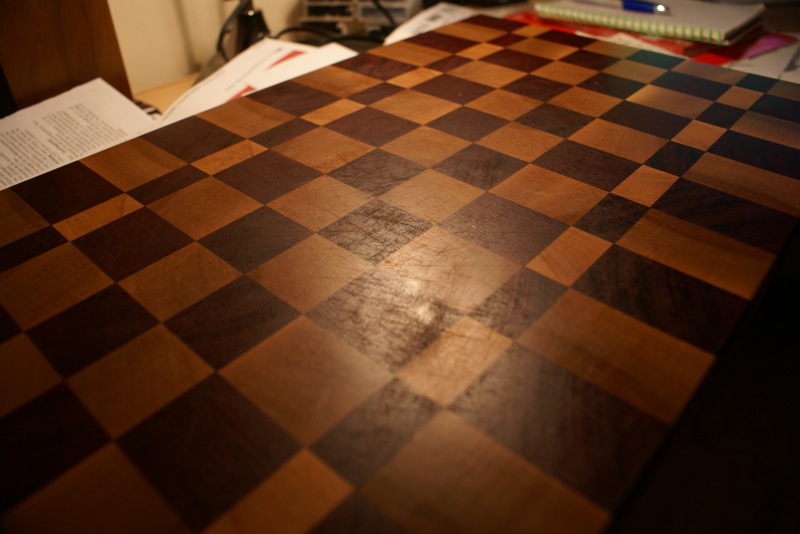
Now let’s talk about maintenance. I haven’t done anything to that board other than a light soap and water scrub after each use, and an occasional white vinegar rub down. And I suspect that in another month or so, I will take the board back in the shop, give the top a nice thorough sanding, reapply a light coat or two of diluted varnish (monitoring how much it takes up), and the board will look brand new. What kind of maintenance does a mineral oil board require? Monthly, and possibly more frequently if used heavily. Maybe I’m just lazy but one of those maintenance schedules sounds a whole lot more fun than the other.
I am by no means trying to discourage people from using mineral oil. After all, its the classic cutting board finish. Use whatever floats your boat. Personally, I have had great success with my method and will continue to use it. The feedback from other folks who have tried it has been great as well. I think its safer, easier, and looks better. Of course my results are not backed by scientific tests. If I still worked in a lab I might be able to test it properly. But I can’t, so all I can do is speculate and bring a little common sense to the table. Finishing is, and probably always will be, one of the most over-complicated and misunderstood areas of woodworking. I only wish there were more scientific resources out there so that issues like this can be resolved effectively without speculation. Until then, do your research and never count on my advice or anyone else’s as cold hard fact. Gather as much information as possible from your trusted resources and then add the final ingredient: YOUR experience, opinions, and common sense.
Viva La Varnished Board!


I sealed one board with the salad bowl finish you used. It looks great but it has a strong chemical smell. How do I get rid of that?
Time and fresh air. That salad bowl finish is nothing more than oil-based varnish and has the smell you’d expect from it. So give the board a few weeks to air out. Give it a light wash and a quick dry every once in a while and eventually it will tone down.
Wow, you have the patience of Job! Good for you! Great information. One just has to read thru
Going to try making a board, thanks to your information.
Ballard
Thanks for the great walk-through, I found it extremely useful!
The only issue that I have had is during the finishing process. I sanded to 220 grit before applying my salad bowl finish. I have done a light sanding with 400 grit in between coatings, but have noticed scratches showing up once I apply the next coat of finish.
Did I do something wrong or somehow miss a step here?
Also where is the best store to find the pads for the bottom?
Hey Will. Ultimately, the finish is meant to be absorbed. If you’re building a film, then you need to stop applying finish. I like the idea of sealing the wood internally and dramatically slowing down uptake of liquids. But I stop before a film begins to build. We aren’t really going for a shiny board, although a freshly finished board done in the way I outline will have some shine to it initially. This should quickly wear off and eventually it ends up being quite dull looking. But it’s a cutting surface, so that’s ok. I would give the board an even sanding with the 400 grit, wipe it down, let it cure, and then put it in the kitchen. Sounds like you have enough finish applied at this point that you can simply move on to using it.
As for pads, I have no idea. I don’t actually have any pads on the bottom of mine.
Thanks for the quick response, Marc!
I certainly didn’t intend to build a film. I did 4 coats on the top and sanded in between all of them. It looks like the maple got a tad too much and the walnut is right where it needs to be. So, I guess I’ll just start using it and get it perfect the next time it needs to be resurfaced.
On that subject, would you use an orbit sander for the initial re-sanding?
-Will
Hi Marc,
I recently started building cuttingboards after watching your video. Problem is, in my ignorance I used a soft maple and finished it with mineral oil and bees wax. After using it a few times the maple seems to stain badly. Is this due to the fact that I used soft maple, and will the finish you use with the varnish help prevent that? (I have already purchased 20 bd feet of rock maple to hopefully resolve the issue)
This is probably due to the use of mineral oil. While many folks use it on their boards, it doesn’t really seal the board completely. So liquids can still absorb and stain. Honestly, that’s just life with a cutting board. It’s a work surface and shouldn’t stay pretty for long. Finishing with a varnish can help prevent that level of staining but not completely. Again, it’s a work surface. But I do prefer the varnish finishing method because it does ultimately slow down the absorption of liquids.
Should you use this process only on end grain boards? Does this process allow you to use more open grain hardwoods like oak for cutting boards?
When constructing a project with glue-ups of multiple species do you worry much about different expansion and contraction rates of the different species? Do you know of a resource for checking compatibility of different species?
It’s definitely something to consider whenever using more than one species. But it’s hard to know at what point there will be a problem. There are just too many variables at play. But in general, it is probably best to avoid combining woods with drastically different expansion rates. One thing you can do is check the relative expansion rates using the Woodshop Widget. http://woodshopwidget.com/
Hay Marc,
I really liked your video on cutting boards. Your method worked well. I have two questions. 1) Do you apply a wax over the salad bowl finish? 2) If a cutting board had a butcher bolck oil on it and I wanted to use the salad bowl oil would I sand down the cutting board and then apply the salad bowl finish?
I am a beginning woodworker. I made the board with hard maple and jatoba. Beautiful. I noticed during sanding that after I had reached a very fine surface with 220 grit and after a day of rest, the glue lines (TiteBond III) could be felt again as fine lines. Am I right in concluding that the glue expands? Sanding again with fine grit returns the surface to a mirror finish.
Yup. The glue line tends to move. And every time the board gets wet, you will feel those joint lines. Just the nature of the beast. I have found though, after a few months of use, a re-sand and re-finish does help to tame the joint lines on a longer term basis. Give that a shot.
I have made cutting boards from left over hardwood flooring pieces. I usually used many coats of boiled linseed oil diluted with turpentine as a finish. Some of my boards have now been in use for over ten years with no ill effects. What are your thoughts on using this method of wood treatment.
I think it’s fine. I know some will object to the use of turpentine and the fact that BLO has chemical driers added to it. But once the oil cures up, I personally don’t think there is much to worry about. But this is one of those areas where people need to decide for themselves, so I try not to make any definitive claims, only my opinions.
Hi Marc please let me know I’m live in Canada and love your videos but I didn’t found mineral oil in any store , somebody toll me abut in animal shops but I’m really don’t know and other people say in a drugstore !!!!
It’s a especific mineral oil for finishing ???
Thanks .
Hmm, it might just be something that is sold under a different name. I’m sure one of our friendly Canadian readers can offer a suggestion. But perhaps look for other names like “white oil”, “paraffin oil”, and “liquid petroleum”. Here in the US it is sold as a laxative product in drug stores.
any local drug store in canada sells it. I get mine at london drugs.
I got mine at Safeway. Go to the pharmacy ask them. Mineral Oil is used as a laxative.
Bloxygen – that is an awesome name! I will look into it, thanks Marc..
Any idea if pre-mixing mineral spirits into salad bowl finish will cause it to cure prematurely? I have a half can left, and a new can on the way. I was thinking just filling the half can to the top with MS so I don’t have to mix it up every time I use it.
Any reason to NOT do that? Thanks!
No it shouldn’t cause it to cure faster. But every time you open the lid and expose it to fresh air, you decrease the shelf life. You might invest in some Bloxygen if long term storage is needed.
What a great site!
I made a butcher block dinning room table out of hard maple.
I’ve got it planned and now am looking to figure out the next step as far as sanding and finish.
Do you have any recommendations as it won’t be a cutting board but would still like to keep it food safe, last a long time, and have a nice finish?
I have had a request from a local winery to make some cheese boards for their wine shop. They did not want the expense of end grain cutting boards, so they opted for some edge grain boards. I typically sand my cutting boards to 400 grit and then apply several coats of mineral oil.
Use and care instructions come with every board I make and it says in big bold letters “DO NOT SOAK IN WATER or USE IN DISHWASHER”. However, even with a little water used just to wipe clean, this raises the wood grain. I explain to my customers that all wood when wet will have the grain raised a bit. That’s the nature of wood.
Is there anything I can do, finishes I can use to slow down or prevent the grain from raising? Would there be a problem with soaking the wood, let dry completely, then resanding before applying the finish?
I have read several posts related to cutting board finishes. But none of them mention raising of the grain.
The finish mentioned in this article will help prevent grain-raising, but it’s up to you if you want to use it on a client’s board.
You can certainly pre-raise the grain before finishing, which I would recommend. But with a mineral oil finish, the grain is going to become raised again at some point. As you said, it’s just the nature of the beast.
On Marc’s suggestion, I have been using Tried & True Varnish Oil on long-grain boards. It is bit trickier to apply, but it does work very well. It’s 100% natural, and it has both oil and varnish. Word of advice, apply it VERY VERY VERY VERY thin.
What I do is this…I take a clean cloth. I Put some of the finish into a separate container (a very little bit. With gloves on, I dip my fingers into the finish and wipe it off onto the cloth. I do this a few times, just so the cloth is basically coated. Then I rub the finish on from that cloth. I wipe it on till the entire board is coated…barely. An hour later, I wipe it dry with a clean rag. The next day I lightly sand with 400 grit paper, and repeat. About 4 coats like this works well.
If you put it on any thicker, it just stays oily and doesnt cure for days. They say this in the directions, but I didn’t believe just HOW thinly it needs to be applied.
Wow you aren’t kidding, what a confusing subject to research. I was originally told to use Tung oil on my cutting board, so i bought some, but then was told it is not safe. Now I came across your website and like your suggestion of mixing salad bowl finish and mineral spirits. I am,however, having a difficult time finding any salad bowl finish; therefore, I was wondering if I could get away with using your method by mixing mineral spirits with the salad bowl finish, but would like to substitute my tung oil for salad bowl finish.
Well unfortunately, “tung oil” in this industry is a highly mis-used term. What is in the can depends on what brand you have. If it is pure tung oil, you should be ok to use this on a board and dilute it if you choose. Just keep in mind it needs a lot more dry time than the salad bowl finish. Also keep in mind that many disagree with my salad bowl finish system on end grain boards, but it works for me so I continue to use it.
When I do an end grain cutting board and use Behlens and or mineral oil it seems to darken the woods enough that you can’t see the different colors anymore. I used Poplar, Purple heart, bubinga and walnut which looked pretty (if I can use that word). As soon as I applied mineral oil all three of the darker woods took on the same color. before the finish I had a deep orange, Purple and walnut color against the white Poplar. I now have a darkened poplar and all three of the colorful woods have blended in to one color. Is there a finish I can use to retain the original colors? Thanks
Wax or perhaps a light oil like mineral oil. Although just about any oil will darken the wood. Since the board is end grain, this is the nature of the beast.
I hear that a plain cutting board with no finish is best if I will be cutting raw meat on it. Is it cool to make one side finished and one not, so you can simply use one side for meat and the other for veggies? Also, I hear coconut oil is the safest, healthiest oil, as it is not a petroleum product. Walnut is great but apparently some people have allergies. Have you tried either of these?
Thanks!
You’ll find that there are lots of differing opinions about how to treat cutting boards. Personally, I would not finish only one side of a cutting board since I don’t really see the harm in using a finish. And I haven’t tried walnut oil (for the same reasons) or coconut oil. I find the mineral oil/wax mixture works great when I need to use an oil. But my varnishing method is my preferred finish.
Thank you! I heard about these alternative ways of finishing the cutting boards from “green” and natural health sites online that are concerned with lessening toxin exposures as much as possible, especially for people with cancer, liver related diseases, or compromised immunities. Apparently, while mineral oil is considered “safe” to digest for most people, it still has some toxins in it due to its petroleum base.
Unfortunately, our world is so full of different toxins now in our food, water, air, etc. that any opportunities to use totally toxin-free substances are recommended..in order to avoid further damage or vulnerabilities, especially in people with health issues.
The natural wood (untreated) apparently has anti-bacterial action to it, and the board can still be washed with soap and water, dried standing up, and then sanded periodically. However, it’s not beautiful like yours. I just wondered if you had any experience with this or other methods considered the most “green” from natural health websites. Thank you!!!
Personally, I don’t feel that there is really anything wrong with using mineral oil on a cutting board or varnish for that matter. But I certainly can’t fault someone for wanting go the most natural route possible. In that case, you might try a mixture of one of the recommended oils and some beeswax. I don’t have any experience with the oils you mentioned though. And keep in mind it won’t look like my board. Well, to be honest, my board doesn’t look like “my board” anymore either. Once a cutting board is in use, it dulls quickly and starts to look like the work surface it is intended to be. So I don’t really worry too much about that. I’d recommend going the oil/wax route and simply reapply as needed.
Does it matter if I use a spirit based varnish and use white spirit to thin it down. It seems to have worked well
Yeah I think we’re talking about the same stuff. White spirits = mineral spirits.
Hello
I live in Norway, and i can’t find mineral oil anywhere (at least not in a sensible quantity).
I have how ever seen parafin oil, which as I understand is basically the same thing, been used for cutting boards.
Any thoughts?
Yes, paraffin oil should be the same thing as mineral oil.
After talking to toxic substance specialists at my job (I work for a health department), I decided that the salad bowl finish w/ mineral spirits is just fine and safe. I’m going with that from now on :)
First off thanks very much for you informative videos.
I am about to start my first in a long series of cutting boards for holiday gifts. I am concerned about the finish…specifically the use of mineral spirits around food.
I assume there is a good answer, but how can something so toxic be safe to use around food? I assume the toxic part evaporates, but is there any data to support that? Something about using a chemical like that on a cutting board just makes me nervous.
I am not trying to argue, just trying to learn :) Thanks again. Your videos are spectacular.
Hey Andrew. Many dangerous/toxic chemicals can be safe after they evaporate. Any residue left behind is washed away with soap and water. All that’s really left on the surface is resin. And many companies sell varnish for food items that is FDA approved. These all contain mineral spirits or naptha, just like their “non FDA appproved” cousins. But if you aren’t comfortable with it, don’t use it. You can always go the mineral oil route. Just keep in mind that if you dig deeper into that topic, you will find folks who are afraid to use mineral oil as it is actually a petroleum produce. All depends on how deep you want to go down the rabbit hole. :)
Thanks for the quick response. I did look at the spec/safety sheet for the General Finish salad bowl finish, and it does indeed contain mineral spirits on its own. But they do specify that it should not be used for chopping blocks, they recommend mineral oil for that. I assume they give this warning for legal purposes because the varnish is not “officially” approved for this purpose.
Have you ever tried or heard of using mineral spirit alternatives, like Citrus-based ones? Maybe this isn’t good because it could spoil:
http://www.realmilkpaint.com/citrus.html
One last question (ok, a few) – should I go with the mineral oil/wax mixture…
1. Any reason to go with beeswax over parafin?
2. Once the mixture goes to room temperature, does it harden? Could I supply each person for whom I make a cutting board a little container of it so they could reapply as necessary?
3. How often (approximate) should the oil/wax mixture be reapplied? Less often than straight mineral oil?
Sorry this post is so long! I plan to start my first cutting board tonight….my first real woodworking project alltogether, 100% inspired by your video, thanks!
For all those Canadians trying to get the Behlen Salad Bowl Finish there is a hardware store called Richelieu Hardware that sells it. Looking at the locations they have quite a few across Canada and you can order it online as well.
http://www.richelieu.com/produ.....selectGr=1
Any thoughts on sending it long distance and not being able to refinish it after the grains have settled?
Hmm, maybe send some sandpaper so you can talk them through smoothing the board out in 6 months?
Hey Marc,
I went to the Sherwin-Williams to get the varnish for the cutting board- (evidently the big stores don’t carry varnish). The counter guy pointed me to a high gloss vs satin (no semi available). He stated the high gloss is more “natural” for varnish; that for satin and semi they actually add flatteners. The choice may be trivial, but I respect your opinions so- what would you have chosen?
Also I’m a little concerned for sending this board as a gift long distance. I feel I won’t have the ability to refinish it or fix it a couple months down the line once the grains settle in. Any thoughts on this matter?
Thanks!
hey David. Since the ultimate goal here is to protect the wood but NOT create a film, the sheen really doesn’t matter. So no reason to buy anything with flatteners in it. I’d just go for gloss.
After seeing your tutorial I decided to make 3 boards for family as Christmas gifts. All the boards were ultimately sanded with 220 and finished with 2 coats of WATCO butcherblock oil and finish on all surfaces. I used one of the boards, gave it a light wash, rinsed it and dried it. After this the top of the board looks dull and the the top is now rough to the touch.
I was curious if anyone can suggest how to refinish this properly, and in a manner that wont lead to this problem reoccurring. Also, the other two boards i gave out have not yet been used. They were treated the same way with the exception that i personalized the back of those 2 with a router. So any help on how to repair the first board and how to prevent the other two from the same fate. Others have mentioned mineral oil but I am reluctant to use that since I already used this WATCO finish. Any assistance would be appreciated thanks
Hey Tony. First things first. Cutting boards are surfaces what will never stay smooth. If they do, that means you aren’t using it. By nature, the boards will absorb some liquid while also being punished by knives and other cutting devices. To expect this surface to say smooth is unfortunately not realistic. Generally speaking, I find that my boards all react this way after they are made. The grain raises and you can feel all the glue lines. What I found to be the best course of action is to continue using them for a few months. Let them get some wear and tear. After a few months, take the board back in the shop, give it a light sanding to smooth things out and reapply your finish. Now this time, you should find the board doesn’t get quite as rough after it is used again and the joint lines won’t be as noticeable. But they will still be there. Its the nature of the beast and its something that happens to all cutting boards.
Marc,
The video is not working here. Do you have any other mirror links or on itunes or anywhere else where this video can be found?
Thanks
Hey Alex. I think this video was accidentally deleted. I’ll look into it.
Marc,
Thanks for the tips on finish. I am finishing 13 boards with the salad bowl finish of varying thickness (1-2″). I am having trouble determining when the wood is saturated. The first coat soaked right in like you said and I flooded it until it came through. I have just applied a second coat and it already appears to be standing on the surface. Do I continue to apply a 3rd coat? I don’t want to build a film like you talk about. Also, do you ever sand after the final coat with fine steel wool or is that a mistake? Thanks for your help.
Hey Ross. If the second coat lays on the surface, simply wipe off the excess and let it dry. Flip the board over and do the other side and you are good to go.
And feel free to buff the board after the final coat. Bottom line is, the board shouldn’t be shiny like a piece of furniture. So abrading the surface after the fact is ok.
Hey Marc,
First off I want to thank you for all of the information in this site! I’m a definite future guild member!
Now on to my question. I’m all set to finish a few boards that I made for Christmas presents and I was going to use General Finish’s Salad Bowl finish and follow the process you use in your videos. I noticed on the can of Salad Bowl Finish it specifically says not to thin. Is that a general warning like “do not drink” or is there something that I missing?
Thanks!
Yes that can be ignored. My assumption is that they don’t want you to thin because they can’t guarantee its behavior once thinning is involved.
Hi Marc,
I did a boo boo, I made a 20x15x3 end grain cutting board
And not remembering to use at least Tiebond-II (water proof), I used Tiebond standard.
But I think this varnish technique to seal from water and moister is the perfect solution.
Thanks
The trouble is that I did not notice any sap before or after cutting first and second time. But after glueing up second time little black spots appeared on the Maple only on certain boards. Is that sap coming out or something else? Anything I can do to prevent.
By the way everyone loves the boards THANKS
You’re very welcome Ron. While I don’t think the black spots are sap, I am still concerned about them. Black spots could be indicative of a few things. Could be mold or it could be cause from small bits of metal. Either way, both possibilities make me nervous thinking of them being used as a food prep surface. Perhaps I’m being a little too cautious but better safe than sorry.
So maybe try sanding the board a little more to see if the spots go away. If they should reappear, before or after finishing, you might consider scrapping them (as much as it pains me to say it).
I wonder if you could advise me with anything that can be done to eliminate the sap from coming thru. Out of 11 boards doing the same process only 2 had sap spots. Help;
Hey Ron. Honestly, a board that’s excreting sap might not be the best choice for a cutting board. Sometimes you can seal sap in using finish, but that’s not a great idea for a cutting board. We don’t want to apply a thick film on the surface. So if those were my boards, I would probably cut them down to remove the area with the sap and pretend I just made a new design. :)