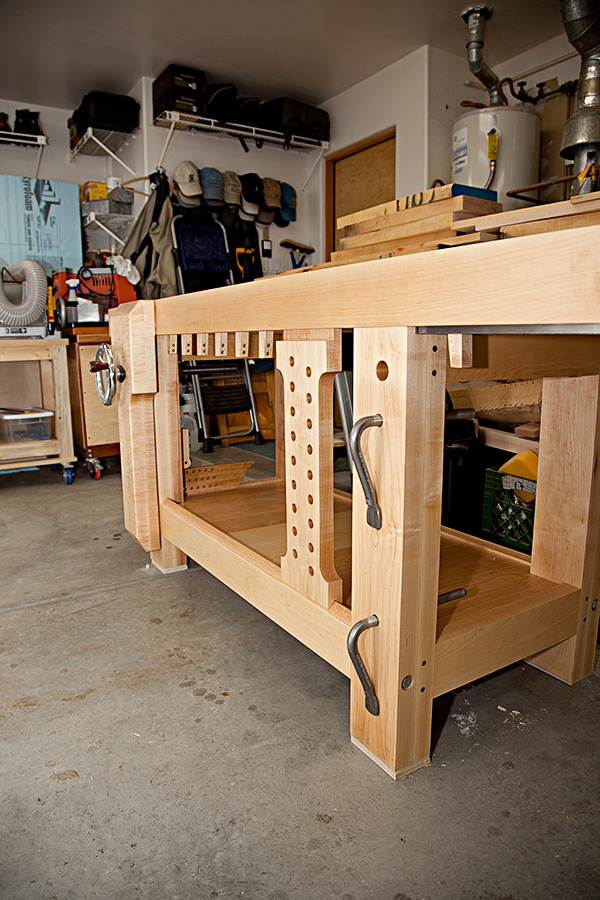
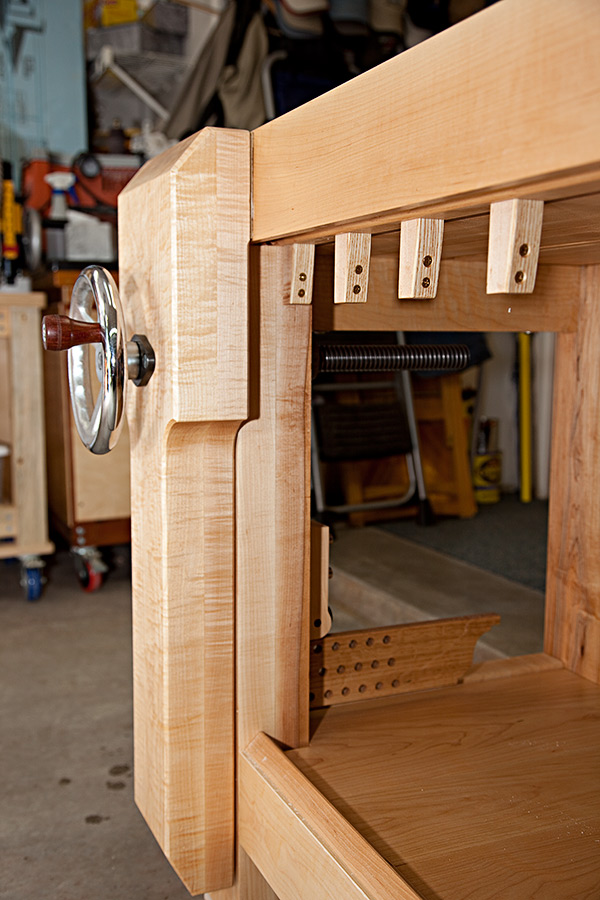
Brian’s Benchcrafted Split Top Roubo

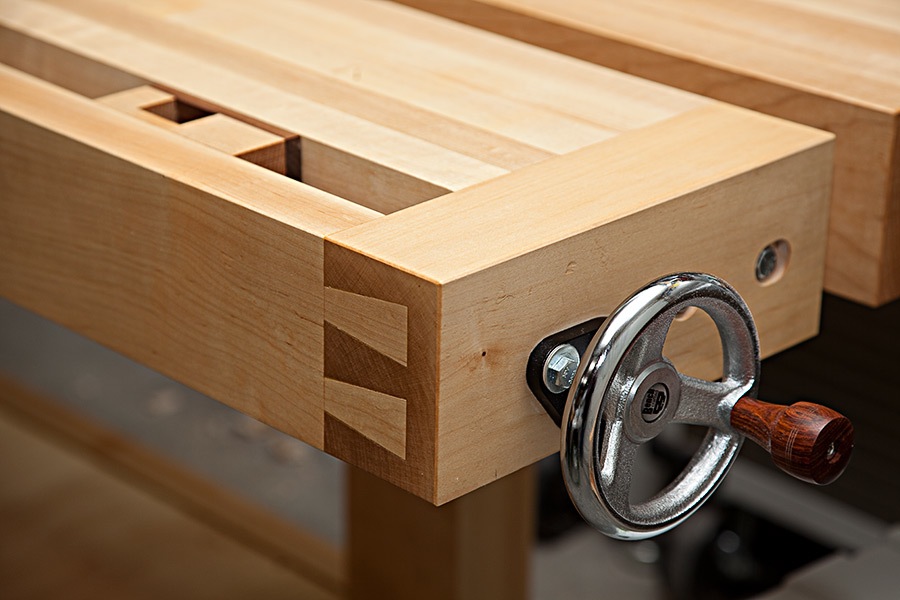
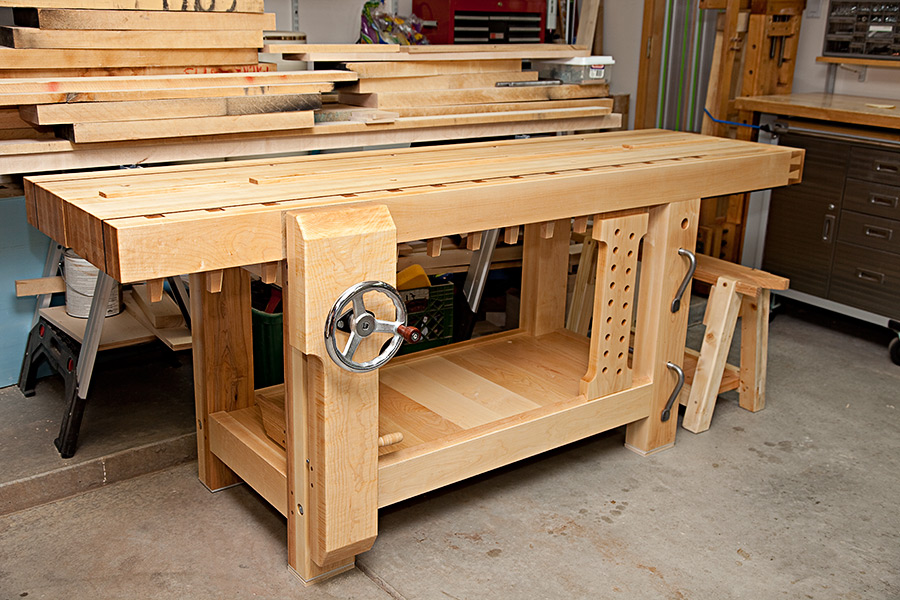
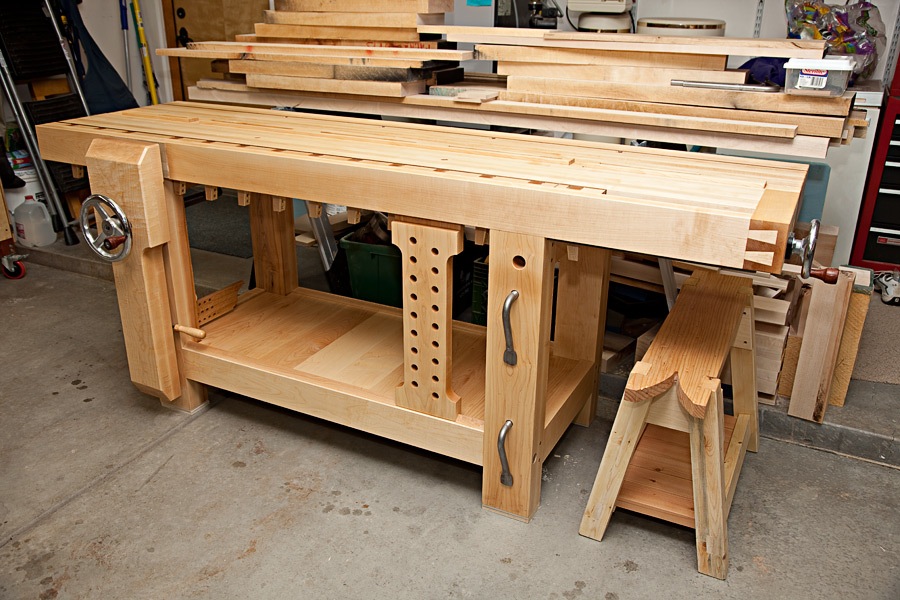
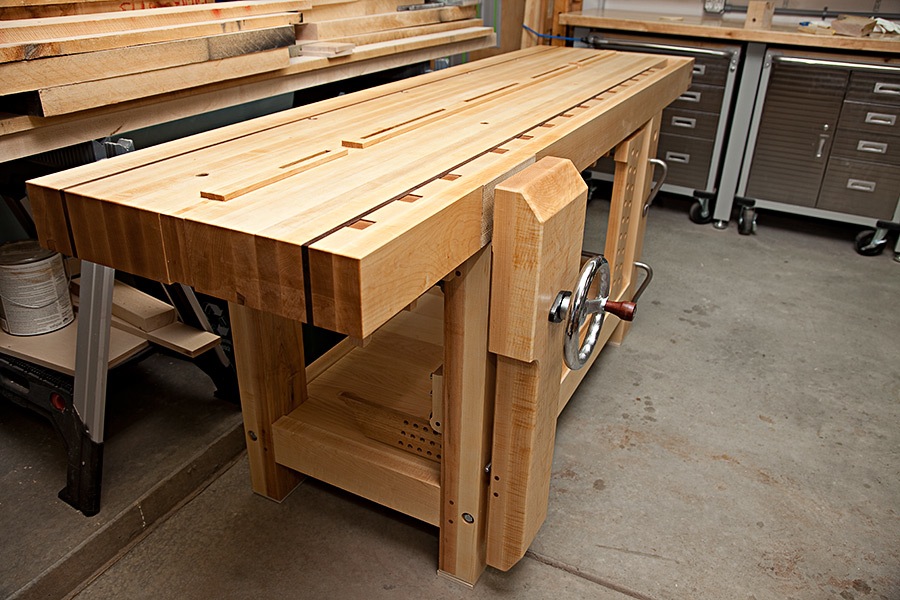
Got inspired by watching the progress of others on the Festool Owners Group Forums and by watching Shannon’s podcast build. I have been woodworking on and off most of my life, but mostly just small stuff. Always wanted to build a real woodworking bench, and when I saw the Benchcrafted plan, well, the rest just fell into place. I had a hard time finding enough Hard Maple for the bench (very limited supply in Santa Fe at the time), but eventually it all came together. It ended up taking over two months, working nights and weekends. It made me feel good to know that something I made with my own two hands will actually out last me and maybe even my two sons. Maybe my grandson might even get it…who knows?

Wanna build along? Sign up for the Wood Whisperer Guild today!
Comments

  1. Dan Drabek January 16, 2012

    A beautiful bench that should last a dozen generations.

    DD

  2. Nick J January 16, 2012

    Great looking Roubo. The walnut accents look fantastic.

  3. james January 17, 2012

    Fantastic looking bench .. hopefully one day I will be able to build something like this.

    James

  4. Bill Daniel January 17, 2012

    That bench is not going anywhere anytime soon!! Very nice and functional!!

  5. Joe D January 17, 2012

    Great job. Thanks for sharing. I wish I could find the time to build a bench like that.

  6. Brian,
    Do you find that the danish oil and was makes the benchtop slippery?

    Love the tiger maple chop on the legvise.

  7. Brian January 17, 2012

    Thanks guys,
    To those of you considering building a bench…..like Nike says…”Just do it”. You won’t regret it. It seems like a massive undertaking but it’s a great way to learn and when you’re all done, it’s not the end…but the beginning. This bench was completed a little over a year ago, and it’s been a joy to work on.
    Erik, I haven’t found the Danish Oil and Wax finish really to be a problem. I know there are pros out there that actually rough up the surface of their benches intentionally, but this type of finish is what I’m used to and the small bench I had for many years prior to this one was European Beech with a Danish Oil finish as well.
    It just comes down to preferrence.
    Brian

  8. Michael Meola January 17, 2012

    Brian,

    What a nice bench. You should be proud of the quality job you’ve done. I can only hope that I can get mine done in two months.

  9. adam January 17, 2012

    I am afraid that hat project is beyond my ability.

    Absolutely stunning!

    • nateswoodworks January 17, 2012

      Don’t feel that way. I like Marcs saying about projects are just many steps put together, it’s just a matter of knowing the steps. Also if your not already a member the guild is getting the videos showing Marc building his-showing you those steps. Also the forum is a great place to ask any questions you may have or problems you may face.

  10. Don January 17, 2012

    Wow nice looking Bench. Great Job.

  11. nateswoodworks January 17, 2012

    Brian, beautiful bench! What was your favorite part of building your bench, anything that pushed you to become a better woodworker? Iam always intrigued to hear peoples comments on this and I think it can inspire others as well.

    • Brian January 18, 2012

      The hardest part of building the bench was getting past the “I don’t have the right skills, I don’t have the right tools, I don’t have the time…..blah, blah, blah…. bs” I had to just start and then everything else past that just became one more step. Every day was a learning experience. Lots of mistakes, followed closely by lots of problem solving. The one thing that was constantly on my mind was doing the end cap dovetails. I had only made a few small dovetails prior to these and they had me scared, but they turned out decent and now I’m looking for projects with dovetails! Cosman and Klaus better look out! (just kidding guys)

  12. Tom Pritchard January 18, 2012

    Very impressive. I love the finish and workmanship.

  13. Lone_Wolf January 18, 2012

    Brian,

    Rock on with your bad self! It is awesome. I get tingle just looking at it. Thank you for sharing.

  14. choots January 19, 2012

    This is no doubt a well-crafted and beautiful piece. I’ve been admiring all the workbenches on this site for a while, and have been noticing a recent trend to more massive benches. I just have to interject a comment I have yet to see regarding most of them. Where is the responsibility and stewardship with wood in building a workbench like this? Is there really a need for such an amount of wood as this to make a sturdy, functional, and long lasting bench? You could make that top and those legs almost half as thick and you wouldn’t lose any functionality and it would still look great. There’s really no need for a 500-600 pound workbench that’s all wood when you can weight it down salt/sand/etc when needed. As woodworkers, we should be responsible with wood and able to produce designs that meet requirements for a reasonable cost with the least env. impact possible. We need to be good stewards with the resources we have – the trend towards bigger is better in benches that I see here and elsewhere is troubling.

    • Choots, although mine is built from reclaimed barn wood, it is my hope that my bench will live on and on. I think that’s probably what many of us building hope. If that is the case, I think it is best that it is built to withstand years and years of abuse and use. We should all try to take into account your thoughts here, but my feelings are that in building a piece, even a bench, to heirloom quality, we are respecting the life of the tree that gave it original life.

    • runningwood January 19, 2012

      I agree with Vic and James. Wood is a given resource to work with and build beautiful things. Tree will always grow and people have been working wood for many years. I love to look at trees like the next guy but I think people take the “sustainability” thing too far and its the current “feel good” cliche of our times The size of a bench will not do much for the number of trees out there.

    • Farley January 19, 2012

      IMHO…I think that stewardship isn’t considered as much as it should. However, I also think this is a very personal decision. For example, as a beginning woodworker/hobbyist, it could be considered wasteful to build such a bench. However, if I were to become an advanced, full-time woodworker that same bench could have useful qualities far exceeding other designs. Theoretically, a well built bench has the potential to last generations, which ups it’s stewardship value. Compare that to some of the incredible wood turnings I’ve seen where over 95% of wood was taken away, leaving a beautiful bowl, or lampshade. They are stunning, yet I can’t help but consider how much waste was involved. Just my thoughts on it.

    • Dan Drabek January 19, 2012

      I would suspect that you have never had the opportunity to work on a classic, heavily built bench. Build something on one–especially with hand tools– and the benefits become quickly obvious.
      If you only require is an assembly table, then anything flat will do.
      Secondly, American maple is a non-endangered, easily-renewable wood. No rainforests have been destroyed in its harvesting.

      DD

    • Choots, I admire your ability to think this way. However, the best way to practice stewardship is to buy wood. The minute we start consuming less, the market plunges and wood becomes less valuable. Now the landowners dump their investment while they can and sell it to the highest bidder which is usually the paper and pulp mills. Now that wonderful furniture/boat/etc wood is made into Hello Kitty notepads and such. By keeping a market alive for woods, the value remains strong and forestry management plans are regulated and maintained in order to keep the “investment” valuable and sustainable. Moreover, the growth in concern for sustainability in lumber has cause an explosion of better forestry mgmt plans and higher replanting ratios. Today we are at a point where some species have a higher natural replanting ratio than we can simulate and at some point our forests will need to be thinned to keep them viable. Less demand for wood and suddenly more supply leads to a much more catastrophic scenario where the market tanks and mass cutting takes place in order to keep the forests healthy. Where do those cuts go? To the burn pile or pulp mill. How is that stewardship?

      One more point then I’m off my soapbox. A massive workbench is best built using 8/4 and thicker timbers. Cutting lumber in these thicknesses is more common and wastes less of the tree. 4/4 can be unstable and exposes more defects that can be hidden inside a thicker piece. Therefore more 4/4 is “defected” and burned than 8/4, 12/4, and 16/4. Thicker lumber uses more of the tree and that to me is smart management.

      In case anyone is wondering, yes I do work for a lumber company so yes I do have a vested interest in lumber sales, but I also have an even stronger vested interest in keeping our supplies strong, healthy, and renewable. ‘Nuff said

  15. It is a shame Brian doesn’t have his other sawbench pictured here. He built a pretty innovative new design that he shared with me recently. Maybe he can be convinced to submit it as a project too?

    • Brian January 19, 2012

      Dang Shannon! It told you that saw bench was top secret until the patent clears :{)
      Seriously, it is holding up great and is as rock solid today as when I made it. The only change I made was to drill some holdfast holes in the top and add blocks underneath the holes to have a little more thickness where needed.
      Glad you liked it!
      Brian

  16. James January 19, 2012

    choots,

    I think you have a valid point, at least that ww’ers should keep sustainability in mind. However, it doesn’t seem to me that it has to do with dimensions of the project, or the lumber sizes you choose, but rather being educated about where your lumber is sourced and how it is harvested. I imagine Shannon could add more, but to me I am glad that wood is a (fairly) renewable resource. If we foster sustainable practices in harvesting it, we should be to responsibly use lumber of all (reasonable) sizes.

  17. choots raises a good question about sustainability. Luckily, this question can be answered pretty quickly.

    My Roubo is made of construction lumber (Douglas fir), is 8′ long, has a 3-1/2″ thick top, 5″ square legs, is about 29″ tall, and uses 4×4′s as stretchers. Altogether that’s about 88 board feet of wood. If I add in the pine boards that I used for building a shelf across the stretchers for storage, that’s an additional 10 board feet.

    The first bookcase plan that I found on the FWW website is a freestanding bookcase that is about 5-1/2′ tall, 3-1/2′ wide, and 15″ deep. It has 5 shelves. A quick calculation gives me about 40 board feet of lumber to make that project.

    So these “massive” Roubo benches is the equivalent of 2-1/2 bookcases in terms of the wood used. Assume that you made another workbench design that uses half the wood of a Roubo. That saves about one bookcase worth of wood. So I hardly think that this is an extravagant waste of resources given that a well built workbench is something you will use every single time you step into your workshop.

    And given that most people would make these benches out of relatively cheap or reclaimed wood, the sustainability issue becomes even less of a factor.

    Disclaimer: I’m about as big of a lefty-socialist-hippie-commie-tree-hugging-bleeding-heart as you’ll find. And I think that Gibson Guitars really was up to something (sorry, Shannon). Even so, I still think that try ingot make the case that a Roubo bench is an extravagant waste of resources is a bit of an overstatement.

    • I don’t blame you feeling that way about Gibson Wilbur, and you may be right. However the charges they are cited for are ridiculous and will lead only to an American company moving more jobs offshore. If regulation is to help prevent illegal logging then how is Gibson guilty of anything considering they had their FSC and CITES paperwork in full compliance. So if they indeed are “up to something” then blame the ambiguous regulations for legitimizing what they are doing. Their foreign competitors are certainly doing a lot worse and I applaud Gibson for staying viable despite the extra hoops and massive expense required to comply with CITES and Lacey. Too bad that expense means nothing both because the govt ignored the compliance and if the wood is in fact harvested poorly then the regulations are truly a farce and wasted expense.

  18. Choots, I think it would only be a sustainability issue if it wasn’t purposeful. The thick, heavy, beefy workbenches are built that way so that they more useful benches and so that they survive. My workbench will out last me. My workbench will probably outlast my children. I hope it will be in one of my grandchildren’s workshops some day.

    It is more wasteful to build something that uses less materials, but doesn’t last generations, then to build one that uses more wood, but could last 100 years.

    Jonathan
    ===========================

    • Brian January 20, 2012

      Jonathan,
      I’m with you on this one, especially the grandchildren part.
      The mass of the bench is what makes it work so well. I spent decades chasing a small Levard bench around my garage, even with the sand bags under it.
      Brian

  19. I see a few issues at play here.
    -The sustainability thing bothers me. The concept of sustainability is that forests should be managed in a way that ensures that they aren’t depleted. In terms of so much of the products that get pumped out… Cabinets, Trim, poorly made furniture… It means a never ending stream of trash. Use for a few years, and then off to the dump. This bench is a better use of the material.

    -On the subject of poorly made crap, how many sjobergs benches will end up in the dumpster, and how soon? Building a solid bench is a better option. My guess is that this bench will outlast many crappy benches.

    -This is maple, not Rosewood. It’s unused fireplace fuel.

Leave a reply

XHTML: You can use these tags: <a href="" title=""> <abbr title=""> <acronym title=""> <b> <blockquote cite=""> <cite> <code> <del datetime=""> <em> <i> <q cite=""> <strike> <strong>

Coming Up


  • There are no upcoming events

  • Video: Flattening a Benchtop With a Router

    May 23, 2012
  • Wood Talk Online Radio

    May 23, 2012 - 5:00 pm MT
  • Adirondack Chair Class (William Ng School)

    June 4, 2012
  • Video: Turning a Tool Handle

    June 6, 2012
  • Woodworking in America (Pasadena)

    October 12, 2012

Live Shop Cams


Enter the live room →

Pressure Treated Wood Utility Poles for building structures, distribution or transmission.

Cliq Studios sell quality Kitchen Cabinets in a range of woods including cherry, oak and maple.


what wa