Pardon my little rant today but I was in my shop making a few adjustments to my tools and came to a very annoying conclusion. Perhaps you feel the same way.
So here’s a surefire way to drive a woodworker crazy. Give them a tool that serves a critical function in the shop, performs miracles when tuned up properly, and performs like doodie on a stick when out of calibration. Now here’s the secret sauce: make the adjustment mechanism over-sensitive and impossible to make fine adjustments on.
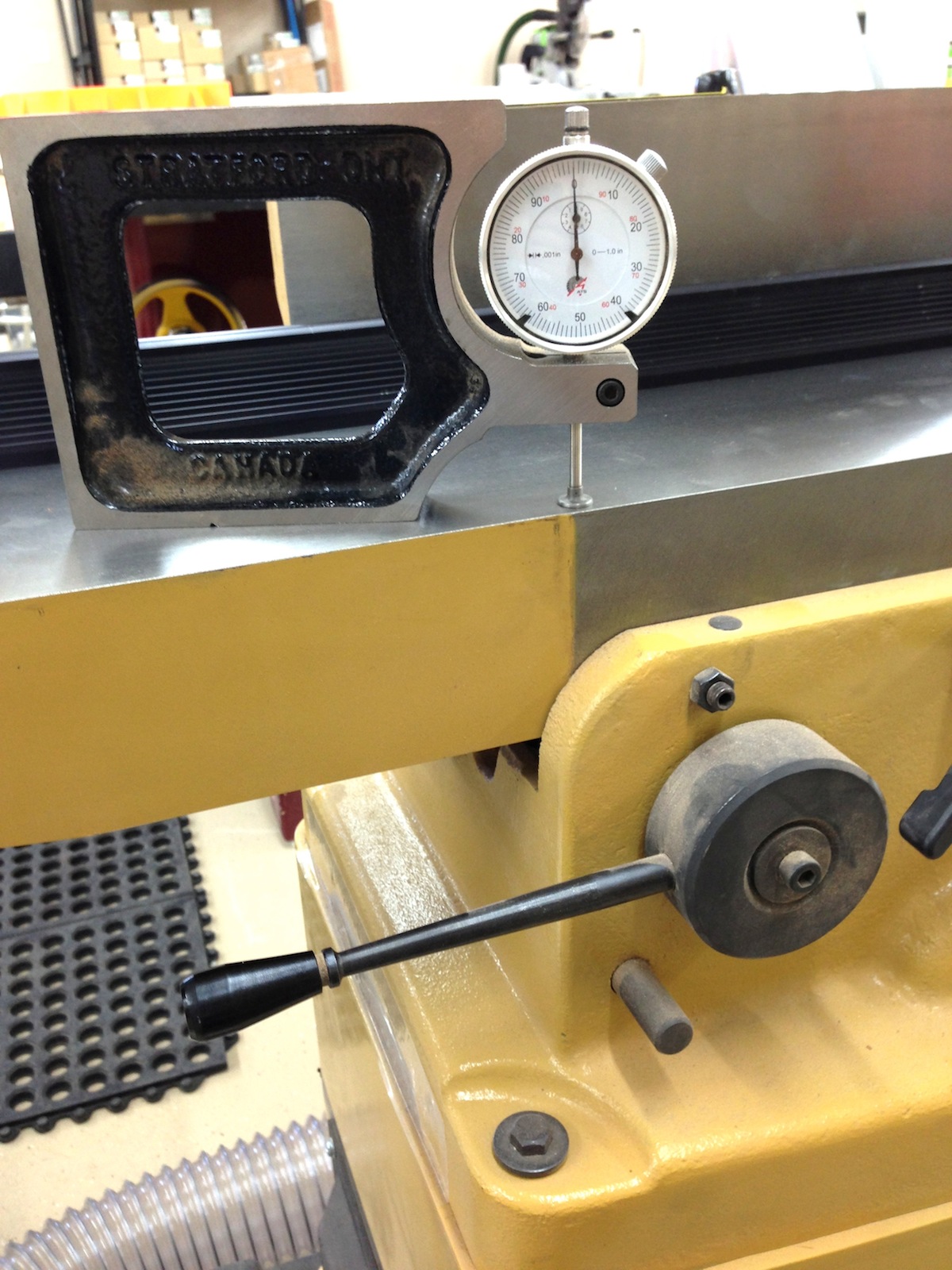
We can argue all day long about whether we really need to adjust our tools to the nearest thousandth of an inch. Honestly, on most tools, I think we tend to fuss more than necessary. But on a jointer, I feel the extra work is absolutely justified. If your outfeed table isn’t in perfect alignment with your cutterhead, the jointer just doesn’t work properly. Just a few thousandths can and will throw it off. So why oh why for the love of Norm do all jointers come with clunky, jumpy, inaccurate adjustment levers?!?! I feel like I’m raising and lowering my jointer bed with a greasy turkey leg! I will get there eventually, but I am constantly pushing and pulling on the lever as I repeatedly over and under-shoot my target.
I am certainly not singling out any particular brand as this problem exists across all jointers I have ever come in contact with. I am sure some are worse than others but this is pretty much a universal dilemma we face.
Personally, I feel that if the tool REQUIRES a certain level of adjustability to function, the manufacturer should be obligated to engineer an adjustment mechanism that is at least more dependable than smacking it with a mallet. Will it raise the price? I’m sure it will. But if it means I can calibrate the tool and get back to work faster, it’s well worth it.
I certainly haven’t used every jointer on the market, so if you have one that is actually easy to micro-adjust, tell us about it.



It’s not just jointers. I just spent a frustrating afternoon trying to get my band saw table square to the blade. I would loosen the trunnion screws, use the “mallet method” to get the table square, but then tightening the trunnion screws would throw it out of alignment. Lather, rinse, and repeat.
I think the manufacturers make adjustment difficult so that when you complain to them that their machine doesn’t cut accurately, they can blame it on improper adjustment.
DD
I agree with Dan. Its just like having a warranty on paint, they always blame it on the preparation!
Hi Marc,
Try the felder range of machines. I believe it’s the 500 series. I’ve been doing some research on this topic as I’ve had a monsteresly bad time trying to dial in an over under machine. Felder, although you will probably need to sell your house to buy one boost a 0.1 mm incrament adjustment on the tables throw in a spiral cutter and from what I’ve heard about these machines is you just don’t get better. I think they start around $10 000 so we are all dreaming but hey it’s nice to dream.
Has anyone had any experence with the hammer a3 31? I’ve just come across one secondhand and an ok price???? Love to hear from you all.
Thanks
Yes I have one of the HAMMER, (which is made by Felder,) combination machines. Like Marc says, it really is good for a small workshop, yet still has a 12 inch thicknesser and jointer. With a 2.2 meter sliding table, also the spindle moulder. All have separate motors, 4 hp each. My experience is 15 years, and the last two years have been with this machine, my opinion is they are excellent, highly recommended.
All the best,
Aaron
Sorry, I bought mine second hand, $6,600, five years old, fantastic.
Thanks Arron,
This unit is 4 years old barely used with the 4 hp motor. Asking price is $2700. I will be picking it up on Friday. Giddy up! Thanks for your in put.
I have a Jet 6″ and each time I change the blades I check the alignment of the tables. I take the tables all the way down. Give a squirt of silicone spray on the tracks and ease my way back up-stopping just where I need to be. Seems to have worked for about 10 years and the silicone takes out the jerkiness of the adjustment and they seem to stay very clean too!
Know exactly what you are encountering. I have the same jointer you have and worked for a full day to get it close to accurate. I also find the right angle adjustment nut is poor design.
Use machinist threads and that unit will be the winner.
I am looking at selling the Powermatic and purchasing a poratble (smaller unit – due to lack of room in my shop). Do you have any suggestions for either research or personal experience with a smaller unit.
Thanks
Hey Greg. Have you considered one of those fancy jointer/planer combos? The European style units fit in a fairly small footprint and house both the jointer and planer. Might be a good alternative.
Do you have a suggestionn in reference to the European style units? I know you do a great deal of research when you purchase tools.
Thanks
Greg
Possibly the best jointer/planer ever made is the Swiss made Inca Series. The 550 (two blade head) and the 570 (tersa head) were sold for $2,500 bucks a pop back in the 1980′s (so roughly 6k in today’s money). You can find them used somewhere between 500 and 750 if you can find them.
Spare parts aren’t hard to find (call Jessie Barrigan, owner of Eagle Tools in Los Angeles) and there’s a very active Inca listserv out there as well.
There’s a copycat version made recently, but I don’t know if the quality compares to the Inca.
Festool jointer, now that sounds like a great idea Mike!!! I sure buy one of those
Hi all, Marc, I have a European machine, Austrian in fact, a HAMMER jointer. It, in my opinion, has a great adjustment, a ‘nut’ system, with a good sized handle. Very accurate, and I find easy to set. I don’t have this on my machine, yet they also come with a digital readout in the turn handle on the thicknesser.
On ya, keep up the great work,
Aaron.
Spot on the jointer adjustment dilemma. I have a Powermatic 6 inch, 2006 vintage, same issue . N.A.S.A. level precision adjustment requirements, Fred Flintstone adjustment mechanism. If Festool made a jointer, I’ m certain the adjustment mechanism would be ultra easy and precise.
Absolutely! For $25,000 lol
thats my sentiments on all my woodworking equipment. Nuts ! it just gets worse the less you spend on it! Oh Well… I wonder if European stuff addresses these issues ?
My jointer gives me issues as well! To get it perfectly flat is a huge pain and then all it takes is one bump of that huge clunky lever an its all out of whack!
I do think the jointer is the hardest to adjust, although worth every second of attention that it takes to get it right.
In general any machine that is spot on is easier to work with!
Well I have been fiddling around with fine tune the in and outfeed tables of my grizzly portable planer. It had a terrible tearout when I moved a piece through and after using lots of scrap I do have a descent configuration. To be on the save side I make everypart a few inches longer so I can cut off tear out.
Any of you encountering this problem?
Erik
The Netherlands
Haven’t you heard the old woodworking adage? “Measure with a micrometer. Mark with chalk. Cut with an axe.”
lol
Hate to admit this, but that is one of the reasons I hardly ever use my jointer. I tend to use my planer with the board on a plywood sled to get level, and for a clean edge, again plywood to the rescue. Double stick tape and a factory edge, run the factory edge along the fence of your table saw to get a clean face on one side of your board, remove the plywood and tape, then adjust the fence and flip the board, you have two “jointed” edges.
Times like this I’m glad I got a dove tail way jointer. If it needs adjusting its about a one minute process!. All you need is a piece of wood. Run it on the jointer and if you see a gap between the board and the out feed then raise it and if it hits the out feed or has more resistance then you lower the out feed table more than needed and raise it till it touches.
How about using the ESTA Self-Set Jointer Knives?
Those are pretty neat, but they don’t really address what I’m talking about. Of course they would certainly make life easier for knife setup. I’m just talking about when you initially set the table height with reference to the cutter head. In my case, my table moved thanks to the beefy moving guys. So I just wanted to lower it a bit so it is back in alignment with the blades. But the adjustment is too coarse. I am actually trying to avoid resetting the knives if possible. :) But I will certainly look into the ones you mention.
I have a Minimax Jointer / Planer combo machine that has a Tersa head… it uses disposable knives that are two sided, so you can get two uses per knife. The beauty of the Tersa system is that the knives set themselves perfectly each time you change them. The centrifugal force of the spinning head automatically engages the gib that clamps the blade into place. It is stunningly simple and effective, slide the old blade out, slide a new one in… no bolts or set screws. I change out my blades a lot more often now since it takes less than 2 minutes to change out the 3 knives and have flawless cuts every time.
I bought the 8 inch model of General International with helical cutter head. The only adjustment I’ve made is the height of the outfeed table. I appreciate this kind of cutter head as the 36small knifes are easy to change and no adjusement is required as they have 4 cutting sides. If some thing append to it, only unscrew and 1/4 turn the broken pieces, no need to sharpen them too. I do not have much experience but I have seen a great improvement in the quality of the work pieces for the small projects I’ve made since this purchase. The cutter head was build in straight with the outfeed table. So far I love it.
Marc,
What is the gauge you’re using? I’m wondering how much better that is vs a long straight edge…
Thanks
Dave
Never mind, I just read the jointer setup article that was to the side…
Hi Marc, some of us (amateurs like me) can not have the very precise machines which tend to be quite expensive, heavy and big. So i have very inexpensive table saw which is light small and mobile. But also not very accurate. You know the ones made in China. Do you or maybe others have some tips to improve the accuracy on these machines? I changed the blade and that alone was a great improvement.
Thanks,
P.S.
excuse my english, i’m dutch
Just do what I do and spend a few extra hours sanding the wavy lines away. 8-)
Marc, just put on an extension arm on the leaver say 2 foot long you will have way more control :)
My Delta DJ20 has two bolts that serve as stops to lock the tables in position. So when I want really fine adjustments, I loosen the locking nut and use these stop instead of the lever to move the in-feed or out-feed table.
I agree with Jim K. My griz parallegram jointer has those table adjusters and makes it easy for setting table height. Now making sure the tables are on the same plane. Thats a different story. I’m glad that came fine from the factory.
I´m not sure there is a problem or it could be that I don´t understand it or that the machines you use have a different construction than ours in Europe. (But I´ll guess they all came from the same source in China or Taiwan).
The outfeed table on my jointer is only calibrated one time, together with the infeed table so they are parallel.
Each cutterblade is then calibrated against the out feed table when switched after sharpening. I have no trouble at all in the way you describe it. Why would one have a lever to do adjustment on the outfeed table?
Greetings from a hobbyist in Sweden.
Clearly the worst tool in the shop to get adjusted correctly. The last time I tuned mine a 6″ Jet to which I added shelix knives, took me three days of adjusting with a mallet!
Clearly, there has to be a better way. I would be happy for at least the type of controls on Marc’s 8″ jointer as shown in his video.
This first I tuned my Jet with my dial indicator it took about 3 days to get it right.
I just posted a rant on woodtalkonline about adjusting an incra miter gauge I purchased. I agree 100%. Especially when osborne made it SO easy!
HA HA HA HA HA HA HA HA HA HA!!! “FOR THE LOVE OF NORM” I sense a new hash tag in the making…#FTLON
I don’t own a jointer unfortunately, so I’ve never faced this issue but aren’t jointer beds on a parralelogram mechanism? If so, then wouldn’t a discrepancy mean the mechanism parts are not built to matching specs, or is that dumb noob question?
The only thing I know is that not all jointers use a parallelogram mechanism. Mine, for instance.
The jointer is the one tool that if not calibrated correctly, then whats the point of even having it.
You are saying what everybody is thinking. Maybe fine-tuning/micro-adjusters are the next big thing and the first manufacture to do so will be the next leader.
Well my PM 1285 has 2 nuts. 1 is for adjustments and the other rests against it to lock it down on a piece of threaded rod that is threaded into the cam mechanism . I thought the cam adjustments would be faster, but after reading your post here I would guess that it isn’t. My adjustments are a little finicky. I suppose if they used a finer threaded rod it would make life a bit easier and adjustments much finer. The first time I tuned up the machine I recorded about what a 1/4 turn (on the nut) resulted in, and while it is not an exacting science it usually gets me within my acceptable range of which is 2 thous.
AMEN!!!!