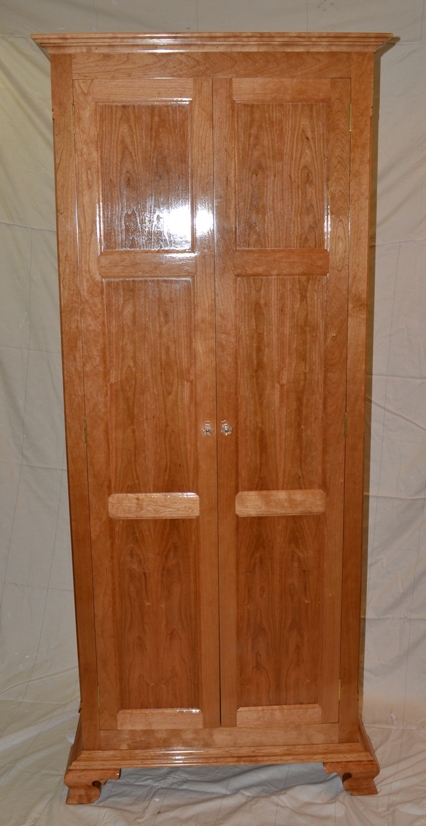
Well over two years ago my lovely wife asked me to build a cabinet to store kitchen appliances and excess stuff. It took me awhile to get this done since most of my previous projects are of the Mission/Craftsman genre and I wanted to do something with a new challenge for me personally. This 74” X 30” X 18” cabinet was the result.
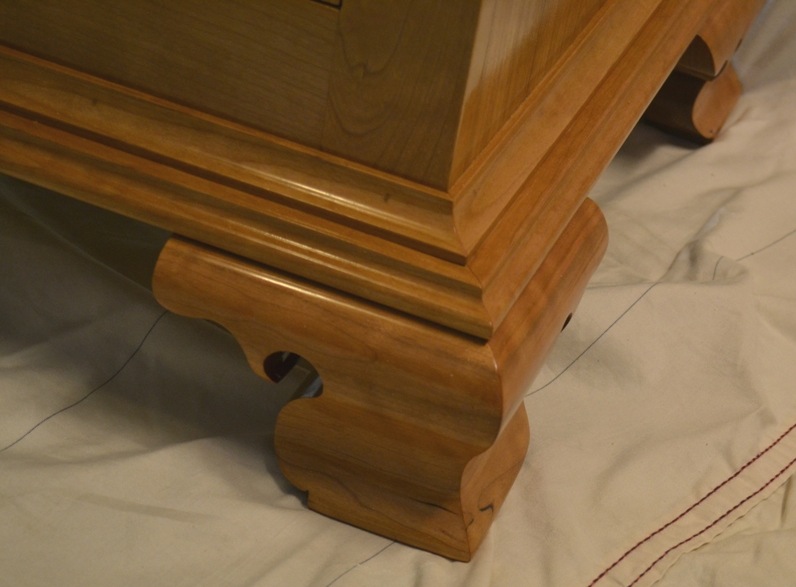
The main challenge was the mitered bracket feet with an ogee curve. All my previous projects have generally been straight sided or with simple legs tapered on the table saw. The bracket feet are my favorite feature of this project and I’m pleased with how they turned out. They allow the cabinet to be something other than my usual carcass with doors.
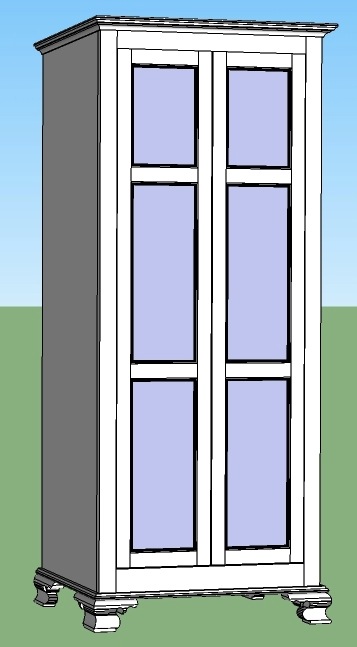
This project also had a lot of personal “firsts.” Besides the previously mentioned bracket feet, it is the first time I have used a cabinet door bit set for constructing doors. It’s also the first time I have used veneer (paperbacked) material on a project. The veneer materials made it very easy to book match the door panels. I gave pocket screw technology a try when I built the face frame and for attaching it to the carcass. This is also the first project I designed myself rather than using someone else’s or from a magazine. I used SketchUp to visualize my design ideas and needs.
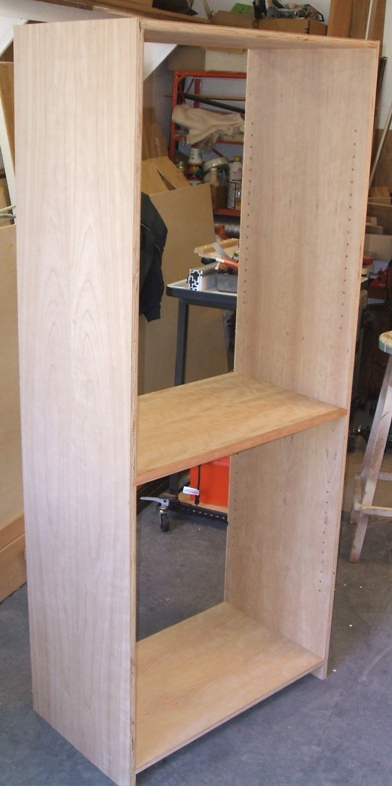
The carcass and shelves are cherry veneered plywood. The face frame, door frames, bracket feet and moldings are solid cherry and the door panels are paperbacked cherry veneer on ½” birch plywood. Four of the shelves are adjustable. The center shelf is stationary to add integrity to the structure.
The finish is oil based poly. I wiped on four thin coats using the method described in Marc’s, “A Simple Varnish Finish” DVD. I have yet to build a perfect project but this is certainly the best finish I have ever applied.


I like it – you don’t see a lot of freestanding & enclosed kitchen cabinets these days
Really nice project I love the style
The attention to detail on the feet paid off. They do look great. As does the cabinet. Well done sir, well done.
Nice work, you
should b proud of yourself
Very nice piece. Your design seems to allow to make cabinets of different heights without changing the structure of the cabinet. I like those legs that bring a lot to the design.
Those are some beautiful feet. Love how that miter work flows from the molding to the feet very well done.
Nice.
Great job, those feet really are a showpiece. The crown makes it pop as well. Looks good.
Cabinet looks good. What was your finishing process? Brother that is shiny.
Thanks, Sean. I used Marc’s wipe on finish method. It was four coats of thinned out oil based varnish with a light sanding between coats. I initially sanded up through the grits with my final sanding using 220 grit. Arguably, 220 grit may be over kill. I think the camera flash makes the finish look glossier than it really is.
Extremely beautiful work Greg. Great detail and work on the feet. Love the piece.
The feet are great! You have every reason to be proud of that project.
Wonderful proof that a first attempt at something doesn’t mean that you have to fail at it. With a little thought and planning, any attempt should be successful.
Very nice piece. Those bracket feet certainly look tricky, but they came out great!
Gregg,
Awesome job. Its beautiful. Kudos for challenging yourself with something new. There’s no stopping you now. Your wife must be extremely happy.
Well done !
fantastic job.. it looks great Gregg. I really like the feet and am getting ready to start into a clothes closet for my kids room and can take inspiration from this .
Nice piece, great looking finish. Would like to do something with bracket feet sometimes.
Awesome job on those feet. Great work!
Beautiful project. The veneering is impeccable and those feet are great!
Great work! It is a beautiful piece.
beautiful cabinet. However, I prefer a less shiny finish for a kitchen cabinet.
Greg I think you did great. There is nothing more satisfying then achieving those “Firsts” in a project. Good work, something to be very proud of.
Very nice – I love the larger shelf spacing right at chest height, perfect for storing the bigger/heavier appliances.
Forgot to add: For me, it’s these details that make or break a project. Woodworker porn is cool, but first and foremost a functional piece has to *function*. Otherwise, it’s just a piece of sculpture.
Thank you, Derek.
I agree with you completely. Although I had a lot of fun trying new-to-me concepts on this project, first and foremost the cabinet needed to be functional and sized to fit a particular spot in my home. I’m sure I violated many aesthetic design concepts (golden ratio being one of them) but the final result met the goal.
Love the feet, mitered on the front dovetailed on the back! Great job!
Nice work, beautiful result! I made the mistake of showing this to my wife and may have just had another project to the “It is done for me yet” list.
How did you accomplish making those great feet?
First of all, thank you all for the kind comments. I have never submitted a piece for review before and feel honored to be on the Wood Whisperer website. Thank you, Marc; you are inspiring a lot of folks.
Eric, how did I do the feet? How long of an answer do you want?
I spent a lot of time looking at Google Images to locate design ideas. The curved portion on the face of the feet is roughly an ogee style curve and the cut out (scroll?) portion is my own design but similar to many of the examples I reviewed on the web.
Using Sketchup I was able to print out a full size drawing of the foot shape, glued it to a piece of ¼ inch plywood and then cut and sanded it to form a template. I used the template to transfer the shape to the feet blocks.
The miter cuts were made while the blocks were rectangular and easier to manipulate. I built a simple (somewhat ugly) router table jig to safely hold the mitered pieces to cut a ¼ inch slot for the vertical splines. The splines have the wood grain running parallel with the grain of the feet. Orienting the spline in this direction maintains the strength even if the spline were to split. I also cut spline slots on the inside portion of each foot to help hold the mounting blocks.
The scroll portion of each piece was cut before gluing the miters. I used the cut out portions later to assist with gluing and clamping. The tightest curve, surprisingly enough, matches exactly the diameter of a one inch Forstner bit. Boring out the little curves made the process a lot easier when I cut out the rest of the pattern with the band saw.
After gluing the pieces together, I built a small square box to temporarily fasten the feet to. Mounting the feet to the box held the feet square to the band saw table top and provide safer distance from the moving blade while cutting out the final ogee curve. There is a lot of exposed blade while performing a band saw cut of this nature and I reminded myself several times to take my time and let the saw do the work. After cutting them to shape I did a little rasp work and a lot of hand sanding to get them to final shape. The feet are glued and screwed to the base of the cabinet and they feel solid as a rock.
Love it.
Well done!!! The work on those feet is first class!!! Love the finish as well!!
Very nice job.
Do you have a sketchup of the feet you can share?
Yes I do. It’s a very simple drawing showing the shape and curves but doesn’t show the details used to strengthen the construction. I haven’t a clue how to send it to you?
Great work, glad my girl don’t have so many aplliances!!!
Beautiful cabinet. I love the feet. Was the customer happy? ;-)
Very happy!