153 – Wall Hanging Tool Chest Pt 2

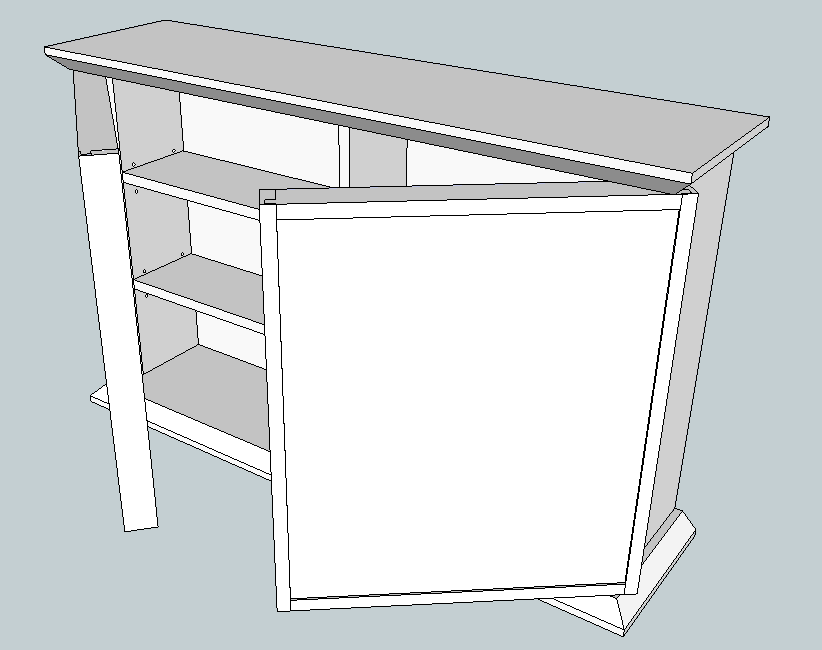
As is always the case, my designs tend to change on the fly. And since this was a Guild project, a lot of Guild member input went into the design modifications. So this video begins with a quick screencast showing you some of the changes I made to the tool cabinet since our last presentation. Viva la Sketchup!

With the design mostly complete, we can start the construction phase. My goal is to build the project entirely out of Baltic Birch plywood. Its cheap, stable, and doesn’t look half bad even without edge treatments! It really is the perfect material for shop furniture and jigs.

Now one thing to keep in mind is that my ultimate goal here is to teach you how to build your own cabinet. This is completely different than giving you a plan and saying, “Copy this!”. I am providing you with my working Sketchup file and my cut list, but due to the nature of plywood and its variations in thickness, you will absolutely need to put your thinking cap on and do some design work on your own. But with the Sketchup File, the video, and your noggin, you have everything you need to build this project or some variation of it.

Download the free Sketchup Plan today!

Remember, this video is being pulled from the Wood Whisperer Guild archive for your viewing pleasure. For more information about the Guild, check out WoodWhispererGuild.com

Other Episodes in this Series:
Wall-Hanging Tool Chest Pt. 1
Wall-Hanging Tool Chest Pt. 3

Category: Projects

Comments

  1. Bryan H July 26, 2011

    I really like the centerline approach to lining everything up and utilizing the specific plywood to give you your spacing for the cleat. Its amazing how many times I’ve measured correctly but because the material is slightly different then it messes with the results. Bring on Part 3!

  2. Tinus July 26, 2011

    Hey Mark,

    Still can’t get it in my head that you have a nice high precision Festool rail saw and have cut your sheet extra on the tablesaw ??
    I always saw panels right the first time with mine festo(ol) (yeh right a 18 year old saw buddy still going strong) so i have less wear of carbide sawblades.

    As always i enjoy your clips, thanks

    •  

      The reason is two-fold. First is because I don’t like to go too heavy on the Festool stuff on the show. Most of us have a tablesaw so its important that I show methods most of us are capable of doing with our existing tool set. The second reason I use the tablesaw is more of a functional one. I like the repeatability and the parallelism of the tablesaw, Repeated cuts and perfect parallelism can be a little tricky using a tracksaw alone.

  3. trz July 26, 2011

    Love that flowery coffee mug! Can we do something about that. LOL

    • Mark C August 5, 2011

      I saw that pretty mug too. The flower design looked similar to the flower design in the call out that defined “whisperize” This is great stuff.

  4. Alan July 26, 2011

    Mark,

    I really appreciate you putting a guild project on the free site. As usual, you are a very engaging host; a proper mix of precision with humor. I can’t wait to build my own wall hanging tool cabinet.

    Alan

  5. Wirenut July 26, 2011

    Nice. Laying out the position of dadoes with center lines using the material itself as a guide. Now that is one clever idea. Never thought of that but it makes perfect sense.

    Very useful tip. Thank you WW

  6. Fred July 26, 2011

    Hey Mark,
    I noticed that when using the Rockler shelf pin jig, you reference it off the end of the board. I’m pretty sure that the jig is designed to be referenced from a center line, that way you don’t have to keep track of which end you’re starting from. I use the same jig, and after mixing up the end I should be starting from and ending up with uneven shelf pin holes, I now always make sure to reference from a center line instead.

  7. Wade July 26, 2011

    Dude….I love me some Famous Daves….Rock On!!!

  8. Hey Marc – great video.

    Regarding the measurement of the back panel: the most accurate method to measure the length of it, rather than measuring the distance between the inside of the side panels and adding 3/4″ for the grooves, would be to use a folding carpenter’s rule.

    At the end of the final section of the rule, there’s a slide out piece. That allows you to unfold the rule to however many sections are just shorter than your measurement, and then deploy the slide so that you can actually measure from the bottom of one groove all the way to the bottom of the other, the actual length of your back panel.

    Of course, the most use I’ve ever gotten out of the folding carpenter’s rule was when I was about 7 years old. I’d fold out two sections on opposite ends, leaving the remaining bits together. This made a pretty awesome ramp for my matchbox cars!

    James

    • Sam July 27, 2011

      That’s a nice tip James. I was thinking of using two thin strips of wood, abutting each one into a groove and taping them together. I have a foldout rule and never thought of using it that way.

      I can’t believe I’m excited to go try this out; I’m such a nerd! he he.

      • Claude Stewart July 31, 2011

        Two sticks and clamp work great. Measure like an Egyptian.

  9. Paul July 27, 2011

    What happened to the Kapex?

    •  

      This video was actually made in 2009 so things will seem out of order in my “shop evolution”.

      • Mike July 27, 2011

        Was going to ask why you didn’t use the Cutlist plugin in Sketchup for laying out your cutting pattern…but maybe it wasn’t out in 2009?

        • Paul July 27, 2011

          I just started with sketchup. Can you provide a link to that plug-in.

    • Sam M. July 28, 2011

      Hi Paul here’s the link to cutlist ( http://lumberjocks.com/daltxguy/blog/5143 ). That’s where you can get it and it also has a link to the guys site. To be honest I haven’t been able to get it to work quite right but I’ve tried the option to output to cutlist plus and that works great. You have to pay for cutlist plus but it seems like a very good program (http://cutlistplus.com/). I’ve been using it for a few days now and so far I love it. Anyone have any experience with it?

  10. Rob July 28, 2011

    Great video – I have been building garage cabinets lately and your tips on design have given me alot of ideas for the next set. Thanks

  11. I like the “work in process” change-as-needed way this is done. I like all the videos and articles though.

  12. Claude Stewart July 31, 2011

    Hello Marc How do you like that Jet Sliding Miter saw? My Milwaukee bit the dust and I’m looking for a new one.

    •  

      I thought it was a really solid saw. My only gripe was that dirt would sometimes accumulate on the bars and cause a little hiccup when I pushed the saw in and out. I’d have to use compressed air to blow the dust out. I also suspected that it was in the bearings too since that wouldn’t always resolve the issue.

      • Claude Stewart August 1, 2011

        Never had a slider before. Maybe I’ll just my Milwaukee fixed. My shop is always sawdusty.

  13. Gary Bell August 1, 2011

    Marc,
    Great video.

    This is a perfect example of the value of drawing plans and solving problems on paper (or in this case sketchup) before you cut the wood. Granted you had to figure out a lot of deminsions as you went along but the written plans gets a person started in the right direction. It beats the Grind-it-tell-it-fits method of design and construction.

  14. Troye August 2, 2011

    Hi Marc,
    Great job on the cabinet! I love all the additional commentary. It’s detailed and muy informative! I have the DeWalt tracksaw and made a knock-down cutting grid that sits on sawhorses when cutting full / partial sheets of ply. It helps a ton so that you don’t have to use / store insulation panels or cut on the floor!

    Will send you a link to where I got the idea.

  15. Tom August 3, 2011

    Thanks for the video Marc, very helpful.
    Question, does anyone have any experience with any iPad apps for sketching? I have looked briefly at iDraw, but not sure if it will cut it. I have Google Skecthup on my PC, and I use high end 3D cad software for work, but the iPad is so convenient that it would be great to have something passable to use on it.
    Thanks in advance,
    Tom

  16. Jules August 5, 2011

    Marc,
    Love your show! Did you make an extra dado or mortise in your bottom panel @ 23:00? Can’t wait to see part 3 when it all comes together!

  17. Just an FYI. 4×8 sheets of Baltic Birch plywood are becoming more readily available in the US. I was able to get 4×8 pre-finished sheets when I was building cabinets for my shed. I also left all the edges exposed like Marc does in the video, and they look great.

  18. Ryan August 12, 2011

    Nice design and i like the golden ratio application. I wish ply wood was so cheap in the uk as it is in the us I’d be using it more as i love the way the edges finish. if it was me i might be tempted to make the top holder nogin levers to hold the planes as a slip under and drop into a cleat type to avoid a two handed plane draw. With the tuck under design you’ll be going for the fast 1 handed draw when you have something in the other hand. you could even go for the two plane fast draw!

  19. Brad McMahon August 19, 2011

    Any recommendations on an epoxy set? Looks like it’s less viscous then the typical dual tube type of epoxy we all know.

  20. Eric October 3, 2011

    Hey Mark,
    How much do you typically oversize your cuts when creating your cutlist?

Leave a reply

XHTML: You can use these tags: <a href="" title=""> <abbr title=""> <acronym title=""> <b> <blockquote cite=""> <cite> <code> <del datetime=""> <em> <i> <q cite=""> <strike> <strong>

Coming Up


  • There are no upcoming events

  • Video: Flattening a Benchtop With a Router

    May 23, 2012
  • Wood Talk Online Radio

    May 23, 2012 - 5:00 pm MT
  • Adirondack Chair Class (William Ng School)

    June 4, 2012
  • Video: Turning a Tool Handle

    June 6, 2012
  • Woodworking in America (Pasadena)

    October 12, 2012

Live Shop Cams


Enter the live room →

Pressure Treated Wood Utility Poles for building structures, distribution or transmission.

Cliq Studios sell quality Kitchen Cabinets in a range of woods including cherry, oak and maple.


what wa