Interested in my new Hybrid Woodworking book? Sign up and be the first to know when pre-orders are open!

164 – Marking Gauges

Subscribe (iTunes/RSS)

If you’re not using marking gauges or some sort of blade to lay out your joinery, you are really missing out! I remember a conversation I had with William Ng at the William Ng School when he told me, “If you want to make good joinery, use a pencil. But if you want to make great joinery, using a knife!”
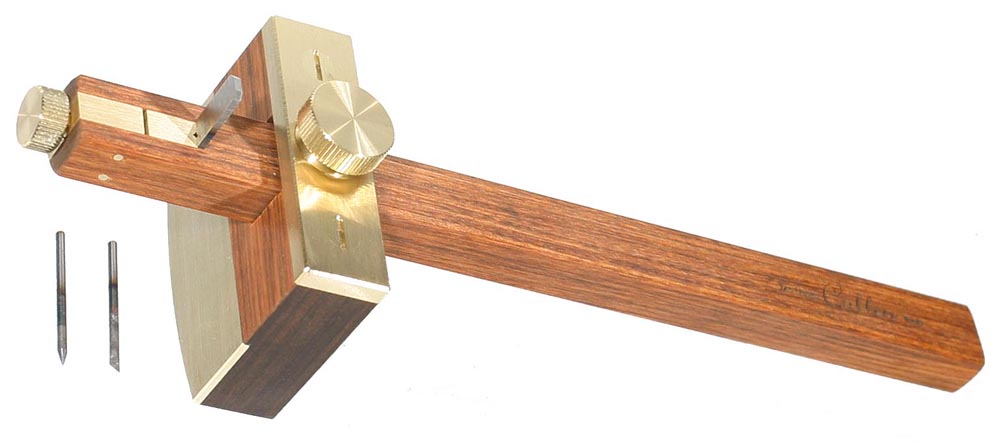
Marking gauges come in several forms but they are all fundamentally similar. They consist of a post, a moveable fence, and a blade or scratch pin. My personal preference is for blades and you can see a fairly standard traditional marking gauge to the left. So why should you use one? Keep reading.

Accuracy

When you cut with a knife, the resulting line is maybe a couple thousandths of an inch wide. Compared to a big chunky pencil line, its much easier to know when you’re exactly where you need to be in reference to that line. Additionally, marking gauges have fences which allow us to be consistent when marking multiple sides of a single workpiece for dovetails and tenons.

Tearout

No doubt you are very familiar with the concept of tearout. When you cut wood across the grain, you’ll inevitably notice small bits of wood tearing out at the end of the board where the fibers are unsupported. So if you actually cut that grain ahead of time with a blade and then cut right up to the line with your saw, you end up with a nice clean crisp shoulder with absolutely no tearout.

Tool Guides

If you use scribe lines, you’ll have a perfect place to lay the tip of your chisel or saw blade with absolute accuracy and consistency. If you try to line up the tool with a pencil line, you will almost always end up on one side of the line or the other. There’s just too much variability there. But if you have a little trough from a marking gauge or knife, you’ll have a no-brainer aid for locating the tool in the proper place.

Categories: Techniques, Whisper Minis

Comments

  1. Guy LaRochelle August 11, 2012

    When setting up a mortise gauge with a blade which way do you place the bevel of the blade? Towards the fence or away from the fence? I’ve tried both ways. Not sure which I like better. There are times that one way works better than the other. I’m just wondering which way was it designed to face. Thanks.

  2. Richard February 4, 2012

    hey Mark just in defense of the veritas round marking gauge, you used it in the same way as your blase cutters maybe your bade is looser than mine but mine has never spinned and if it did it would allow for wobble in the blade I would presume. I rotate the marking gauge in my hand as I move along the piece this works for me and especially when going with the grain as it prevents it following the grain. a little bit slower and done in about 2 inch strokes but because you have a constant reference fence doing it in the one movement isn’t necessary.

  3. Luke D Johnson January 30, 2012

    I enjoyed the video, wish I could remember where I read an artical on how to build your own think it was Pop Woodworking?? Thanks Luke..

  4. Jon McGrath January 30, 2012

    After the video and reading all the replies I went over to the Hamilton site and reviewed their offering. Purchased and can communicate I beyond pleased. It is a very high quality tool. Of course it is beautiful as well, but I cannot get over just how well it works and the comfort of using. I would say to anyone on the fence, check them out. Well worth it.

    Thanks

    Jon

  5. I’m surprised nobody has mentioned the Glen-Drake Tite-Mark gauge. I’ve had a couple of cheap “wheel” marking gauges that were terrible. The Glen-Drake is superb, the blade is thin and very sharp. The adjuster is very handy, and they have mortise blades for it as well.

    http://glen-drake.com/v-web/ec.....p?cPath=24

  6. dmishler51 January 28, 2012

    Great and timely video. I had just started to build a series of heirloom type handtools to pass down to my son. I was building them for their visual qualities until I saw this video and realized how important these tools, that have been around for so many years, still shine for todays woodworker. Keep up the great videos Mark, not only do I love the vids but you do a great job presenting the different topics.

  7. Tom Wilson January 27, 2012

    I found the video interesting because I have always had difficulty marking accurately with the traditional marking gauges. I use a Glen-Drake circular marker and I find that because of the shape of the cutter it keeps the reference face pulled tight. On my Marples marking gauge the cutters some times want to follow the grain if I don’t keep the cutters very sharp. Over all I like both types but I don’t have to sharpen the circular cutter, just rotate the blade.

  8. Marc, 89 comments (and counting) on a five-minute video. You must know your audience. Fun to see comments from both newbies and the old guard.

  9. Dan January 20, 2012

    I am going to attempt to build myself a marking gauge, possibly this weekend. Found some decent plans in an issue of FWW that I will roughly follow. I have a nice little chunk of purple heart for the body, but not enough for the ‘arm’ any reccomendations for that peice, I have oak, walnut, maple, cherry scraps to use up.

    Thanks

    • Dan, think quarter-sawn if possible. Oak might be first I’d look at.

    • Richard February 4, 2012

      Dan Hope this comment isn’t to late. I made one with maple and walnut, the walnut was used for decoration and to prevent the maple getting dirty when working against timber, just laminated a 5mm strip of walnut to my maple stock, when you make your own have the option of replaceable stems, I have a 10mm by 20mm stem and two 10mm x 10mm this allows for mortice marking as well. all my stems are held in place by a wedge,

  10. Dan Pleska January 20, 2012

    Nice video Marc. I’ve been using the Veritas wheel gauge for a while. Now I know why I wasn’t really satisfied with it. I’ll be looking for a good knife gauge soon. Thanks

  11. eddie antley January 19, 2012

    i’m learning something everyday.new at this craft sometimes older wood workers forget that we green horns haven’t been as far along down this journey of wood working as others thanks for the reviews and tip .this is the penultimate of my comment
    your friend eddie

  12. Ken B January 19, 2012

    Knife lines can be hard to see so you can rub a little pencil lead in them to have the best of both worlds.

  13. Dave January 19, 2012

    I second the Hamilton gauge -
    http://www.dlws.com/Marking-Me....._gauge.htm

    Got one after taking a joinery class – I still have teh round veritas gage I went to the class with but once I used the instructors Hamilton – - – it was an “I need one of these” moments.

  14. Great little video. I knew I’d need to get a marking guage eventually, but this vid has steeled my resolve! Plus, I know exactly what to look for now. Cheers Marc.

  15. Richard January 18, 2012

    Could it be the duller the marking blade is the longer marking guage fence needs to be?

  16. Jeff Yates January 17, 2012

    I have to say, it’s video’s like this that have inspired me to start working on my skills.

    Just curious…how often are you honing your knife? Just waiting for it to dull?

  17. I use both a marking knife and a wheel marking gauge. The wheel gives me a nice, crisp mark, and the knife is awesome for everything the wheel gauge can’t handle.

  18. Rick H. January 17, 2012

    Love your videos, I am a fairly new sawdust maker and think I am ready for a marking knife. Keep up the good work.

  19. Mark Williams January 16, 2012

    marc,
    Long time to talk! I had bought the style of gauge you prefer after watching you on a guild video with it. I could never get mine to cut. I think it may be dull any tips on sharpening the knife on it?

    •  

      Hey Mark! The knife on the gauge is usually like any other blade. You need to hone the back flat and sharpen the bevel. Not all that easy if the blade is real tiny. So you might try making a little honing jig of sorts…..something like a slot cut into a 3/8″ dowel. That would give you something to work with.

  20. Allen January 15, 2012

    As my woodworking moves up the learning/abilities curve I find the pencil line to be the one of the most frustrating points – our lack of one – of my woodworking endeavors. I have considered getting a knife in the past, but have continued to lived with the frustrations of the pencil. I think it is time to upgrade. Thanks for pushing home the point.

Leave a reply

XHTML: You can use these tags: <a href="" title=""> <abbr title=""> <acronym title=""> <b> <blockquote cite=""> <cite> <code> <del datetime=""> <em> <i> <q cite=""> <strike> <strong>

*

Online project based woodworking education.

3 Membership types

  • A la Carte
    Starting at $25/project
  • Subscription
    $129/year
  • Superfan Subscription
    $299/year
Learn more →

Simple Varnish Finish DVD

Coming Up


  • Thorsen House Tour w/ Darrell Peart

    May 21, 2013
  • Live Guild Session

    May 21, 2013 - 3:00 pm MT
  • Turning the Post Pt. 2

    May 24, 2013
  • The Router Jig and Dovetail Slots

    May 31, 2013
  • The Legs

    June 7, 2013
  • The Top & Pivot Block

    June 14, 2013
  • Assembly & Finish

    June 21, 2013
  • Spiral Alternative

    June 28, 2013
  • Baseball Bat Alternative

    July 5, 2013
clearvue-200x200
TWW_v6_200x200

Pressure Treated Wood Utility Poles for building structures, distribution or transmission.

bellforest200x200-tww10