In the final part of this series, I assemble and attach the base, install the handles, and apply the final finish to the top. This project was an incredible learning experience, and not in the way you might think. I actually found it incredibly challenging to step back from my primary shop tools, and focus only on the portable power tools. Not only did I find new ways of doing things, but I have a new found appreciation for the tools I have been taking granted for years. But hopefully you’ll see now that even with a very basic set of tools, you can still produce high quality furniture.
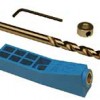
Mini Kreg Jig and Kit – $19.99
This is a less expensive and simpler version of the jig I used on the show. The kit contains the jig, a pocket hole bit and a stop collar. Check it out!
A Simple Varnish Finish DVD
I mentioned my finishing DVD in the video, so here’s a quick link for anyone who might be interested. A Simple Varnish Finish
Quick Links:
Low Entertainment Center Pt. 1
Low Entertainment Center Pt. 2
Low Entertainment Center Pt. 3
Low Entertainment Center Pt. 4
Low Entertainment Center Pt. 5


POCKET SCREWS?!?!?!?
Now I have nothing to be ashamed of… ;-)
Hi
Thanks for this porject video. I am contemplating building my first piece of furnature, and am aiming for entertainment center for bedroom flat screen.
WIll be perhaps 24-26 inch high with two cabinets on sides, and two shelves and a bottom drawer in the middle.
Got some ideas from this and even better, some inspiration.
Thanks again,
Jerry
Glad to see it finally done. Looks amazing!
Question, though… If a person wanted to approach this project using cabinet grade ply and their own handpicked veneer… Would it be best to veneer the plywood in the very beginning, prior to cutting and assembling? Or would it be best to try and apply the veneer afterwards?
I’m assuming apply the veneer first, but thought I’d ask just in case.
=paul
To be honest Paul, there are very few, if any, cases when I would veneer something after construction. I find it easiest and I get the best results when I veneer in the flat.
I’m still curious about how you gonna deal with the cables from TV and still allow the furniture to be flush to the wall – without some gap for cables – I guessed you gonna drill some holes in the top for that but you finish it!
End of project
Tanks for posting another nice video
Nothing a forstner bit or hole saw can’t fix :)
I recently built a similar entertainment center. In oder to run cables, I drilled holes in the plywood shelves (near the back) as well as in the bottom-rear corner of the sides. In order to make the holes look nice, I cut down brass plumbing pipes that have a nice lip on them (available at any hardware store) and installed them into the holes. The result is extremely attractive and allows the wires to be hidden. The speaker cables and power cord exit the hole in each side.
Hey Marc
Very cool to finally see the finished project. I am blessed to have the tools I do and you are indeed right. It does help to ground yourself but also it helps keep those initial “old school” skills sharp.
Nice project.
What are we building next????
I love the trick of using clear packing tape to hold the miters together. I just tried it earlier today on a different project, and it worked like a charm!
I had seen that trick before, but with masking tape. The thing I really like about using the packing tape is that it’s clear, so if something goes awry, you can see exactly what’s happening underneath the tape.
Almost forgot!
Congrats on the additional sponsorship from Rockler.
Great job as always. One comment though. I do a lot of through holes where I work and if you don’t want to use a block on the backside you can use tapered bits. Rockler sells them in kits and seperately. They come with counter sinks attached and are sized for common wood screw sizes. They do not break out the back and generally leave very clean holes. Just thought you might want to give them a try.
I use a 3/16 for hardware for like knobs/pulls and I have a 7/32 for drilling holes for false fronts. We use blum adjusters on our false fronts and the bigger screw hole allows for more adjustment.
Thanks again.
Yay, glad to see you use pocket screws. They may not meet “purist” standards, but man are they fast and strong. I’ve used them to great advantage on the backside and underside of tables and cabinets.
I love the convenience of the pocket screws. Do you need to pre-drill through both attaching pieces? I noticed that you only drilled the pocketed part, and not the part that receives the screw tip. Is this going into your home or on commission?
I only drill into the piece with the pocket. You don’t really need to drill into the adjoining piece. The screw biting into the adjoining piece is pretty much what pulls the joint together so tight.
This piece was built over a year ago for our bedroom. I wound up giving it to my mom and that’s where it lives today.
Nice to see the completed project, looks great. It’s nice to see basic tools used to make a quality piece of furniture. Let’s us beginners know that we don’t have to wait for a complete shop to make something nice.
marc,
another great show. it was nice to see a project done with the tools that i am normally working with. it is slower, but i have found i can get most things accomplished with minimal tools.
Great project. I’m glad you kept the major power tool usage to a minimum. Hmmm… I wonder how Roy Underhill would have built this? Roy?
Hi Marc,
In your response above to ‘demowen’ did you said you built this piece for your mom and HER home, or for your place?
You also said something about having built this piece “a year ago”… Did you end up building a total of two (as Norm Abram used to do on his shows)?
I’m so sorry to ask, I’m SURE I just didn’t understand your answer (that’s what too many polyurethane fumes have done to me).
Hey BoredCutter. The piece was originally made for MY house and My bedroom. When we moved, I gave the piece to my mom. Now she has it.
The piece was made and filmed over a year ago. It was originally a project series developed for FineWoodworking.com. 6 months after they published it, I had the option to publish it myself on my site for free. So that’s what I did.
So only one unit was made.
Marc,
Thanks again for another great video for us newbies! Right now a compressor and brad nailer are a bit out of my range, but I am sure I can make due!
Another great show. Just a quick question. What type of blade were you using on you circular saw. Was it a “plywood” blade or just a higher tooth count blade?
Thanks for providing an entertaining and educational show.
You know what, I don’t even remember what the exact model was. But it was definitely a blade with a high tooth count. Very likely a plywood-specific blade. And you’re very welcome!
James, you might want to look into this item.
http://www.lowes.com/lowes/lkn.....J-6901-100
This is a CO2 regulator but not the cylinder (tank). I looked up the cylinder items numbers they listed but Lowes doesn’t seem to have them. I did find a Brass Eagle Black 20-oz. Refillable CO2 cylinder on Taget’s web site. You’ll have to do a search on Targets site. The URL was about 3 miles long so I won’t post it here.
You can hook this up to a brad nailer (or pin nailer). The 20 oz is listed at 1,000 shots so it should last you awhile. I hear you can get these refilled at a paint ball shop. You can look for a used brad nailer on craigslist, or at a flea market or garage sale.
I saw someone on TV use a small compressed air tank. They said it was compressed to 3,000 psi, and would give you about 1,500-1,700 shots, but my guess is that it would cost much more to set this up, but I’m not sure.
The packing tape on the miter is ingenious, I will try that on my next project. Pocket screws are great, I built several painted screen doors and I used dowels for the filler plugs and you can’t see where they are.
Great job on this project.
Hey Marc,
I love to see projects that can be done without a huge array of expensive tools (my shop feels pretty limited in that arena…) Thanks so much for your hard work in putting these videos together! I check your site at least twice a day everyday for the next “viewer project” or video, etc… I have watched enough of your videos that as soon as my wife hears the intro or at least the first few words of a video she’ll ask, ” is that the ‘Woodwhisperer’ again?” LOL!!!
Thanks again!
Spencer
If you don’t have all the expensive tools. But the desire to make a wood project. I believe a man shows what he is by what he does with what he has.
Im very glad that you showed a video using minimal tools! Hopefully you will do more in the future. I live in Austin Tx and have been very lucky to have met a person that owns a block long wharehouse in a prime location downtown, That i have made into my perfect shop! However, I have been building kitchen cabinets, furniture pieces and now a line of handcrafted artist equiptment.But on very minimal tools.
I had spoken to several artists in the area and women that had mentioned learning woodworking, However once again the main problem being costs of equiptment and tools for most people. So then it hit me! To start up classes for artists and women using minimal tools. With the economy and country changing ive noticed recently alot more people interested in learning trades and tangable skills! I believe that this is important! So if you could do more in the future on this topic that would be really cool!
I will brief you on my tools!
I have a crappy $500 table saw but use good Blades, A homemade router table with a variable speed router.” Hand router and assortment of bits. I rip large sheets of plywood using a homemade saw guide and circular saw. Mitersaw, drills, tons of clamps, all basic trim carpenters handtools and last but not least! A pocket hole jig!
Are these types of projects better built open like this or with face frames?
I wouldn’t necessarily say “better”…..its just different. Face frames do give the piece a little more support, but it also changes the look and will affect the type of doors you install (if the cabinet has doors). But both face frame and frameless cabinets are perfectly legitimate.
i am just getting back into woodworking and i was poking around some of the web pages for woodworking techniques and how to’s and found your site. i watched all of the tv cabinet series and was inspired to get going on a tv entertainment center of my own.
Fantastic! Down -to- earth; informative; interesting, and useful without seeming like just another corporate lacky. Thank you and please continue to be available (on the net), and to be real.
Did you hide the plywood edges of the sliding doors?
Nope. Those panels had an MDF core and once finished, its barely noticeable so it wasn’t really worth the effort to wrap with some sort of solid wood.
Hi Marc,
Any concerns or issues with using plywood for the base? My experience with ply is that the veneer can chip away if the peice catches on carpet or tile, which might be likely when moving a big peice like this. Would adding solid wood edging to the very bottom (maybe 1/4 inch) be worth the time to prevent a potential chipout, or have you not noticed it to be much of an issue?
Thanks, and great series!
Hey Joel. If you plan on moving the piece, that could definitely be a concern. Especially if you’re making the piece for someone else who might not think anything of just dragging the piece on a carpet. So I’d say either use hardwood edging or simply buy a few little plastic feet with the pins in them. That will raise the piece up a bit and allow it to slide fairly easily.
Hello Marc
Greetings from South Africa
This is the first time I have heard of the pocket screw concept and it is extremely interesting.
Do you know off hand the manufacturer of the pocket screw jig so that i can find a distributor in this country?
Thanks for the superb videos it gives me lots of inspiration
Hi Henry. Glad you are enjoying the videos. The manufacturer is Kreg. http://www.kregtool.com/