100 – Low Entertainment Center Pt. 4

An important aspect of building furniture that many new woodworkers overlook, is the importance of finishing BEFORE the project is completely glued together. That’s the primary focus of this part of the series.
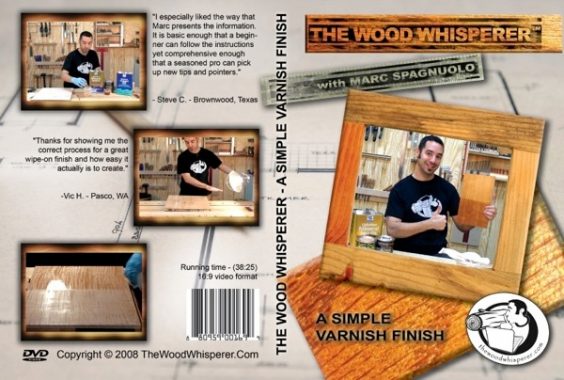
I mentioned my finishing DVD in the video, so here’s a quick link for anyone who might be interested. A Simple Varnish Finish

JIG IT(R) Shelving Jig JIG IT(R) Shelving Jig
Our original JIG IT(R) Shelving Jig is now even better!
Get perfectly, consistently spaced and centered shelf-pin holes!

JIG IT(R) Shelving Jig


Quick Links:
Low Entertainment Center Pt. 1
Low Entertainment Center Pt. 2
Low Entertainment Center Pt. 3
Low Entertainment Center Pt. 4
Low Entertainment Center Pt. 5

Categories: Finishing, Projects

Comments

  1. robodude666 September 29, 2009

    Beautiful unit Marc!

    If you didn’t want the dowels from the shelves to stick out under the shelves, and wanted them “embedded” into the underside, how would you go about cutting the indents in the shelves?

    •  
      thewoodwhisperer September 29, 2009

      I suppose the easiest thing to do would be to notch them out with a router.

  2. Congratulations on your 100th episode Marc :)

  3. Aaron Cashion September 29, 2009

    Congrats on the 100th episode. to the next 1000. Keep up the good work.

  4. jHop September 29, 2009

    One other shelf support you could consider using are those plastic (or metal) “half-pins,” the ones with the ledge notched into them. (Or you could do the same for your dowels, if you wanted.)

    I noticed you just dipped the pad into the stain before you mentioned the oxidation of the wiping finish; does the stain not oxidize at the same rate as the finish? And have you tried any of the weatherstripping / foams for filling the grooves to keep finish out of them?

    •  
      thewoodwhisperer September 29, 2009

      Hey jHop. The stain I used was water-based, and water-based finishes need to evaporate before they cure. Fortunately, water doesn’t evaporate quickly enough to worry about it too much.

      That being said, its always a good idea to transfer the stain to another container for the sake of cleanliness. But I tend to break that rule all the time.

      Never tried weather stripping. Interesting possibility. Have you tried it?

      • Marty September 29, 2009

        Congrats on the Hundy, Marc! I tried the weatherstripping once and the stain bled a little into the joint. It wasn’t bad but I still prefer blue or green tape. It takes a little longer to apply but the results are perfect.

  5. Rob Knott September 29, 2009

    Great looking cabinet marc!
    Another option to de- nib after the final coat of finish is to use t-cut, we use this at work, and is especially good for high gloss finishes.
    Always picking up great tips from you, and it helps the quality of my work no end, cheers!

  6. Robarov September 29, 2009

    Congratulations Marc,

    I bought the jig a while ago – also after you recommandation and its a wonderfull tool. Love it. really easy !

    I would like to check out the ARM-R-SEAL, but does anyone know where we european can buy the ARM-R-SEAL or other General Finishes products ? as all american companies are not allowed to ship it …. hmmm … bummer ?

  7. Robarov September 29, 2009

    What was the website where you ordered the exotic woods again ?

  8. Dan September 29, 2009

    Too 100 and beyond!!!!!! Congrats on the milestone, you and your support staff must be delighted…Steak dinner and dessert in the desert tonight! or is it desert in the …anyway, thanks for the entertainment.

    I am glad your new episode is on line. Since I broke my right hand and cannot do much I have been bangin my head against the wall, now I can bang it on the computer desk.

    How is the new shop and are there any new pictures?

    Dan

  9. Damien September 30, 2009

    Great videos, I like them.

    But this episode raises for me a question. I am an occasional user of a minimal workshop. So no table saw etc. ,that’s not a problem. But as I have no dedicated finishing room, I first fully assemble the furniture and either: move the furniture out to a temporary finishing room or block the workshop for the finish activities, maybe for three layers. I see that you are able to put five layers (sanding-cleaning-painting) on part of your project in the workshop. Of course making a video changes the normal flow, but I am curious to know: how do you combine a workshop – finishing room?

    Damien

    •  
      thewoodwhisperer September 30, 2009

      Hey Damien. There’s really not trick to it. I finish in the same space that I woodwork. So its important to keep the area clean and as dust free as possible. And when finish is drying, no wood gets cut. There’s really no way around it in my shop.

  10. GaaMan September 30, 2009

    Hi Marc, is it just me or is the video for this episode wonky? I can’t get it to load properly at all. I’ve tried 3 browsers, 2 computers (1 mac and 1 pc) 2 different ISP’s and still no luck.

    •  
      thewoodwhisperer September 30, 2009

      I hate to say it but it might just be you. Have you gotten it to work yet? Consider downloading the MP4 version if you continue having trouble.

      • GaaMan October 1, 2009

        Marc, thanks for the reply, finally got the video to play properly. Had to “fix” the firewall in the office so Shh!! don’t tell anyone. Ahh the simple joys of the IT staff ;)

  11. Jeremy September 30, 2009

    I’m curious – and maybe a little anal. I understand keeping the finish out of the dados that will receive the panels in the final glue-up, and off of the ends of the panels themselves. But won’t you have the same (or a similar) problem if you build up a finish of several coats on the ends of the panels themselves? You know, the very ends, that have to fit into the pre-cut dados? Or is the film finish not thick enough to cause problems there? For that matter, does having finish there mean the glue in those joints is effectively only reaching the plywood edge, and not the “shoulders?”

    Sorry, that’s a lot of questions. Congrats on 100! I’ve been watching through most of law school, and now that I’m done, it’s time to get out to the shop (after work, of course) and follow along.

    Jeremy

    •  
      thewoodwhisperer September 30, 2009

      Good observation. This is one of those calculated risks that I sometimes take for the sake of convenience. The best thing to do is to tape off the very ends of those vertical pieces so that the wood stays raw. That would certainly provide the best glue bond. And yes the finish will make the glue bond significantly weaker. But, in this particular case there are a few things going on that make me feel ok about taking a little risk. First, the extra finish on the panel actually makes it an even tighter fit than when I did the dry assembly. So once those panels are popped into the dado, they aren’t likely to come out without a dead blow hammer, even without glue. We’ll get a decent glue bond on the edge of the vertical partition and we’ll get the diminished bond where the finish sits on the shoulder. But as a whole, the joint is still quite secure.

      So is this the best practice? No. It might have been a good idea to reinforce the joint with a few screws. And you could even assemble it in such a way that the final glueup is with the bottom up, so you can drive the screws where no one will see them and the top would have been glued on prior to any finishing. I didn’t do that but its certainly a way to handle if one was concerned.

      So I wouldn’t consider it anal at all. A very valid point.

  12. Nice episode Marc. You are inspiring me to start to design a small Entertainment Center for our living room. I like your design, but in our living room it needs to be a corner unit. I’ll see what I can come up with.

    Mike

  13. Anthony October 2, 2009

    Marc, what do you think about spraying the finish (HVLP or something like that)over large surfaces such as this?
    Thanks!

    •  
      thewoodwhisperer October 2, 2009

      Spraying over large surfaces is a pure pleasure. But spraying casework can be tricky. You get lots of overspray coming back at you and onto the work piece. So when spraying its pretty important to have a good finish or pre-finish strategy.

  14. colegirlsdad October 2, 2009

    Another great episode gratz on the 100. On the wiping varnish you said to reduce it 50% with mineral spirits. Does the arm-r-seal come already reduced?

  15. AZ October 5, 2009

    Hey Marc,
    Love your teaching. I have two questions on this episode. After the distilled water is used to raise the grain, what grit sandpaper did you use to knock down the grain? And lastly, when you are drilling dowel holes on both sides of the center uprights, did you have to worry about them meeting or did you have to offset the holes so they wouldn’t meet, or does it really matter? Offsetting the holes wouldn’t let the shelves be vertically aligned all the way across and I don’t know enough to know if that is something a good design is supposed to incorporate or not.

    •  
      thewoodwhisperer October 5, 2009

      Hey AZ. Thanks for the feedback! I use 180 grit after raising the grain. Basically, I would the same grit you left off with prior to the grain raising.

      And when you are using 3/4″ ply, it doesn’t really matter. Some of the holes could very well go all the way through. But the shelf pins don’t penetrate more than half way through the ply so it doesn’t matter much. But its still a good idea to stagger them if you can. And even as I am saying this I am not sure why. For some reason I would prefer the hold doesn’t go all the way through, lol.

      Its definitely good to think about shelf alignment, but in this case you could at least make it symmetrical, with the two outside shelves being the same and the middle shelf being slightly off. Since the shelves are adjustable, you probably won’t have them all in exactly the same position anyway. And furthermore, you could keep the shelf pins at the same vertical locations, but just push the entire row back 1/4″. SO that’s one way around it if its a real concern.

  16. Dean October 11, 2009

    Great use of common tools. As a starting wood worker, with very limited space for tools, its great to see what can be acomplished in this manor. Keep the good stuff coming

  17. Hello Mark, I am professional saxophonist living in Venezuela, but long ago I like carpentry and I’m very much into that as my hobby, I have my machine and try to learn as much as I can, but get to your page I find incredible and very well done congratulations,,,, shame that I do not speak very good English and I am merely the image and video,,,, I like that even if you make a basic video in Spanish with someone you tradusca, ,,, for the Latin American market as ,,,,,, help me a lot and congratulations again ….. Horacio

  18. Danny boy November 25, 2009

    Hi Marc!
    Nice project! I also love to work with walnut. It has such a rich look! Have you ever considered using gel stain as a way to add constancy on the grain color? (I see you have used a water based stain)

    I’ve had beautiful results with that kind of stain. Mostly because walnut seems to have very large pores and gel stain prevents the stain itself from going too far under.

    If not, I wonder if the use of a sanding sealer would have been a good idea before coloring the wood.

    Any toughts?

    Au revoir de la part des gens de Qu

    •  
      thewoodwhisperer November 26, 2009

      Hey Danny Boy. While I don’t always do it, I think adding some “walnut” color to walnut is actually a pretty good idea. It intensifies the color and makes it more consistent. And really, water based dye or gel stain would both work great. No real reason to use a sanding sealer though, since walnut usually takes up stain very nicely.

  19. Frank Kovach February 6, 2010

    Marc, I just watched this again because I am building something similar. Well, using similar methods, but mine is upright and being installed in a bathroom wall. Anyway, I know you made this in your new place using only three power tools, but I was wondering who it was for.

    •  
      thewoodwhisperer February 6, 2010

      Originally, we put it in our bedroom. Shen we moved, it was given to my mom.

  20. David Julian August 20, 2011

    Too keep the finish out of your dado’s try using backer rod (used to fill the space between the rough in and the window frames) the foam rod comes in various sizes, and it might be reuse able.

    Thank you for the great pod casts.

  21. Jay April 22, 2012

    Now that I’m caught up on the WTOR, I’m slowly chewing my way through the vids too. 100 down and about 40 to go I think. I’ve already seen a bunch of the latest ones. Looking forward to more soon!

Leave a reply

XHTML: You can use these tags: <a href="" title=""> <abbr title=""> <acronym title=""> <b> <blockquote cite=""> <cite> <code> <del datetime=""> <em> <i> <q cite=""> <strike> <strong>

Coming Up


  • There are no upcoming events

  • Video: Flattening a Benchtop With a Router

    May 23, 2012
  • Wood Talk Online Radio

    May 23, 2012 - 5:00 pm MT
  • Adirondack Chair Class (William Ng School)

    June 4, 2012
  • Video: Turning a Tool Handle

    June 6, 2012
  • Woodworking in America (Pasadena)

    October 12, 2012

Live Shop Cams


Enter the live room →

Pressure Treated Wood Utility Poles for building structures, distribution or transmission.

Cliq Studios sell quality Kitchen Cabinets in a range of woods including cherry, oak and maple.


what wa