Trestle Table – Playing With Curves

So today I started to take my trestle table from a small sketch to………wait for it……. A BIG SKETCH! Yeah not super exciting but its a great opportunity to show the details of a very non-scientific part of my process. With so many curved lines at play, this is not something I can model up in StetchUp very effectively. So its pencil and paper all the way. You can see with the image on the left that I had several ideas to play with. Those are just two. But the bottom left version is pretty darn close to what I’m aiming for at this point. Obviously this is going to be an exercise in making one piece flow smoothly into the next. No abrupt changes anywhere. But before I can even think about making this thing a reality, I need to make a full-sized drawing. That’s where I’ll hammer out much of the detail.

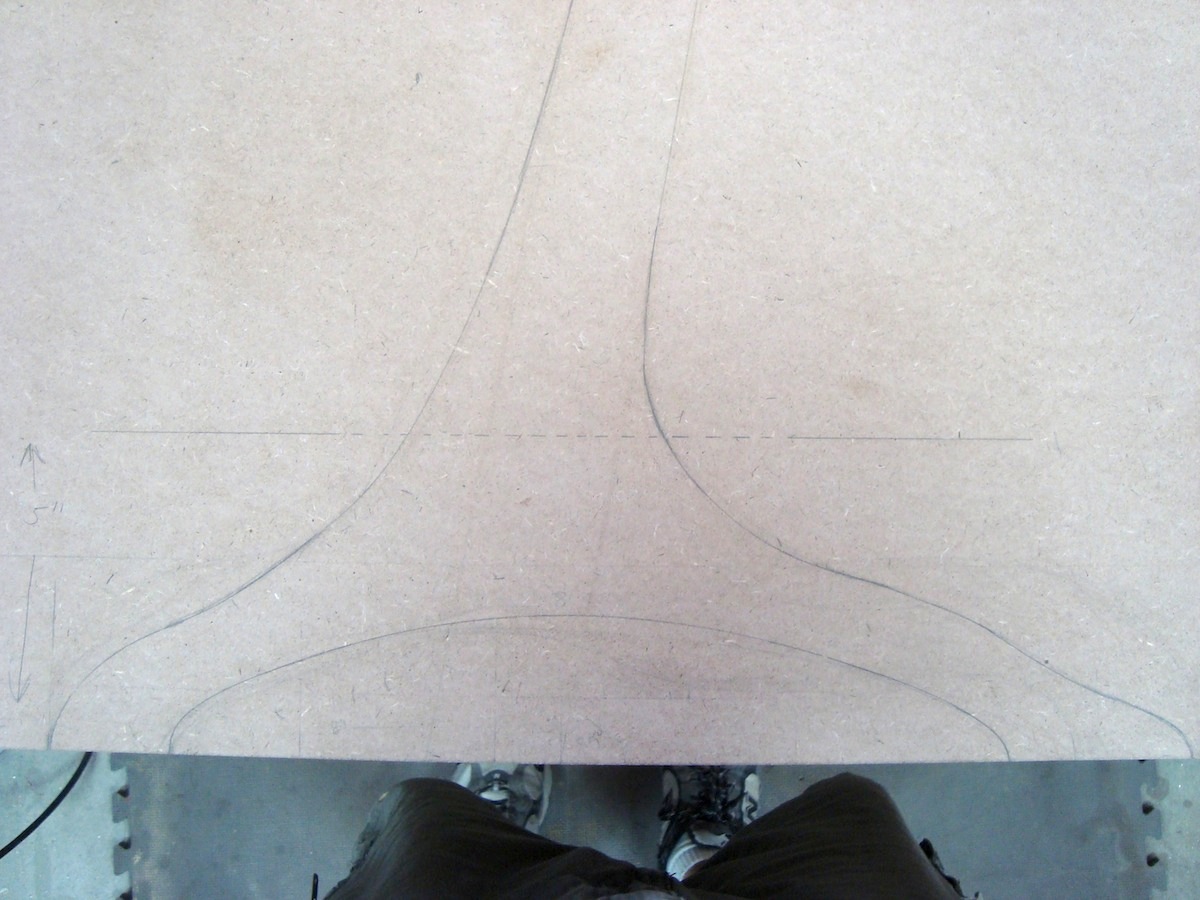
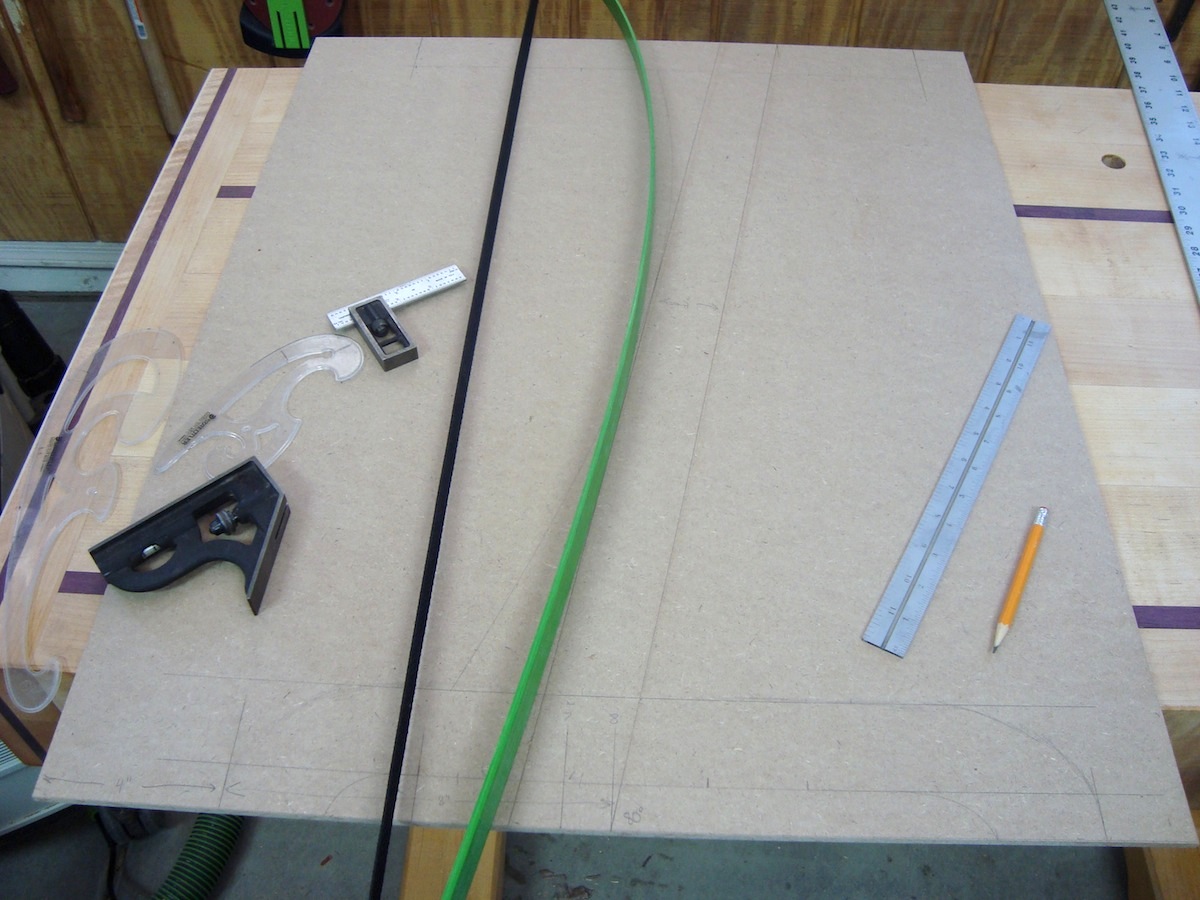
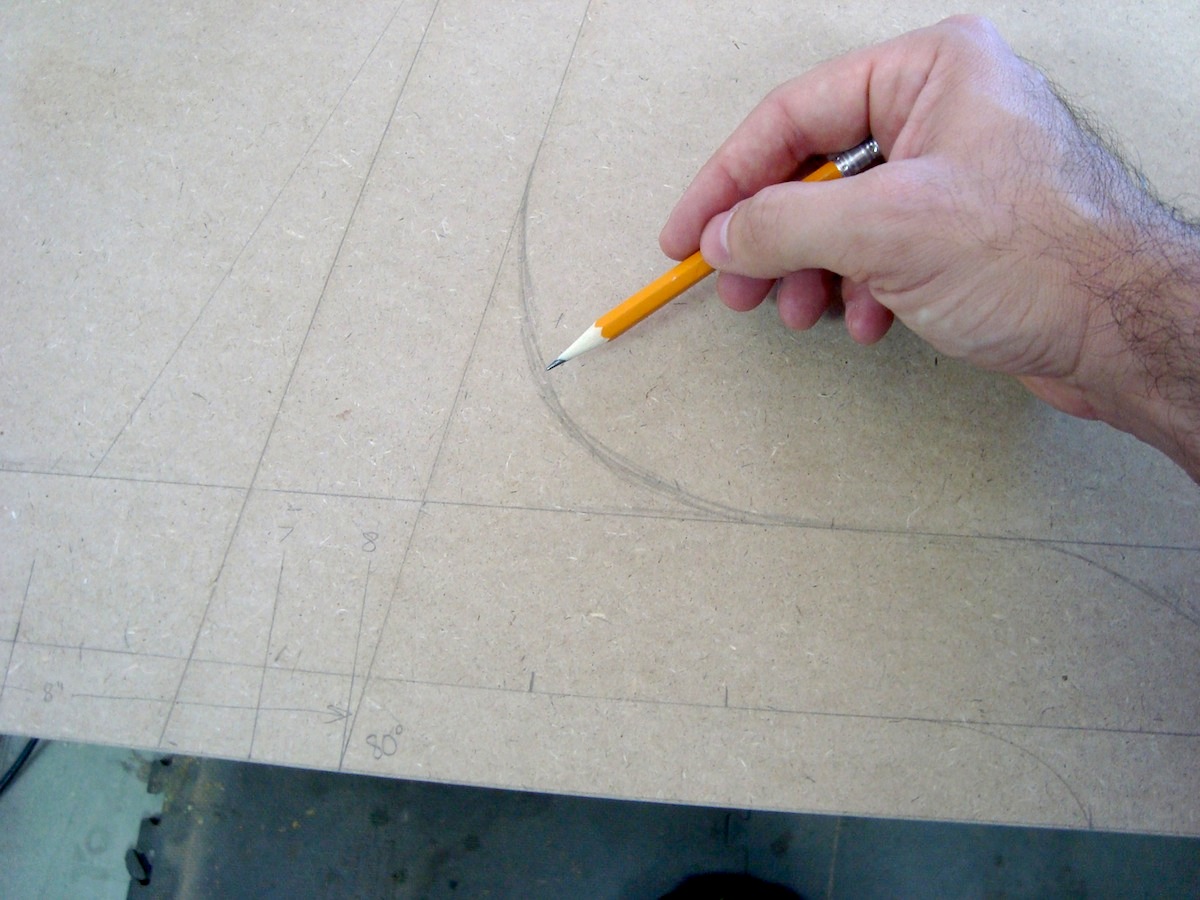
I started by sketching the basic shape and including my best guesses on the angles and widths. The angle I liked the best (for the vertical pieces) turned out to be 80 degrees. The next order of business was to start “roughing in” the curves. This is something I like to do completely by eye, using my original miniature sketch for reference. I make wide pencil strokes back and forth and essentially scribble the curve in place just as a basic starting point. I will step back every few seconds and even screw up my vision to get a better feel for the flow of the piece. Not sure if anyone else does that, but sometimes, a set of curves is hard for me to judge when looking at it with absolute clear vision. So I actually go just slightly cross-eyed, intentionally, to create a blurry view. And oddly enough, I tend to see things that my clear vision doesn’t allow me to see. Is that weird? It sure sounds weird to say it.

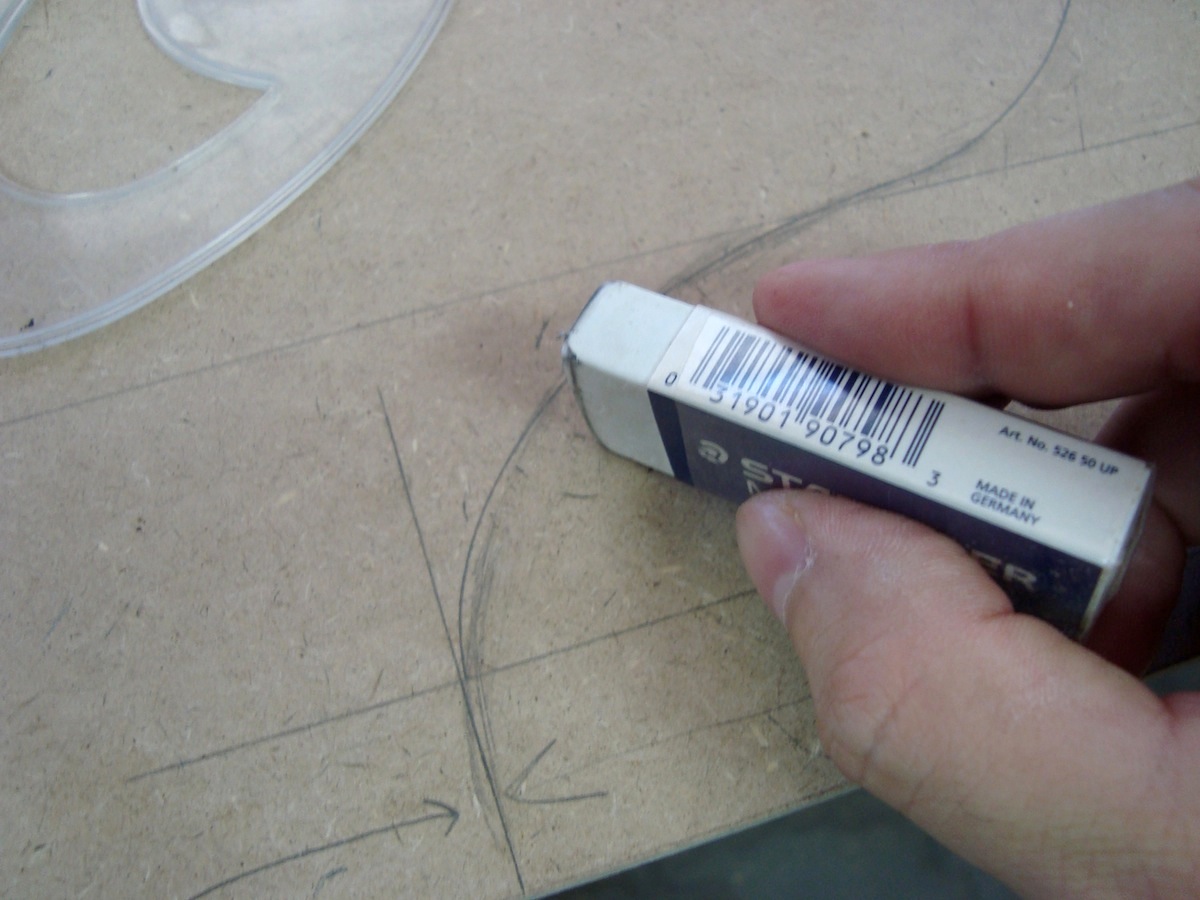
Well anyway, once the curves are roughed in, I’ll go back with my French curves to see if I can match them up with my existing scribbles. The French curve produces beautiful asymmetric curves, so if I can get a close approximation to what I drew by hand, I will simply trace a nice clean line right over my scribble. Then I go back and remove the scribble with an eraser.
The basic structure and curves are now in place and its time for the fun/hard part. You have to decide if you like what you see, and if not, figure out how to fix it. So I tinkered with some more ornate feet, which ultimately looked too busy and bulbous. That then led me to thin out the foot for a more delicate look. Now we’re on the right track! I started to trim things back all over at this point, including the top and the vertical support. All in all, the more slender look put a smile on my face. The shape is beginning to look like something out of nature with a dash of whimsy, which is exactly what I’m going for.
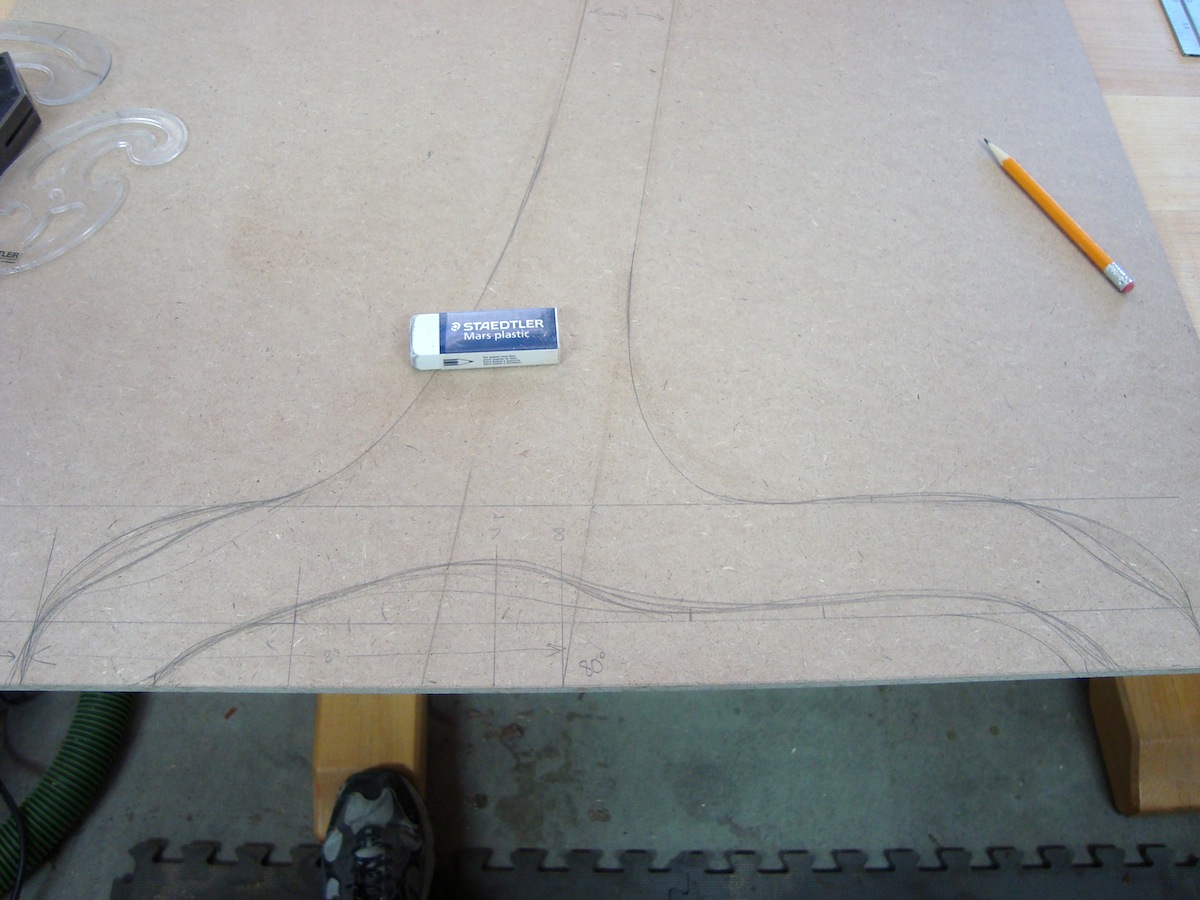
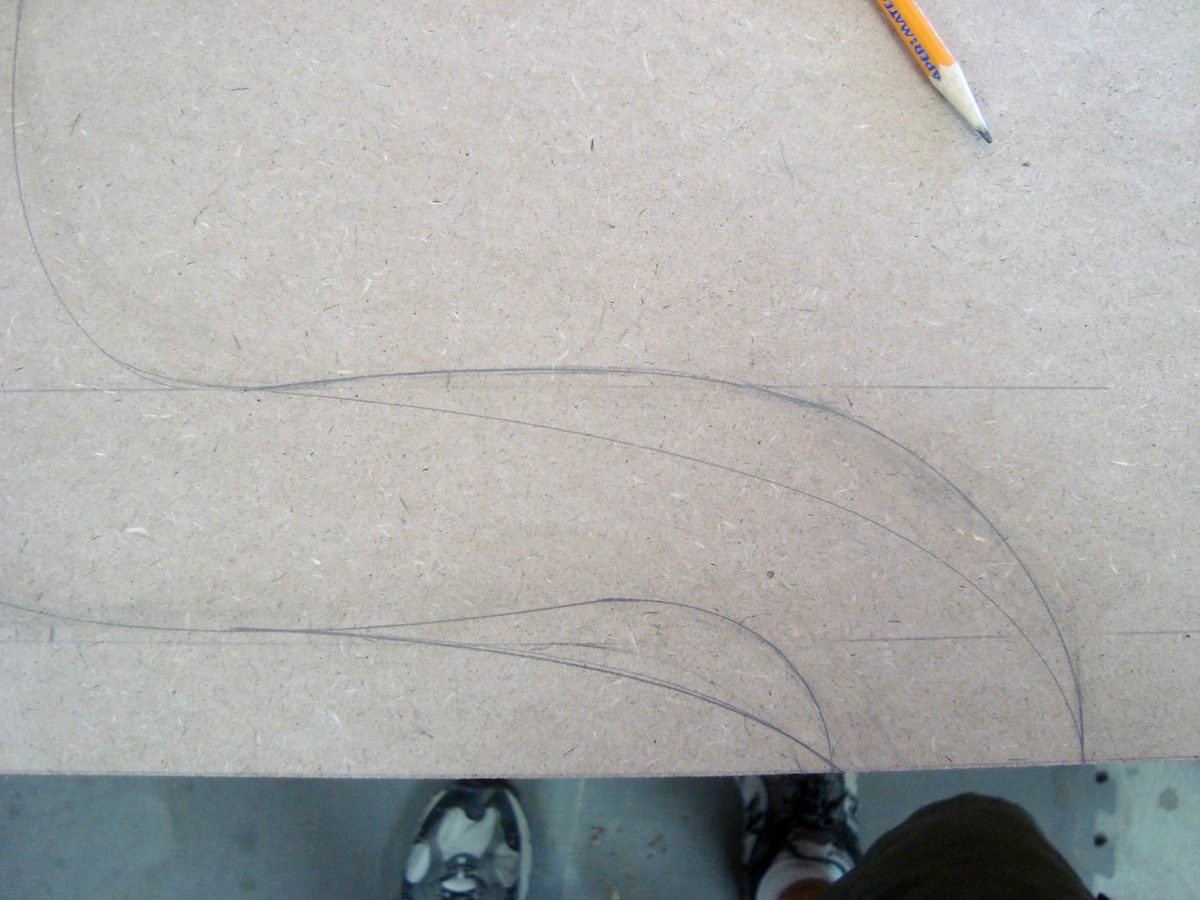
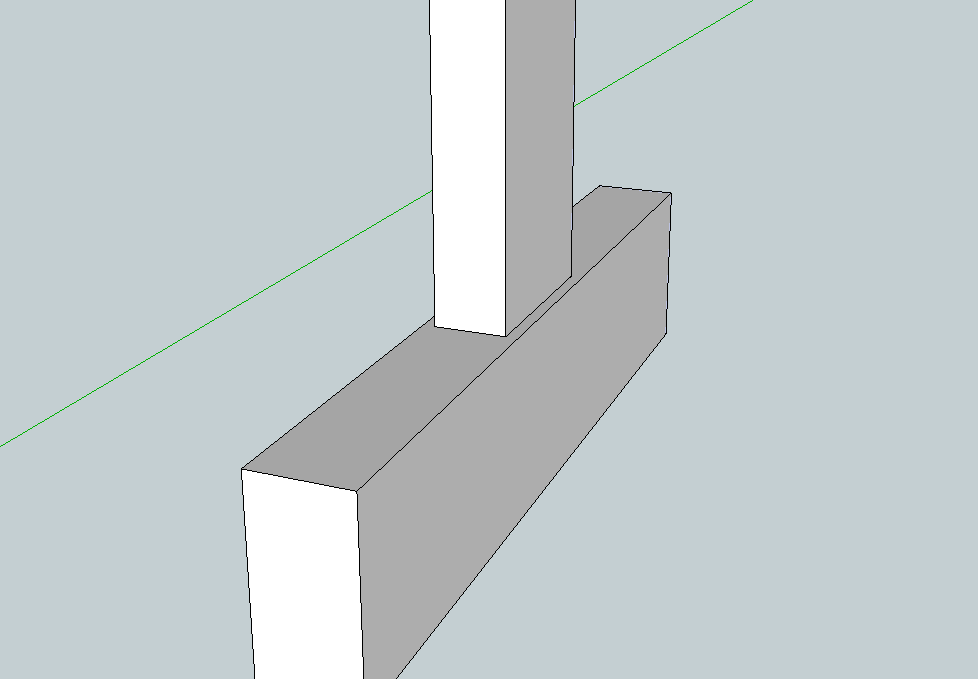
Now the next step was to begin thinking about how this form would come to be from actual square pieces of wood. I will most likely use 8/4 stock for the top and bottom supports, with 6/4 stock on the vertical pieces. So my goal is to not only blend the vertical pieces to the top and bottom with respect to the curves, I also want to blend them in terms of thickness. The Sketchup image below gives you an idea of what the rough pieces might look like before blending. Also, I should note that the joinery connecting everything together will be a mortise and tenon. I may even use the Domino to make my life easier. You’ll notice in the final picture below that I quickly sketched in the potential locations for the two cross-members. I’ll worry about those tomorrow.
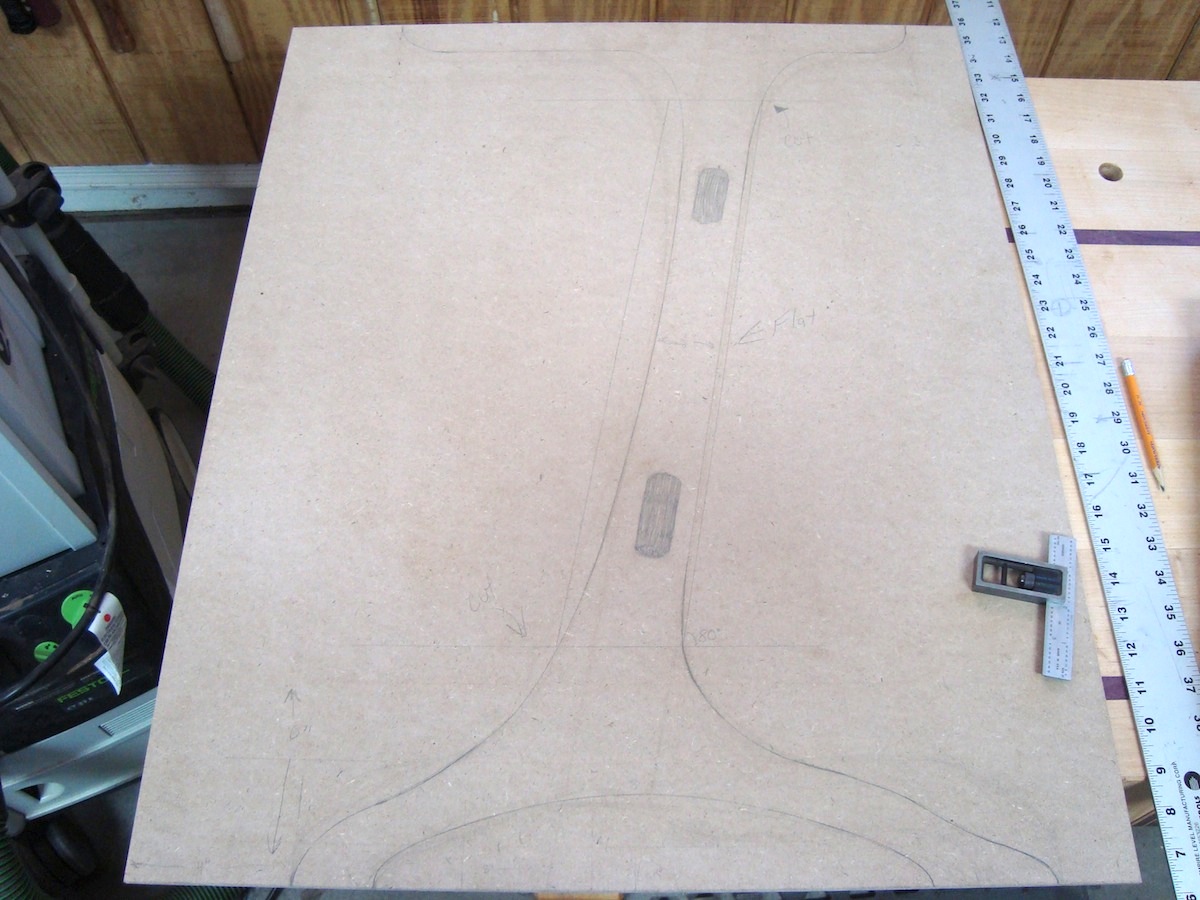
I can’t even begin to describe to you how subjective this part of the process is. As woodworkers, there are some things that we will almost universally agree look “off”. And there are surely things that we will all agree look “just right”. But everything else fits into that gray area, where its simply an expression of our personal taste. So don’t be too hard on yourself at this point. Its not easy going from a blank sheet of paper to an actual project. And don’t worry so much about making mistakes, that’s what erasers are for. I stared at the sketch for hours today, trying different curves, different feet, different thicknesses, and it was pretty clear that there would never be one right answer. I have a few more ideas and I really want to let this particular design “rest” overnight. Tomorrow I’ll look at it again with a fresh set of eyes and perhaps I’ll see something that wasn’t evident the day before. The next step will be to cut out my templates and make a prototype. I need to see this bad boy in 3D before going any further. And at some point here, I need to break out the video camera and start filming this episode. Wish me luck!

Recently I mentioned that this project might be a good candidate for a “design by committee” experiment. Well, once I started getting into the details with all the curves, I realized its actually a terrible candidate. If we attempt something like that in the future, its going to be on a project that’s a little more straight forward, not only in design but also function. I think I confused some people by calling it a gaming desk, when what I had in mind the whole time was a trestle table with no fancy storage. So we’ll do something like that soon, just not on this project.

Category: Shop Journal

Comments

  1. Rob September 21, 2010

    Mark,

    What’s your plan for the top? It sounds like it’ll be narrow and long. Hardwood edged Plywood? Breadboard edge?

    •  

      The plan at this point is a simple 4/4 top with a table-top roundover. Considering a shape that might support the wrists on the right side of each person’s position but not 100% on that.

      • Eoin October 20, 2010

        ” considering a shape that might support wrists on the right side of each position”
        Marc, just a quick suggestion for wrist/arm support. I made a small homework desk/study table for my goddaughter and put a tapered channel/groove for her forearm.
        It started as a mistake with an over enthuisatic hand plane and now its a major feature. The groove allows her to rest her arm from about mid forearm on. It might be over kill for a gaming table but it works for my god daughter.
        (so long as she doesn’t grow too tall)

  2. jersey mike September 20, 2010

    I love seeing your thought process. I’ve been doing something similar for my second little project. I was worried that I was overthinking things, but seeing you draw everything out and make constant changes makes me happy. I still may be overthinking my simple little table that has no curves or anything, but at least my process isn’t as off as I thought it might be. Thank you sir.

    •  

      Yeah man its definitely a lot of back and forth for me. And many times I have to dive into the project for lack of time, even when I am not 100% sure about the shape. This is going to be one of those cases. I need to start blocking out more time for these things.

  3. Paul wesley September 20, 2010

    You do like a curve don’t ya. Cheers Marc, I just finished a free standing book shelf for my son, it has lots of curves, I’d never have thought of that without you videos. It also has a bit of router inlay as per your video. Thanks. Paul.

  4. medfloat September 18, 2010

    Why does your sketch remind me of the USS Enterprise???

  5. John P September 18, 2010

    The organic flow of the leg assembly is very Maloof! What a fine tribute to the man. I should expect that you will bust out your rasp and shape the curve, right :P

  6. Hey Marc, I also like using the old pencil and paper routine. I will also use gal, quart, pint containers of paint, flat fender washers or whatever as templates for the curves. Mix and match Even use some of my wifes hair spray bottles. You can get very creative without using autocad or sketchup.

  7. matt rakowski September 18, 2010

    very nice design i cant wait to see more

  8. Vic September 18, 2010

    I don’t know if it’s normal, but when I’m sketching a curve, many times I find myself making the line fat and erasing to the curve. I have to do the out of focus thing quite a bit, too. I have NO idea why it helps, though, but it does.

  9. Brian September 18, 2010

    Looks good so far. Are the legs going to be 90 degrees to the top?

    •  

      With respect to which dimension of the top. I’m not 100% what you mean. Do you mean straight up and down (vertical)?

      • Brian September 18, 2010

        I’m not sure my last post worked but yes, I was curious if the legs would be plumb (vertical) or angled. I was kinda thinking it might give you a little more leg room, stability and would look great.

  10. medfloat September 17, 2010

    Just a few questions…You mentioned the 8/4 poplar, is that going to be your prototype wood? How are you fastening the top to the legs? What are the dimensions of the top?

    •  

      Yup, poplar for the prototype. And the dimensions of the top will be about 24″ deep by 92″ wide long. Having worked out the attachment to the top. But it could be as simple as screws in some oversized holes.

  11. Gary September 17, 2010

    Design looks good. Wood (lol) love to see some videos along the way.

  12. Karl_S September 17, 2010

    I also blur my vision when sketching things up. In the case of the legs, it gives you an idea of how you will see them when your eye is focused on the top. Think about 2 photos of the same subject. With the only difference being the depth of field, the one with a shorter depth blurs the items you are not interested in. Many beginning photographers take a picture and then loose their subject. Their depth of field is too great. It is what our eyes lick up, but not what our mind translates the image to be. By blurring your vision on your sketch, you are seeing what you would see when you focus on the top. You are seeing that part in better context to the whole.

  13. “Crossing your eyes” to get a different view of things makes perfect sense, in a kind of zen way… I do a similar thing by sort of squinting through one eye only, nearly closed. It’s a way of abstracting out the essential properties, or trying to see it the way you’d see it in your peripheral vision, or when you’re not really paying attention, to figure out if it works on that level, almost subconsciously… it’s actually a process I used to do in photography, to compose a shot… especially pre-digital, when you were more motivated to get it just right, because it took a week to see if it worked…

  14. Chad September 17, 2010

    Ah yes, the old squinty eyes technique, I use it all the time. Actually I have the (mis)fortune of being near sided so a lot of times I’ll just take off my glasses – instant blurry vision. The reason this practice works so well is that it diminishes the “known” elements from view so your right brain has a better chance against your left. You are basically evening the playing field since typically the left brain dominates (left brain = logical, analytical; right brain = spacial, creative). I’ll even do some of my broad sketching that way then go back and refine later. Nice design btw. I definitely like the more slender look.

    •  

      I knew there must be some scientific reason for it. Glad to hear I’m not nuts. :)

    • jlsmith September 17, 2010

      regarding squinting:
      When you squint you automatically remove lots of the color information and reduce the scene to simple shades. It a way of viewing the contrasting elements in the scene without being distracted by the color information.

      Regarding lateralization:
      Broad generalizations are often made in popular psychology about certain functions (eg. logic, creativity) being lateralised, that is, located in the right or left side of the brain. These ideas need to be treated carefully because the popular lateralizations are often distributed across both sides.[1]

      1.Westen et al. 2006 “Psychology: Australian and New Zealand edition” John Wiley p.107

      (http://en.wikipedia.org/wiki/L.....ten_2006-0)

  15. Derek Kest September 17, 2010

    I like that design. Curious though, having never really worked with odd curves. Do you build a prototype as you mentioned or a template and then a prototype?

    I know, newbie question, just curious.

    •  

      Well the template you see there actually is a prototype in and of itself. So once I make an actual prototype of the trestle support in wood, I’ll have a better idea of whether my prototype template can be used for the final project, or if I need to go back to the drawing board. If the design looks good, the prototype template gets an upgrade the to official template. :)

  16. Hey, you use a real pencil?? And I thought the guy in the interview said he was the ‘mere mortal’

    Looking great thus far though

  17. David Allred September 17, 2010

    I would love to see the design process in a video, I think all would benefit from it. I love the curves on the support and legs, not too busy.

  18. This is gonna be a good one Marc. I’m reminded of your side table from over a year ago. Definitely a Spagnuolo original. I’m with you on the sketching thing. It’s probably why I will never be a competent user of SketchUp because I just enjoy the tactile nature of sketching so much more. I remember reading several places that sketching increases your observational powers and deeply engrains a design into you so it has to be good for the build right?

  19. Darrel September 17, 2010

    I have a question along the same lines of Caleb.

    I’m wondering about the stresses on the wood. Do you have rules of thumb that you use for determining how much stress the wood can take? Especially on the cantilevered top. Someone putting weight on that while standing up will put quite a bit of strain on the joint at the back, correct? Will the species of wood that you choose effect that aspect of the design?

    That’s one thing that scares me is whether things I build will actually survive. Any advice you can give would be great.

    •  

      Well I am by no means a structural engineer so I can only take an educated guess and then observe the results. Now this isn’t exactly something I would want to build for a client, and then hope it doesn’t have problems down the line. But for my own personal furniture, I don’t mine being a guinea pig. After a few years, I’ll know a lot more about not only this design, but the mahogany used to make it. But until I have a bank of knowledge to rely on (or a more experienced builder’s advice), I will have to continue to experiment a bit and try to push the limits.
      That being said, I don’t feel that this particular design is pushing the limits all that much. I don’t really think I”ll have any particular problems over time. But, we shall see. :)

  20. Jerry S September 17, 2010

    I really like the look. How’s the schedule of this build working out? For me, this would not be a fast build. Can’t wait to see the prototype and what get tweak. I’m always amazed at how some things can look so different when compared to the paper drawings.
    I pictured that lower strecher as a foot rest also…I bet locating those stretchers is going to be the toughest part of the build. Good luck. I’m going to watch this one close…:)

  21. runningwood September 17, 2010

    Great educational description of you design process. I realize this is very early in the design but the last picture makes me think about a potential issue. If this trestle table is going to be used as a desk /table for computer use and gaming, I would strongly caution you about that low stretcher. If you are sitting at the keyboard with your legs stretched out in front of you, you really want full clearance under the desk. Unless it will be used as a footrest ?

    •  

      Actually, you touched on a really good point David. The bottom stretcher is indeed going to be used as a foot rest. If I don’t, I’ll have to clean the scuff marks off the wall from nicole’s cute little tootsies. So I am going to have to keep the low stretcher low enough for the foot rest, and the high stretcher high enough that it doesn’t become a knee banger. Definitely going to be a challenge to get that right. I think I will need to setup some sawhorses and 2×4′s to confirm before I make any final decisions.

  22. Gonna be tight!

  23. the imagination can more than physics and mathematics.

  24. Will Leingang September 17, 2010

    It’s as if Davinci blogged his thought process.

    •  

      haha someone’s fishing for a Guild membership! ;) You are too kind sir.

      • Will Leingang September 17, 2010

        trust me if I had the time to build any of the guild projects I would have bought a membership already.

        • mark williams September 17, 2010

          Hey Will,

          I have not had time to do a guild build yet, my membership is up in a month or two….I will be renewing! The depth of information has increased my skills on the small projects I do have time for! It is still worth it. Plus I am pretty sure that this winter I will build the shaker table, only a year late!!!!

          Mark

  25. Nicely coming along, Marc. While I’m eager to part of the design committee I’m also one to do my designs in seclusion to only my own satisfaction. So no sweat on doing this design by your lonesome. Let’s hope it makes a nice table.

  26. Chester September 17, 2010

    We’ll be watching!

  27. Mike Mader (http://mmader.com) September 17, 2010

    Looking good! I can’t wait to start seeing your design come alive!

  28. Caleb September 17, 2010

    Hi Marc,

    Looks like an awesome design and can’t wait to see it take shape. But when I design a project I have doubts about some of my design ideas due to the actual engineering/physics of the piece. For example, how when designing a project, do you ensure that,let’s say your 80 degree slant of your support combined with the width of your top won’t make the table tipsy (not that yours will be, just hypothetically speaking). Because sometimes the creativity of a design can take you places where it just wouldn’t creat a “structurally sound” piece. Maybe this is obvious for some but I find this dilemma holds me back from thinking a little bit more outside the box when designing a piece.

    Thanks and looks great!
    Caleb.

    •  

      Hey Caleb. That is definitely a valid concern. For this particular design, 80 degrees isn’t very far off from 90. And we know 90 works because that’s the basis of every trestle table in the world. So to help balance out the 80 angle, I moved the center piece forward a few inches, in almost a cantilevered arrangement. Now my gut tells me it will be fine. But I won’t have 100% confidence until I make a prototype. And frankly, that’s what I would recommend you do. If you are pushing the limits and you just can’t answer the question with a pencil and paper, you have to actually build it to test it thoroughly.

    • Caleb -

      The angle of the vertical piece is irrelevant, as far as tipping is concerned. A table will tip over as a function of two things:

      - The overall center of gravity
      - The width of the base.

      i.e. If in the end this design comes out the slightest bit tippy, Marc could easily compensate after the fact by filling the base with lead shot.

      The angled leg does become relevant when considering the strength of the joint. As the angle gets further and further from vertical, the downward force of the top starts to become a twisting force that will try to torque the tenons out of their mortises.

      All that said, integral tenons in 8/4 mahogany make this engineering overkill.

      • Rob September 21, 2010

        Don’t forget to consider any cross forces that could tip it over. A table can be balanced with the CG over the base, and if someone bumps it, it tips over. You’re right that the angled leg doesn’t really matter, as long as the top is generally aligned with the base. But for a computer desk, you’ve also got to plan for things like a dual LCD monitor stand that lets you swing the monitor back away from the edge oft eh table top.

        •  

          Well the good thing about this setup is that its going right against a wall. The weight of our arms plus the keyboard will be the only weight at the front, and the monitors will be focused primarily at the back. And give the 20″ span of the feet, I don’t expect to confront any tipping issues at all.

Leave a reply

XHTML: You can use these tags: <a href="" title=""> <abbr title=""> <acronym title=""> <b> <blockquote cite=""> <cite> <code> <del datetime=""> <em> <i> <q cite=""> <strike> <strong>

*

Online project based woodworking education.

3 Membership types

  • A la Carte
    Starting at $25/project
  • Subscription
    $129/year
  • Superfan Subscription
    $299/year
Learn more →

Simple Varnish Finish DVD

Coming Up


  • Live Guild Session

    May 21, 2013 - 3:00 pm MT
  • Thorsen House Tour w/ Darrell Peart

    May 23, 2013
  • Turning the Post Pt. 2

    May 24, 2013
clearvue-200x200
TWW_v6_200x200

Pressure Treated Wood Utility Poles for building structures, distribution or transmission.

bellforest200x200-tww10