This article was inspired by a question from Anthony. He writes:
Is it normal for a mixture of poly and mineral spirits to become like a jelly if its sitting around for about a month or two? I made a half and mixture and when I went to use it the other day it was useless. I guess it would be smarter to make as much as needed rather than making a larger batch?
Hey Anthony. When an oil-based finish turns to gel or starts to solidify in any way, that means its starting to cure in the can. This is a non-reversible process so its a good indicator that the finish should be disposed of. Oil-based finishes cure by oxidation, so the more fresh air the finish sees, the faster it will cure. There are a few things you can do to slow down this process and make your finish last longer, and they all involve minimizing the finishes exposure to oxygen.
Use Secondary Containers
Pour the finish you need into a cheap plastic food container, then put the lid right back on the can. This not only makes the finish last longer, but it prevents all kind of crap from getting back into the original supply. I find the best place to buy these is at the Dollar Store. They don’t need to be real high quality because you’ll be throwing them away sooner than later. So don’t buy the good stuff.
Give It A Squeeze
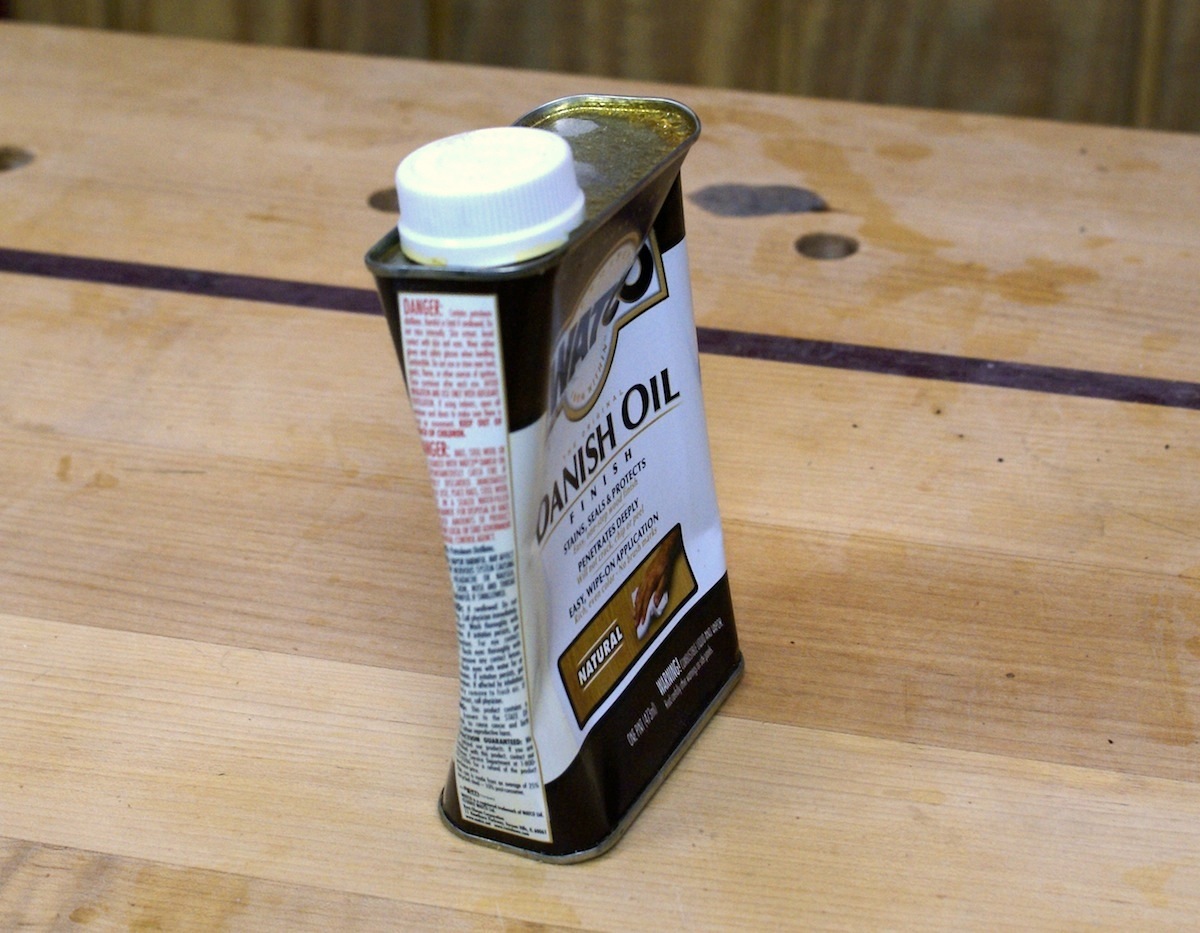
Some cans are thin enough that you can give them a little squeeze, and they will bend out of shape. Use this to your advantage. When you pour out some finish, carefully squeeze the can until the finish is near the lid, then pop the lid back on. If the liquid is near the lid, there just isn’t any room for oxygen to get into the can.
Don’t Lose Your Marbles
An old-school trick I heard about but never actually tried involves using marbles to raise the level of the finish in a can. Just drop individual marbles into a can of finish until the level of the liquid is near the top. When the finish is used up, clean the marbles with mineral spirits and reuse them later.
Use Bloxygen
Bloxygen is a very cool product that is quite effective at extending the life of your finishes. Its a spray can full of inert gas, which means its non-reactive, non-toxic and non-flammable. For you science nerds, the gas is argon, which is heavier than air. So a quick blast of the stuff into a can of finish will displace the air and create a bed of gas that won’t accelerate the curing of your finish.
I would love to hear some of your suggestions for extending the shelf life of finishes!



I wonder if companies will start selling finish in collapsible bags like they do with wine, to prevent any air from getting in.
http://www.scholle.com/applications/paints/
Marc, maybe you should start selling WoodWhisperer logo “bag-in-box” containers in your store! (I’m mostly joking.)
I can see it now, General Finishes Box-o-Varnish.
I’ve heard of people reusing containers that wine comes in (wine in a box) after thoroughly washing the wine residue from it. I’d probably use one that had white wine just in case I missed some. I wouldn’t want it to stain the finish.
I’ve used the marble trick several times with good results. You just have to be careful that they don’t roll out and splash all over the place!
The marble trick seems like it would be the easiest but if you wanted to use an inert gas, why not make it yourself. Use vinegar and baking soda. Here is a link to a video that can demonstrate it. Naturally, you wouldn’t want to pour it from the first bottle since you could accidentally pour some of the mixture in with it. http://www.break.com/index/gla.....usion.html
My preferred storage medium for custom mixed finishes (I also sometimes tint my oil based finishes with stain as well) are mason jars. They are cheap and usually found in your grocery store somewhere around where zip-loc bags are kept. These jars are usually used for jams and perserves, or for canning veggies and fruits. They can be bought individually or by the case. Here is a link to a source online (more so you can see a picture of what I mean) http://www.amazon.com/Ball-Wid.....d_sim_hi_4
The advantage is they can be reused when the finish runs out buy cleaning them with mineral spirits first then usually i run them through the dishwasher. If I am storing for any length of time I put them in a closed dark cabinet in case UV may effect the finish (coloring, or some other effect – especially where maintaining a color match with something in progress is important).
I keep a set of sticky labels (I just bought a pack of generic labels meant for inkjet printer) in the shop and stick on outside of jars saying something along lines of “1 part minwax Red Oak stain, 1 part BLO, 1 part Minwax Satun fast dry poly, 1 part Mineral spirits.” The mason jars also have a scale (in ounces I think) on the outside of the jar which aid in mixing your own finishes consistently each time. When I finish a jar during staining/finishing part of project it is easy to just remix the same mixture for subsequent coats and get a consistent result.
The Bloxygen Marc refers to last also sounds like a good idea to add to my shop to put some heavy inert gasses on top of any oil finishes that I have custom mixed.
That brings up a question for others. What brand stain finish do you guys prefer? I have up until recently been a user of Minwax because it is so easy to find in big box stores. Recently, though, since I have become a more regular follower of online woodworking media I have seen good stuff mentioned about General Finishes and Behlen products online. Fortunately there is a Woodcraft store nearby so there is not much of a hassle factor involved in getting those brands. Anyway curious what others think of the more “specialty store” only brands of finish.
Jim “Wood Warden” Woodward
Incidentally, I think this was a Tom’s Tips (not Lips) tip in a previous Wood Talk Online podcast episode.
So you mean that was’nt Jelly I put on my toast this morning?
Somewhat related to this topic is the cleaning of the brush. I have been freezing the brush in a ziplock bag after using and have been getting about 2 weeks of use before it begins to set up.
I have been following Marcs advice and using secondary containers. My finishes have lasted twice as long. Plus it is less messy.
I learned some time ago to store opened varnish cans upside down. That minimizes air infiltration since the product itself seals the can.
I’ve successfully stored paints and varnishes in their standard metal cans for up to several years by laying a sheet of Saran Wrap over the mouth of the can and pushing the center of it down into the can till it flattens out on the surface of the paint. Putting the lid on the can seals the edges in place, and no air can get down to the paint. It’s a bit messy when you open the can and pull out the plastic wrap, so it’s not for something you will be opening frequently.
DD
Someone told me that you can substitute rocks for marbles, is this true?
I suppose if they are clean rocks…….:)
I am no chemist but “Air” is roughly 3/4 Nitrogen, 1/5 Oxygen with Argon, CO2 and a number of other trace gasses. Oxygen is heavier than Nitrogen, so for all of the science nerds (who should already understand this) the only heavy compounds likely to displace the Oxygen are CO2 and Argon. In fact all of the compounds that make up Bloxygen are indeed all part of “Air”.
Sorry but I couldn’t help myself.
haha ok I stand corrected. Two of the three components in Bloxygen will displace Oxygen. :)
From what I read though, Argon seems to be the main component in the mix.
The bloxygen website (bloxygen.com) lists only argon as the contents in the can. I wonder if a cheaper substitute could be made using a mixture of the gases? It seems to me having a pure can of argon (or any gas for that matter) would require more processing than argon with CO2 or other inert gases mixed in…like maybe krypton. I would buy a can then just because it would be awesome to have a can of krypton gas in my shop.
Yeah what he said…
If argon does not affect the finish it seems that it would be a much heavier option than N2, CO2, and Ar combined.
If your going to bottle your own based on weight and price is no factor, I would go with sulfur hexaflouride SF6. It does crazy things to your voice as an added bonus.
For years I have used mason jars and a foodsaver. Foodsavers have a hose and an attachment that fits the top of wide mouth mason jars. When the foodsaver is activated all the air is “sucked” out of the jar and a nice seal is created. I currently have some Waterlox that is very old sitting in mason jars in my garage.
It works amazingly well, but you do have to purchase a Foodsaver to make it happen. I wouldnt recommend a cheap imitation.
If you create a vacuum it will probably cause some evaporation of the liquid. The most volatile liquid components would evaporate first (like alcohol). Might change the composition of the finish, so I’d be careful with a vacuum.
http://lumberjocks.com/topics/4001 – Scroll down a little and read Greg Wurst?s comments regarding the use of a can of compressed air in place of Bloxygen.
http://www.bloxygen.com/data.html – Bloxygen?s MSDS sheet shows that the only gas in Bloxygen is Argon.
http://www.bloxygen.com/BloxygenMSDS.pdf – ANSI compliant MSDS sheet for Bloxygen. Again, Argon is the only gas.
Bloxygen instructions if anyone is curious.
HOW DO YOU USE IT?
First, secure the extension tube into spray tip with twist motion
ALWAYS wear Safety Glasses.
Avoid splash…direct spray to side of container.
Hold container lid/top closely above opening of the container to capture the gas blanket.
Spray inside for 2 full seconds (quart size or less)
Spray inside for 4 full seconds (gallon size or more)
Replace lid on container immediately and capture the gas blanket. The gases now settle on the surface to prevent loss through drying and hardening.
Each can of BLOXYGEN provides over 150 seconds of protective gas.
I have an old can of Bloxygen that says the ingredients are Nitrogen, CO2, and Argon. But the new cans say only Argon. Looks like they either had a formulation change or something is now allowing them to state Argon as the only gas. I have an email out to the Bloxygen guy to get the low-down.
Quite a good system is to pour portions of the finish into dark glass bottles (I use wine and beer bottles – you can get a range of 750ml, 375 ml, 330ml and 275ml bottles in Australia and you get to drink the contents first!) and stopper them.
I put crown seals on the full bottles – you get them from the local home brew shop along with the kit to apply them.
Once a bottle is opened I use Vacuvin rubber stoppers which come with a vacuum pump to withdraw much of the air.
This works really well. Just remember to
1. wash the bottle well and let it dry thoroughly before use
2. remove the original label
3. put on a good label (and make a new one every time you fill a bottle). You cna mark when the finish was bought and when it was opened on the bottle so you can see how old your finish actually is.
PS a collection of plastic funnels is also helpful.
PPS using narrow necked bottles encourages the use of disposable containers for actually using the finish which is a desirable side benefit!
It seems to me that if you use marbles, you’d be rendering a good portion of your finish unusable. (i.e. everything that’s in between the marbles wouldn’t be accessible to your brush, and if you pour, a good portion would stick to the marbles). Doesn’t seem like it’d actually save all that much finish.
I prefer to store finish in smaller, tightly-sealed containers, so I don’t have to open a main container as frequently. (IOW, I make “working stocks”)
I’ve also heard that propane is a very cheap alternative to bloxygen. Sure it’s flammable, but so is the vapor that’s already inside your can of finish. Adding a different gas wouldn’t make it spontaneously combust or anything.
I have to say, though, that I really like the idea of using empty beer bottles and putting new sealed lids on them! Seems like a great way to buy in bulk and open individual bottles as needed.
Just to clear up the mud I created with the gas mix, here is the low-down from Steve Zawalick, Owner/CEO:
“Years ago, we did use a mix of gasses because we adopted this concept from the wine industry and there are flavor issues requiring (in some cases) a mix of gases. Now, however, we use only ultra pure argon. It’s the most heavy, most inert gas. It’s more rare and, therefore, more expensive, but canning the gas costs far more than the gas itself.”
Original post has been edited to reflect the actual composition of Bloxygen.
It’s just me but 10 bucks seems liked a bargin compared to all the wasted marbles….This sounds easier and time I get in the shop is rare…So I will be ordering some from Amazon (via TWW store) right after this.
while we are on the subject of saving our finishes… I just mixed some aniline dye and alcohol. I put it in a cleaned out glass apple sauce jar. Since its just alcohol and dye should I be able to keep it in the jar for a long time?
PS
I mixed up WAY more than I need.
As long as the jar is sealed tight, you should be ok storing it for quite some time in a cool dry place.
Hmmm I live in St Louis. There is no place cool or dry. I’ll have to work on that. Its so humid here, as soon as I opened the bag the dye bottle came in, the label on the bottle and the lid instantly turned from white to purple.
Thanks
My favourite finish is Polymerized tung oil and to store it I take the unused portion and put it in a Mason jar. After that, I just pour some water in the jar to bring the level up to the brim of the jar. The oil based finish will float and the water will sink to the bottom. All of the finish is usable and I don’t have to wash marbles.
In my opinion, this is the easiest/most cost effective way
One of the simplest and cheapest options I’ve heard of is just exhaling into the container right before sealing it closed. I’m sure it’s far from perfect, but everyone has a pair of CO2 machines working 24/7. If you want to get technical, maybe hold your breathe for a minute to raise CO2 concentration? Haven’t been doing it long enough or paying close enough attention to really gauge the effectiveness, perhaps I’ll start.
Dan has the right way, as far as I am comserned. cover the remainder of material with a plastic wrao material. I lay a layer on top oof the surface, and push the resr against the side. The material will stay normal for a few years, as long as You carefully cover the surface and the edges of the wrap pushed unto the side to trap all aiar.
I’m a little behind in keeping up with the boards, and this is probably my first post, but I thought I’d chime in. My background is technical theater, so there are lots of random tools and procedures in the shop and definitely far from traditional wood working. The welders use a gas mix called “Stargon” on the MIG machines. It is a mix of Argon, CO2 and Nitrogen. Not sure how much this would help anyone, but if you’re around any welder types see if you can siphon some off to try…I might.
Hi folks, sorry I haven’t contributed (except through Marc) earlier but if you have questions, I’m here. I own the Bloxygen product and patent. Reading all the writeups here, everyone gets the basic concept: get oxygen away from your oil based finishes. While a can of Bloxygen is $10 or so, it’ll last about 75 uses in quarts, making it about 13 cents per use. If you do finishing even once a month, this will last you over six years! Save your time and your money guys, this is simple and cheap. No need to re-engineer.
Why Argon? Because Argon is has all its electron shells filled, it is considered a nearly perfect inert gas. It is completely stable, heavy, and resistant to bonding or reacting with any other element. Career chemists just simply understand this, but larger coatings manufacturers have still gone to the trouble of testing Bloxygen, just to ensure that the argon we use is as pure as we say it is. Sherwin Williams, ICA, Behlen?s, ML Campbell, NASA, etc. have all tested and approved Bloxygen.
See our website for more or click the link and drop me a line. Thanks.
Folks,
Check out a new video we made that specifically addresses many of the issues here. It’s on our website (www.bloxygen.com) and it’s the “Finishing Best Practices” one.
Enjoy.
Steven
I have purchased some small (8 oz) cans with screw-on lids. When I purchase a quart of finish, I divide it, filling three cans and partially filling a fourth, top them off with Bloxygen, label the cans and put them away. I first work from the partially filled can. I have found that this works very well to maintain the workability of the finish. Have also used 8 oz. plastic containers; they seem to work just as well and allow you to squeeze out any air.
Jim
The collapsible foil bag idea is a great one. Someone from a finish company should jump all over it. Cheaper and lighter to ship empty and the box would be recyclable after use. A very green idea all the way around.
Thought this would be an appropriate place to ask this. How long can a can of stain last? I have leftovers from the previous owner of my home. We recently finished installing more oak doors. I would like to use this on the doors and our new vanity so it matches. It’s at least 9 years old. It mixed up after a while (crud on the bottom). It’s not thick or anything. Am I still safe to use this?
You should be fine. Easiest way to find out though is to stain a sample board and see if it dries. If its still wet or tacky after 24 hrs, you probably don’t want to use it.
Thanks for the reply! Its seems dry this afternoon and thats only 14hours after I stained it early this am. I did note some small circles….more like specks on some of the test piece. They were very dark. I dont recall them present when I applied the stain initially. They were still wet a few hours later and those spots wiped right off. Right now, its been about 14 hours. It feels dry, but if I rub a papertowl across it, it will discolor the towel slightly. Is this normal, even for new stain? Its not tacky at all, and feels dry. I am completely new at this so sorry for such basic questions.
If nothing else, I can at least use this old stain (on the new material) to show the store what I am after and can get some new stain to match. Don’t know if it matters but the brand is “Old Masters”.
Also, any idea when your book (I did the pre-order) will ship? That will certainly help with my newb questions :-)
Most oil-based stains are a mixtures of pigment/dye/boiled linseed oil, and thinner. So if the can isn’t all solid and chunky, its usually OK. the final test being if it actually dries. As long as the stain isn’t rubbing off easily and completely and the surface is dry, you should be fine to proceed with your topcoat. As for the book, we are still hoping for Mid-May.