If you guys are anything like me, woodworking is nearly always on your mind. Even when you’re out shopping or at dinner, you just can’t help but observe the woodwork that surrounds you. I even go to the extent of photographing things with my phone if I find them particularly inspiring, or funny, as the case may be. So I decided to start a new series of posts titled The Roaming Woodworker. There is no particular goal with this series, other than to share some of my observations. If we can get inspired or learn a lesson along the way, all the better!
Recently, Nicole and I took a little trip to Home Goods. “Quality brands at discount prices!” or some crap like that. As I followed exactly 3 paces behind Nicole, sipping my Dr. Pepper and enjoying a nice day dream, I began to notice a number of furniture pieces that caught my eye. Most of the pieces were painted MDF (snore), but there were a few noteworthy things.
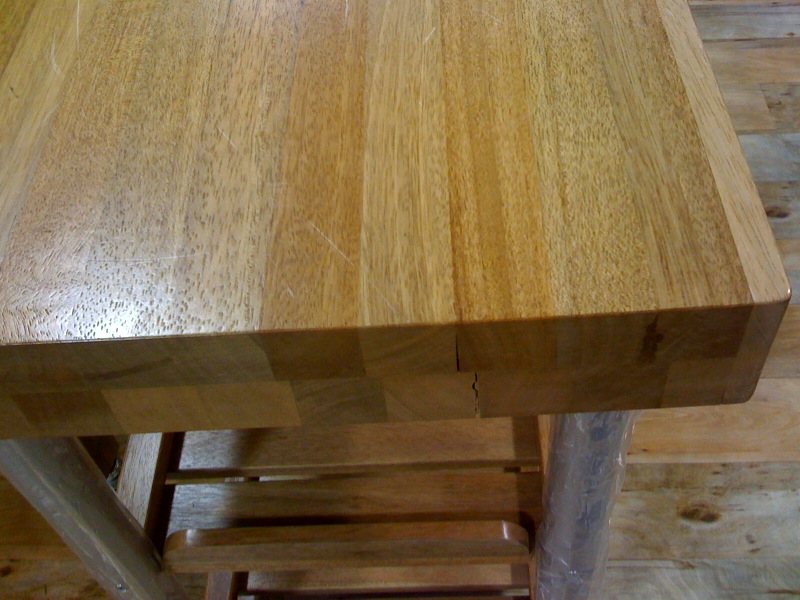
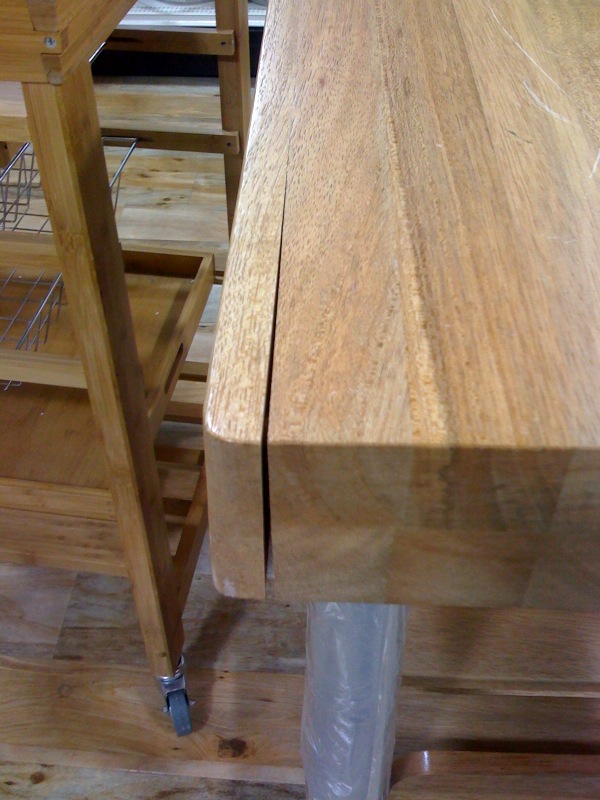
The first thing I saw was this cutting board/prep table made from a double layered glue up. Those are very lovely cracks. Wonder if they charge extra for that design feature? Notice that all cracks originate from the glue joints. Most times when I see a cutting board crack, it occurs along some weak point in the wood and NOT on the glue joint. Also notice the wide open pores in that wood? Salmonella anyone?
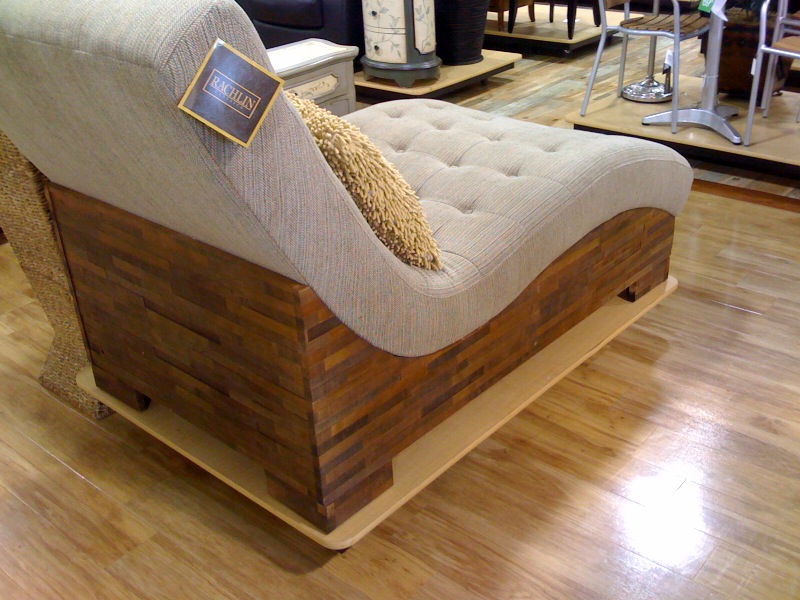
I thought this was a pretty neat chair. Its almost like the body was made from wooden Legos. I would be interested to see the glueup strategy that results in a design like that. Or maybe someone just glued it up one little piece at a time? haha!
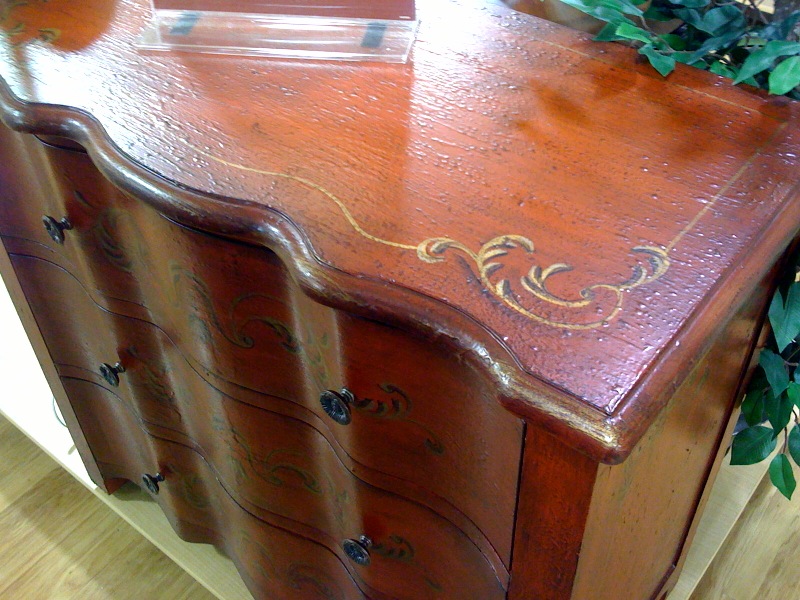
Something like this always amazes me. A nice chest of drawers with serpentine drawer fronts and a nice paint job. If I remember correctly, the price on this guy was $200. Can you imagine making that for only $200?? I couldn’t! There would be a significant amount of labor in the drawers, let alone creating the nifty bubbled finish. That’s the power of the manufacturing process I suppose. Inferior materials or not, its still pretty amazing.
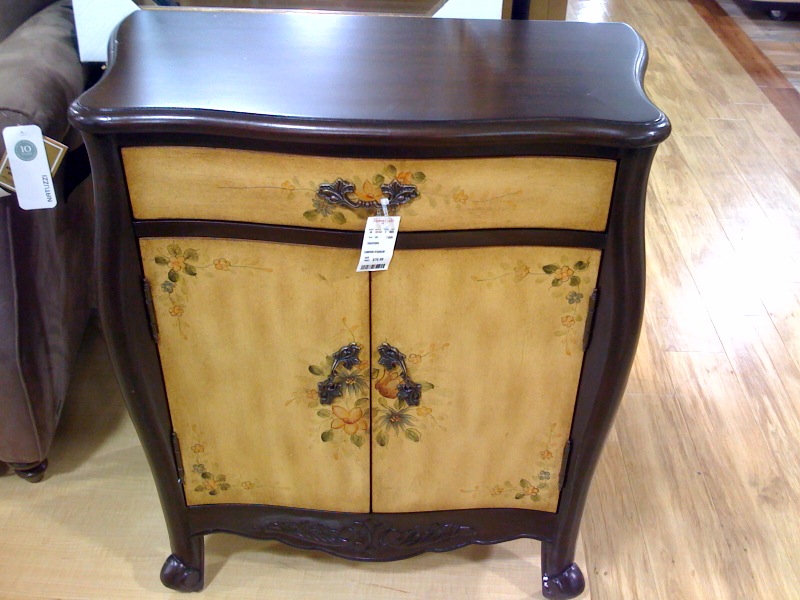
Not much to say about this one. I just really like the curves. The top, the drawer, and even the doors follow the same curved profile. Pretty.
Now THAT’S a butcher block!! And not just any butcher block either. A genuine Boos Block! I was actually very surprised to see this monster sitting there. If you’re not familiar with Boos Blocks, they are pretty much the standard in butcher blocks. Watch just about any show on the Food Network and you’ll see their boards in use. The $999 price tag actually seems pretty good since this style block runs about $1599 on the John Boos website.
This is one of those pieces that I like to stare at for a few minutes and ask myself, “How would I make that?” I don’t necessarily like the blunt and over-emphasized upturn of the top, but its fun to contemplate the construction challenges. Boy that top reminds me of something……..but I just can’t put my finger on it. :)




Marc, this was truly an inspired idea. My wife drags me to Home Goods all the time, and lacking your creativity I just find the most comfortable chair I can to nap in. Or maybe I just need a little Dr. Pepper kick to get me in the right frame of mind. Another store I really do get lots of ideas and inspiration from is a place called Arhaus (www.arhaus.com). Their designers roam the world’s flea markets and antique fairs looking for fresh ideas, so I figure I can let them do all the leg work for me, and borrow from the best of the best.
Cool pics Marc. Since I’ve been coming to this site, I can’t help but notice more about the wood around me … like entertainment centers most likely made from veneered plywood with edge banding rather than a solid piece. Never would have even thought of that before.
One thing I noticed from your pictures was the butcher block with two dark plugs in the middle of the block. I can’t figure out what they could be for since it looks like the block is solid wood throughout there so there isn’t anything to screw to? Any ideas?
And thanks for all the hard work you guys do to keep this place running!
Sorry I missed this question earlier man. Just caught it. Anyway, my guess with the plugs is that they cover a threaded rod. Many times big butcher blocks have a threaded rod running though them so they can be tightened down if thinks ever start to loosen up and separate.
Thanks, that makes sense. One day I’d like to make a butcher block like that. Really gorgeous stuff:)
Something about the clown just creeps me out Marc. lol. Who is the clown? I must be hanging around here too much because I see a slight resemblance to David Marks.
I also find myself staring at furniture and fixtures in a different way when out and about. I usually contemplate the construction and look for cool ideas.
I am in no way degrading Mr. Marks by the way. I just see slight resemblances in the face.
That’s Bozo the clown!!!! It’s time for the Grand….Prize….Game! I guess you had to grow up with him to get that :)
I’ve this ‘bad’ habbit to look under boardroom and meetingroom tables if I like them. I must see how they are made and if they are a large piece of ‘honest’ woodworking. There have been enough times I had to explain this behaviour to my hosts.
Nice idea to photograph with the mobile, never thought of that. Guess if I start to photograph in meetingrooms and boardrooms I’ll get nicked for business spionage ;-)
That clown is “Bozo”, Jason. Boy, I know I’m getting old when folks no longer recognize Bozo.
Interesting observations, Marc. I too evaluate and critique the woodworking I see around me. Just last night I was at a Ted’s Montana Grill restaurant. It features lots of wood paneling that actually looks pretty nice. The miters are far from air-tight, but nice nonetheless.
I like to look at a local unfinished furniture store. I’m seeing a lot of table tops made of short, glued up pieces. The ends of the pieces are spiked and fitted together. What kind of technique is this? Is is solid?
Whenever I see something like the piece with the cracks on display in a store, it makes me wonder what the other pieces they have of that item look like. Presumably they put out a good one for display. Then too, I wonder how a company that puts out goods like that can stay in business.
I’ve been to Home Goods several times and checked out the furniture. What surprised me was how thin everything is. You can probably take any of the drawers and/or doors and break them over your knee.
They do have some funky stuff, but I can’t say I’d want much of it in my house.
Dude, you wanna come over and work my side of the street? ;-)
I love the article. You can learn a lot just by observing the stuff around you. Who knows, all the ‘boo boos’ I make on my projects are well within the tolerances sold at that store – maybe I’m overqualified to build stuff for them!
I think as woodworkers we have a tendency to want to criticize and tear down mass produced furniture. I have a feeling most of these observations are valid but I still think it’s amazing what can be produced and sold so cheaply. I think most people don’t think or care much about quality and just live for the here and now.
Guys :
with regards to how cheaply things are made, in China, the average salary of a woodworking factory floor person is US$150 a month. The factory provides food and lodging (substandard for most part).
Experienced craftsman do not make more than US$350; and these factories are in the boonies anyway.
A professional engineering consultant at the top of his game in high tech makes about US$3000 at most, and that’s in Shanghai, where cost of living is close to what the major cities like New York and LA are commanding.
Go figure :-)
Regards
Tim TAN
And oh yes … the factory people work 7 day weeks. Every day they do not work, their wages are deducted accordingly.
Marc – my advice is skip the furniture stores and go straight to a pharmacy for eye drops for your eyes (your twitter pic).
Interesting field trip.
I would think the cracks in the chopping block are likely due to the combination of using improperly dried wood and low quality glue. And/or glue failure due to working in an unheated shop.
The “lego” chair looks like a good example of making use of scrap cut-offs. A case where materials are more costly than labor.
DD
I do exactly the same thing. We don’t have Home Goods where we live but we do have an Ashley furniture store. I always take pictures of pieces that inspire me and then I use the ideas for other stuff I make. I don’t look at furniture in the store so much. It depresses me. But I do look at the accent pieces and figure out how to do that on a lathe or something.
Good to see someone so young has already learned his place, i.e. three paces behind the wife. You’ll go far lad!
“already learned his place, i.e. three paces behind the wife. Youâ
A watchful eye sees inspiration wherever it goes.
Having said that, the difference between what you guys do, and what you see in these stores, down the road, is the difference between an heirloom piece and a garage sale item.
Marc,
This is a great idea, putting in photos of your observations, especially for those not living close to a “big box store”.
About the piece with the curled up edges – For a shop built
piece, you might curl the uprights out to form handles and
have the top built as a lift-off butlers tray.
Keep em comin’Marc, Jim Lynde, North Hollywood, CA
i do this too. my wife and i were killing time one day to pick up out daughter and went into a fine furniture store and were looking about…… with my phone…..and we were asked to leave this very swanky place. I guess they have this happen alot they said and were cracking down on the wood peep show. Three steps behind? i go with four so if she stops and i’m gawking i dont run her over and i’m only 27
Do you happen to know the manufacturer of their wood floor? It is truely beautiful and would like it for my home.
I read this article about a week ago. This past weekend I came across a beautiful game table in a coffee shop. It seemed very well done. I took some pictures of it (with some guy staring at me the whole time). The table had a checkerboard top that was removable and flipped over to be a backgammon board. The table top itself was s-curved to the corners, with two matching curved drawers in front of each player (assuming each player sits facing each other). It was very painted and very inlaid. It looked to have received lots of use so it seemed well built. Too bad we can’t post pictures on here…
Sounds interesting Ross! You can always post the picture in the Wood Talk Online Forum and then link to it here.