Join us tonight at 8pm Eastern for a live Wood Talk Online Radio with special guest Asa Christiana, Editor of Fine Woodworking Magazine! Click Here for the Live Page.

Sanding Too Much?

This question comes from Michael who asks:

“When sanding, I usually sand down to 400 grit. I saw one of your videos where you sand to 180 grit. Am I sanding too much?”

And my response:
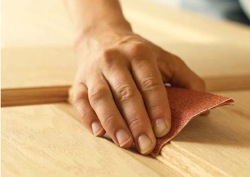
sandingHey Michael. In my opinion, yes. I believe that after 150-180 grit (on most woods), we have a case of diminishing returns. The whole idea with sanding the wood is not necessarily to get it as smmoth as glass. Rather, its to give the wood a clean, even, and scratch-free appearance. To be more accurate, there are always going to be scratches in the surface. But by sanding with the grain, or in a completely random pattern (as with a random orbit sander), your eye will never see them. And the number that I find removes all visible scratches is 180 grit. Sometimes I am even happy with 150, but I usually go to 180 just for good measure. Sanding up to 400 really isn’t going to give you a smoother finish in the end. Because after the first coat of finish is applied, you are no longer dealing with the raw wood. You are dealing with the finish. With sanding between each coat, you’ll have ample opportunity to smooth the surface to your liking. So that’s why I say make the wood look perfect, but don’t worry about it not being glass smooth. That’s what the finish is for. And just as an FYI, I usually increase my grits between each coat of finish. So I sand the bare wood to 180. After the first coat of finish dries, I sand with 320. 400 after the second coat. And 600 between every coat thereafter. On the final coat, depending on the look I am going for, I may buff the surface with 1000 or 2000 grit soft pads. This helps to smooth out any little dust nibs.

Now this is just what works for me. How far do you guys sand your projects?

Category: Techniques

Comments

  1. What are these “soft pads” you’re talking about? I’ve used 0000 steel wool between coats. What is the equivalent grit number of 0000 steel wool?

    •  
      thewoodwhisperer April 20, 2009

      Hey John. Something like this: http://www.festoolusa.com/prod.....92376.html

      I don’t know the exact grit equivalent of steel wood but its pretty high. Im just not a fan of steel wool.

    • Jason Buchta April 24, 2009

      you can also get the soft pads from Mirka. They range from 180-4000. I get mine from supergrit.com

  2. Germain April 20, 2009

    I agree with Marc; 180 for final sanding of the wood. Between coats of finish, I like to use 0000 steel wool.

    I also find it pays to buy quality sandpaper. The cheap stuff doesn’t last nearly as long which means it’s not really a good value.

    • Rob Horton April 20, 2009

      What is “quality” sandpaper? Brand names? or other means?

  3. Wilbur April 20, 2009

    This is interesting, as woodturners will sand woodturning projects up to crazy high grits (2000 grit sandpaper), and they swear that this level of sanding is necessary.

    This could be that the type of finish associated with finely made wood bowls, and other turned objects, is different than the type seen on a piece of furniture.

    • Dave April 20, 2009

      It might also be that they quite often sand across the grain instead of with it.

    • Peik April 20, 2009

      @Wilbur,
      Like Dave said, youll be going across the grain when sanding something on the lathe so you will need to go to a finer grit before you cant see the scratches

    • Brian April 21, 2009

      I took a class from a turner (Alan Batty) and his fresh turned surface was better than my sanded surface. Absolutely amazing. He was a professional turner so the less time spent on something the better. Also I worked at a custom cabinet shop and we sanded 100, 150, 220 and that was it. In between finish we would use 320.

  4. Ken April 20, 2009

    I tend to sand down to 220 on bare wood. My theory is the smother the wood to start (to a point) the better the look of the finish right of the bat. If I use shellac I use 0000 steel wool between coats. If I am using polly I usually use 220 grit paper or better a used 220 if I have one.

  5. Moriah April 20, 2009

    As a turner I sand to at least 600. I have heard a few times from other turners that the finish will only be as good as the surface you put it on. That could be totally wrong but I find it very difficult to not sand until it is perfect. If I spend that many hours on piece I don’t want my sanding to be what keeps it from being as good as I can possibly make it.

  6. Sven April 20, 2009

    Since I only use finishes based on linseed-oil I’ve to reach the targeted smoothness before applying the oil. Even after weeks of drying you’ll ruin your sandpaper with the first stroke on the stuff.

    Therefor sanding consumes a good part of my project. I usually start with 180 and go up to 600 or even 1000. With each grit I make two to three runs between which I wipe the surface with a barely wet sponge. This takes of the dust and erects the loose fibres on the surface, which would otherwise be erected by the finish.

    • Shaun Harper April 20, 2009

      I thought water based finishes raised the wood fibers. I didn’t think that was a problem with oil based finishes?

      •  
        thewoodwhisperer April 20, 2009

        Well, nothing raises the grain quite like water. But other finishes can still cause those little broken fibers to stick up and make the surface rough.

  7. Jacques April 20, 2009

    Depending on the mill marks I have left behind and/or the type of wood I am working with, I may go to 220 before finish but usually 180 is good. then up to 400 between coats and 600-800 on the final top coat.

  8. I agree with all above with one exception. At times I will sand end grain well beyond 180 so as to almost burnish the end and allow for more even staining. I guess you can get the same result with spraying the end grain with shellac but here’s another method.

    RJ

    • I agree with R J on the end grain. DW Shellac is great too, but depending on finish applied, shellac add one more step and can introduce sheen/color issues when topcoating.

  9. Cam April 20, 2009

    I generally sand to 220. However, this depends on the type of finish and wood I am using on a particular project. Especially when using an oil finish on cherry, I always sand to 320 then burnish all surfaces with 0000 steel wool. Burnishing makes a fairly dramatic difference final appearance because it lessens cherry’s tendency to splotch. This technique usually works well on other splotch prone woods.

  10. Dan April 20, 2009

    It depends on the wood, and the finish. And the size of the piece. The harder the wood, the more benefit I get from finer grits. If I’m working a wood as hard as cocobolo for an oil finish, I might sand up to 400 grit. Lignum vitae, I might go up to 600. For something like a knife handle, I might even polish it on a buffing wheel.
    If I’m going to varnish a wood like walnut or maple, 180 grit on the bare wood is fine. I’ll usually give it a couple of wash coats with thinned shellac before varnishing, and sand with 280 – 320 grit before varnishing. Then steel wool or 400 grit between coats. Steel wool can be messy, so it’s important to do it well away from everything, and tack rag it afterwards. But it is pretty good for getting into all the small places on complex surfaces.
    If I’m going to use a hand-rubbed finish, such as gun-stock oil or french polish, I’ll probably sand the wood up to 320 grit, whisker it with water and sand again before finishing.
    There are odd cases–such as classical guitar rosettes, where you simply can’t sand at all, with any grit, because it muddies up the colors. Then you have no choice but to use a very sharp scraper with a very light touch.

  11. Matt April 20, 2009

    I have been sanding to 220. I haven’t found any benefits above that.

    Between coats I like to use the norton sanding pads that are comparable to 0000 steel wool. But I like them better than steel wool because they don’t leave steel flecks on the surface. Some have said they lack the cutting power of steel wool, but I haven’t had a problem with them. If my project is flat enough I’ll cut the pads into a circle and place it on my velcro random orbit sander to buff between coats.

  12. John Daugherty April 20, 2009

    I sand to 220. I then go to 400 then 600 on the finish coats.

  13. So inbetween coats (of say shellac or poly) do people hand sand with the grain or use a ROS? Is there much of a difference?

    •  
      thewoodwhisperer April 20, 2009

      I always hand sand. A ROS is going to be a little bit aggressive and its all too easy to burn right through the finish. If you have micromesh pads, you can probably use the ROS.

  14. On Walnut where I want an ‘oiled finish’ look and Im not too worried about durabilty (lamps, jewelry box, etc.), I’ll go to 320. Then a couple wipe-on wipe-off coats of WATCO ‘Natural’ Danish Oil

  15. Sean April 21, 2009

    I have done quite a bit of autobody finish work, and have recently dove into woodworking.I know Festool is good stuff and they are a “system” and everything. But 3M makes a product called “Finishing film” that is probably cheaper and you can get it at most auto paint suppliers. Also Mirka makes a product called Abralon which is similar to the finishing film but is a mesh weave. I look forward to trying some of my surface prep knowledge on wood projects.

  16. Travis April 27, 2009

    +1 on sanding to 220 or so on flatwork. However, a few people have mentioned sanding on the lathe. In those cases, I will wet sand up to 800-1000, using mineral spirits. Works really really well.

  17. Anthony January 2, 2010

    I’m just starting to get into woodworking and I’m setting up shop right now (the wife said I can have our single car garage!!! woohoo) and was wondering how much I should spend on sandpaper. I think I will get 100, 150, 180, 220 and 320 grits. Anything beyond that I can pick up as projects need it. Thanks for all the posts on this topic people!

    •  
      thewoodwhisperer January 2, 2010

      Congrats on scoring the single car garage! That’s the first step. :)

      How much you spend on sandpaper depends on a number of factors. Brand, quality level, and quantity are three major ones. But as far as grits go, I would stock up on 80, 120, and 180. Then in automotive wet/dry, I would pick up 320 and 600 for sanding between coats of finish. I think that’s a good starter set.

      • Anthony January 2, 2010

        Excellent thanks for the advice!! Is there a difference between regular wet/dry and automotive wet/dry?

        •  
          thewoodwhisperer January 2, 2010

          Not that I know of. The black/gray stuff is usually wet/dry, regardless of whether its sold as an automotive material.

  18. Dennis Stickles February 16, 2010

    I was at the local woodworking store and one of the sales reps there was telling me to try out the micromesh. He said that he always sands up to 8000 and sometimes 12000. He showed me a board that was sanded up to 220 on one side and 12000 on the other. Both sides had one coat of matte, semi, and gloss applied in three separate areas. The 220 side looked dull, but no noticeable scratches. The wood on the 12000 side has a slight sheen to it before the finish was even applied and the applied finish really popped.

    It seems to me that sanding to 8000 or 12000 would not only take fooorrreeevvvveerrrrrrrrr, especially since he was telling me to go through 9 or 10 grits, but would also inhibit stain absorption. I may be wrong on this, but to polish wood aren

    •  
      thewoodwhisperer February 16, 2010

      Hey Dennis. You are absolutely right. Sanding the wood to that high of a grit results in a surface that doesn’t take up stain quite as well. The burnished surface also doesn’t provide a whole lot of “tooth” for the finish to bind to. Now since the surface was so polished, it already started shiny. Adding a single coat of finished to the polished surface, of course, will look better than a single coat on the 220 side. But that’s an unrealistic comparison. How would the two sides compare after 3-4 coats, which is more realistic for an actual project. If the coats were applied with care and with sanding in between, I’d be willing to bet my PM Custom that no one could tell which side was sanded to 12000 grit, and which one wasn’t.

      And for argument’s sake, lets say there was a very small difference between them, would it be enough to justify all the extra work? Not in my book. So I suppose if someone wants to take up sanding as a hobby, there is nothing wrong with it, ;). For me, its 180 and finish. But to each his own.

Leave a reply

XHTML: You can use these tags: <a href="" title=""> <abbr title=""> <acronym title=""> <b> <blockquote cite=""> <cite> <code> <del datetime=""> <em> <i> <q cite=""> <strike> <strong>

Coming Up


  • There are no upcoming events

  • Video: Flattening a Benchtop With a Router

    May 23, 2012
  • Wood Talk Online Radio

    May 23, 2012 - 5:00 pm MT
  • Adirondack Chair Class (William Ng School)

    June 4, 2012
  • Video: Turning a Tool Handle

    June 6, 2012
  • Woodworking in America (Pasadena)

    October 12, 2012

Live Shop Cams


Enter the live room →

Pressure Treated Wood Utility Poles for building structures, distribution or transmission.

Cliq Studios sell quality Kitchen Cabinets in a range of woods including cherry, oak and maple.


what wa