Interested in my new Hybrid Woodworking book? Sign up and be the first to know when pre-orders are open!

Safety is YOUR Responsibility, Or is it Theirs?

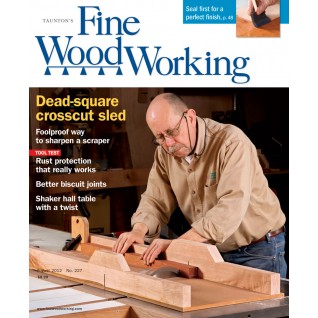
I have been a subscriber to all of the big woodworking magazines for years now. At least a few times a year, these magazines will publish a reader’s letter that castigates them for demonstrating some unsafe practice or another. In the October 2012 issue of Fine Woodworking Magazine, I read one such apology that sticks in my craw: “We should have insisted on hearing protection when we took this photo of Alan Turner.” The photo in question was featured on the cover of the previous issue (left) and it shows Alan making a cut with no hearing protection. One might also point out, if they were so inclined, that he’s wearing reading glasses instead of safety glasses and his sleeves are a little baggy.

Let’s Face the Facts

There are two truths that I think we should consider. First is the true dirty reality of shop safety. Whether most of us realize it or not, there are thousands of shops around the world where a crap-ton of woodworking gets done WITHOUT the standard safety equipment we generally consider mandatory. Of course I am not supporting unsafe work environments but they do exist. The second thing is that a person decked out in a half-mask respirator, ear muffs, and impact-resistant goggles doesn’t exactly make for the most attractive magazine cover. Should magazines be given a pass for things like this or should they be required to strictly adhere to all the best safety practices? Are we really supposed to believe that after nearly 40 years in this business, Fine Woodworking “accidentally” published these pictures? Or can we assume this was just a calculated risk for the sake of better-looking images?

Personal Protective Equipment

Of course I realize that these magazines are in the position of teaching people how to work wood and safety is certainly a major part of their responsibility. I think they do a great job of showing us the safest possible woodworking techniques. But when it comes to PPE (personal protective equipment), do they really need to be so strict? Should there be any allowance for common sense or for how some folks choose do things in their shops? Dust does not make your lungs happy. Wood slivers are not a welcome addition to your eyeballs. Loud sounds will hurt your ears. I’m going to go out on a limb here and say that if you don’t know these things, you probably aren’t ready to be in a wood shop in the first place without direct supervision.

Now don’t get me wrong, you folks know I’m a huge proponent of safety (heard of Safety Week?). I am certainly not condoning un-safe practices. I do my best to show the safest procedures in each and every piece of content I produce. I also know I have a lot of younger viewers/readers and it is incredibly important for me to set a good example when it comes to shop safety. But for things like woodworking videos and articles, which are just as much entertainment as they are education, is there a point where we should cut the publishers some slack? Do they constantly need to remind us about PPE, as if we aren’t aware of it? Are they being negligent if they put someone on the cover who isn’t wearing a full set of safety gear? Is it our responsibility to email them when they fail to include PPE in their photos, as if they aren’t already aware of it?

The Police

I have the highest respect for those who use proper grammar and I try to do so myself, but I have a strong distaste for “grammar police.” Similarly, I am a big believer in safety practices and I believe we should try to be as safe as possible in our shops, but I could do without the “safety police”, primarily when it comes to PPE. So my personal opinion is that we should indeed cut content-producers a little slack. Not to mention, while your email may result in a correction or apology, it probably won’t stop it from happening again. What are your thoughts on this?

Category: Musings

Comments

  1. I think whenever you take on the role of an educator, it’s your moral obligation to ensure that you are not promoting unsafe working practices. It doesn’t really matter whose responsibility it is when someone gets injured. Your moral obligation is your moral obligation, Period.

    If you see an injured child in the street, your morals tell you that you need to go help that child, right? The fact that the child is some other person’s responsibility is irrelevant.

    I think its especially bad when media removes safety devices for “photographic” purposes. People follow what they see more than what they hear or read. The reality is that they rarely put the devices back on when they are not filming/shooting. To me this sounds more like “I don’t use these devices and I don’t feeling like putting them back on for a few photos so I’ll say I left it off for photographic reasons.”

    PPE is personal only in personal settings. Once its on public display, it becomes instructional, whether a comment is made about it or not.

    On a final note, I think most of us share what we share not purely for monetary gain, but because we really want to contribute something meaningful to the woodworking community. So if for some reason I find out that I had contributed to an injury of another woodworker (even indirectly) then I would be pretty bummed about it. That’s why I would hold myself to higher safety standards when deciding to share.

  2. S Watson August 22, 2012

    Much like Cosmo, I heard they airbrushed it! My cousins friend heard from the girlfriend of the cameras mans ex-wife that he did have on noise canceling headphones! Yeah, but the wasn’t sexy enough so they airbrushed Brad Pitts ears onto the poor sap!

    Can you imagine how self conscious he must feel about his ears now! Gosh!

  3. jHop August 19, 2012

    One thing I would really like to see, and I don’t know how soon content providers can come up with this, is the Point of View shot. Not just from over the shoulder, or one from a camera duct taped to some guy’s hat, but an actual shot from the “eye position” of whoever is doing the work. Obviously, this would mean some staging, simply due to the logistics of getting a professional grade camera into the place where some human eye should be, while someone else has their hands clearly visible in the shot.

    (It would not be used on every photo montage, nor in every video, but in an instance where someone needs to see how it might look when you have aligned everything and are in the middle of the process, that would be the most effective use of this. In many ways, it’s like the flying camera in the NFL. Sure, you want to see more from it, but staring at the top of some guy’s head constantly gets pretty boring.)

  4. Jared August 19, 2012

    I side with Mark. What are you going to do if you get seriously injured while not wearing safety equipment? Sue a magazine stating that as your source of stupidity? Brings up a great annoyance I have with people in general on self responsibility. No one is responsible for your lost limbs or such except for you. Requiring companies to compensate for every mistake/accident someone has made is just silly. No need for Safety/Grammer/PC Police (aka Trolls) in this world.

    lol though McDonald’s was sued over hot coffee…

  5. Shannon August 19, 2012

    I agree with Marc, besides if everyone focused so much so on any one photogragh in a magazine it wouldn’t be possible to get through the magazine without that affecting your judgement of what’s in the magazine. If something in a picture affects you that so much to spur you to write an email to the creators, you should learn another safety practice, put it down and walk away from it, leave it alone.

  6. Doug August 18, 2012

    I used to do commercial photography for a “woodworking” magazine and the art director always made sure we adhered to safety. Even when we had no tools running, we were careful to show the shot as you would be doing it, so making sure ear/eye protection, no rings, short sleeve shirts, etc. With that being said, I think most of us would realize what we would do in that situation, and even if someone was unsafe that wouldn’t make us unsafe. However, there might be a few “newbies” out there that might not realize it, I don’t know, our society sure has become dumb-down lately, and everyone is looking for an excuse to sue or complain. I could see it now, lawsuit: “The cover of your magazine didn’t show hearing protection and I went deaf making that project so I want a million dollars”. UGH. Anyhow, keep up the great work, and worry less about “those” people.

  7. Alex August 17, 2012

    Always practice like you play. While it is fine to do whatever you want in your own shop, if you are instructing others or giving them a demonstration then you have an obligation to teach the best practices. If step one of the demonstration is always safety, then when a student goes out to the shop step one will still be safety. If someone ignores it then that is on them, but if you teach, you have an obligation to teach the best practices.

  8. Kim Duffy August 16, 2012

    I think that in the shop or out in the world, people just need to learn to stop blaming everyone else for their mistakes. I’m so sick of the government regulation on companies to make their products safer and pander to stupidity. It’s great that people have come up with technologies like SawStop, but at the end of the day, making fancy features required just puts hobbies like woodworking farther and farther out of reach of the average person. It’s already daunting to calculate the expense of amassing the collection of tools needed to be a hobbyist, let alone a professional. More bureaucracy just means that woodworking may be a lost art one day and we’ll all be relegated to garbage like Ikea.

    I’m sorry you have to be so PC about this, Mark.

    • John Verreault (aka JohnnyVee) August 20, 2012

      I agree with Kim, especially about the PC part. This has been taken to a level that I, unfortunately, see at my workplace all too often were bureaucracy reigns. Going overboard with any topic be it safety, power-tool vs hand tool only, VOCs vs no VOCs or anything else just takes time away from what we really want to be doing–woodworking. ‘Nough said.

  9. Kurt Thompson August 15, 2012

    I 100% agree with you Marc. I think FWW magazine does a good job of balancing the needs of making an attractive cover with safety and clarity of what they are trying to explain. I often see references to appropriate safety equipment and don’t think they need to change.

    Most of the time I hear people complain about not using a particular type of safety gear or safe practice it is because they say it slows them down. For me this is just a hobby I do for fun, so it doesn’t matter whether a project takes 2 days or 2 weeks. It might take me twice as long as a friend to rip some boards because I carefully adjust my riving knife while he just removes it, but I don’t see that as time wasted. If I’m having fun in the shop and I come out with all 10 fingers, I’m happy. It doesn’t matter how fast I complete projects – there’s always another one waiting for me no matter how fast I complete them.

    For a professional it makes sense that they need to weight the risks of skipping safety with the reward of completing projects quickly enough to make a profit. For hobbyists, I see no downside in spending more effort on safety.

  10. Callum August 15, 2012

    Generally speaking, ‘common sense’ is just a disguise for experience. Train the inexperienced in the safest way to accomplish a task, and then let them make their own choice – - it’s how we innovate.

    Then we should require all lawyers, judges, and jurors to be weekend woodworkers, loggers, or maybe just coffee drinkers…?

  11. bob August 13, 2012

    By observation everyone here knows what to do to prevent accidents. “So why is it that 35,000 injuries that involve table saws in an average year works out to $57,000 per injury. ” (quote from FWW Feb 12, 2011)

    People don’t listen and people do not want to be told what to do. So those woundering where this regulation attempt is coming from read the following and see that they say The regulation is for.

    OSHA wants more control I know this first hand from dealing with them for 20 years.

    CPSC states that existing Occupational Safety and Health Administration (OSHA) regulations on table saw safety do not adequately protect consumers, because they are directed to saw use in a professional woodworking environment.
    “Professional woodworkers are more likely to have had training and to be experienced in performing any special or complex operations with the saw and are more likely to recognize situations and set-ups that may be dangerous or require extra care and caution,” states CPSC’s notice. “Amateur woodworkers generally have little or no safety training, nor training in the proper use of the table saw.”

    • bob August 13, 2012

      By the way I used a table saw for 11 years before making my index finger 1/4″ smaller and had countless hours of safety traing and it was my choice to not use a push stick (wish I did now). So my answer is “S&!t Happens” deal with it and don’t blame anyone but yourself. BUT! If it was due to faulty equipment or missing guards and your choice is “use it or be fired” and you are injured. Then yes sew the boss (.)

  12. Kevin Fermenick August 13, 2012

    When I read Marc’s article, I groaned. Safety is everyone’s responsibility; meaning YOU! My personal two cents on the saw blade stop legislation, for example, is that we don’t need it. Simply keep your fingers out of the blade and you will stay okay. Then do what you need to do to keep them out the blade. Period. Paying attention is often enough.

    As to the FWW article. I have that issue and noticed the safety equipment displayed in photos as lacking uniformity. For example, the chairmaking article on p. 64 has the woodworker wearing ear plugs and over the glasses, safety glasses, while using a router, at the top of p. 67. Yet on p. 68, while using a band saw, he is wearing neither. The rust remover guy, p. 30 is wearing rubber gloves but no eye protection. The sanding sealer guy, p. 48 is wearing no gloves, but wears those Subway sandwich shop clear gloves on pp. 50-51. I could go on, but you get the point.

    I guess you could say there is a lack of consistency. So bashing the crosscut sled guy is a bit unfair (at least he rolled up his sleeves a bit ;-). I can appreciate the comments from the impressionable younger woodworkers, but just because we are not steel fabricators does not mean our hobby/profession is without risk. Some accept more risk than others. Some know the risk and compensate. Others are careless and lucky. Then there are the careless and unlucky. It is everyone’s duty to learn the risk. Just because someone makes it look easy doesn’t make it easy. You can’t blame someone else for your short circuiting your knowledge curve.

    One last point. Perhaps every article in every magazine and on every video and TV show, could have a universal disclaimer such as required by California that would read something along the line of “In accordance with Proposition 68 everything you do in life has risk and hazards. Breathe at your own risk.”

  13. I am new to wood working and a lot of what I am learning comes from web sites and magazines. I am 30 years old but still consider myself very impressionable by what I see around me – luckily watching Marcs videos has taught me to use ear defenders, respirators and glasses. However, knowing me if I had seen that picture / article first then I probably would be without them!

    I learnt the hard way about kick back at the table saw and now using the riving knife and blocks so i dont trap the wood against the blade – my bruised stomach thanks me for it now!

    Overall I agree, its totally down to the user at the end of the day – we’re all adults here! some younger than others ;-)

  14. Never considered using ear protection on a table saw cut. Router –planer and joiner yes but never thought I needed it for table saws. 30 years of working with wood and still can hear good.

  15. S.Wellington August 12, 2012

    Wow, This topic kicked up a firestorm :) I agree that safety is a personal issue, Like others, I don’t use the pawls on my table saw, or use a mask all the time. Mostly when sanding. I use the ear protection when I think it’s needed like with my planer. Common sense seems to be a common thread in safety. I don’t think too many people will take their mask or face shield off because the guy on Fine woodworking doesn’t use them. I recently have been watching videos on YouTube about bowls on the lathe. Every once in a while I would get a video where the guy or gal would spend an extra 5 min on wearing the correct safety stuff. I would try and fast forward to get to the good stuff. To each his own. If a person gets dinged, it’s usually because he wasn’t paying attention! Being slow and methodical can be as important as all the safety gear we wear!

  16. Chris M August 11, 2012

    I firmly believe that everyone has a right to choose their own level of risk in life. I also believe publications have a responsibility to encourage safe practices in woodworking and I appreciate the publishers that are diligent in this regard. I am more likely to continue my subscription to those magazines…and they are the ones I will encourage my children to read. Each reader has a right to complain (the editors encourage the feedback) and the publisher has the right to ignore them. I don’t see a problem.

  17. Tim W August 11, 2012

    The short and long of it is this, it is your responsibility to make your own wise choices. If I see that cover that doesn’t make me think “Hey, if he’s not using it why should I?”. I think that this day in age people are just looking for an excuse to point fingers. There is no sense of personal accountability for your own actions any more.

    I have been reading these magazines for years and I can’t think of a time where the safety of a cut wasn’t stressed by the author. If you choose not to use a guard, push stick, goggles or hearing protection that is your choice. Nobody is twisting your arm, so if something happens it is you that lives with it. And besides, every tool comes with a manual, typically, and the first page does nothing but tell you what not to do with that tool.

  18. I’ve not read all the replies so this may have already been coverd. The cover photo on the magazine is from a photo shoot, it was staged to show off the sled not PPE. Now IF the photo was a capture from a video of him making the cut, that is another thing. If the person who wrote in could have seen this man’s shoes he probably would have complained that they were not steel toe work boots. Or (going on the apparent age of the “model”) they would complain that he is wearing pants with cuffs that could catch a hot ember while sharpening a drill bit.

    Magazines, “teaching/instructional/show and tell” websites etc all have to play the liability game. You hear the disclaimers a lot, safety guards have been removed for clarity, never disable your equipments safety features. It is because some maroon will see something and assume they can do it as they saw it and then sue because they have lost their hearing or a finger etc etc.

    I was an aircraft crew chief in the Air Force many moons ago. They beat safety into our heads on a daily basis. But there were times when some things were done way outside the lines in the name of mission readiness. I still remember the day a supervisor pushed me out of the way and removed a liquid oxygen converter without any PPE as we were about to lose an aircraft sortie. Anytime I was on the flightline side of the offices in our hanger I was wearing my hearing protection. I love jet noise but it hates ears. Even with protection and sometimes that was plugs and earmuffs, I am nearing hearing aide time. It happens!

    Sadly too many are sue happy! If I remove a safety feature and get hurt, my bad. It is no ones fault but my own. But there are some that would sue because they should have made the safety feature so that it could not be removed.

    Well, I am off to remove the tags from my mattress. Have a great and safe day!

  19. TexasTed August 11, 2012

    Too many woodworkers have found out, after the fact, that PPE would have saved eyesight and hearing, and prevented unsightly scars. I have to wonder if those woodworkers became PPE advocates or not, after the fact?

  20. CessnapilotBarry August 10, 2012

    Put me in the “personal” camp, no apology from FWW necessary.

  21. Tom Collins August 10, 2012

    I totally agree with you. I am getting sick and tired of super polite apologetic responses like the one Fine Woodworking gave. They should have just said that often photos in their magazine do not include PPE for clarity and aesthetic reasons

  22. Cal August 10, 2012

    What seems often to be lost in these knee-jerk criticisms is a lack of understanding of the basic risk. In this case, hearing loss risk is three-dimensional. Those risk factors are intensity (volume), duration, and frequency. I know that in my own case I wear almost always hearing protection for certain tools that are exceptionally loud: planer, jointer, and (sadly) random orbital sander. My table saw falls somewhere in the mid-range as far as decibel level is concerned, and my dust collector is housed in an enclosed space for exactly this reason.

    Therefore, if I were making this 30-second cut (the duration factor) on a cross-cut sled on my table saw, I would wear eye protection, but I probably wouldn’t wear hearing protection or dust protection. On the other hand, if I’m going to be spending fifteen minutes breaking down sheet goods or ripping solid lumber, my head is going to be encased in protective gear of all sorts.

    Eye protection provides a counterpoint to hearing protection and dust protection in that the safety risk is not diminished by duration; therefore, it is always de rigeur.

    The difference is whether the risk is acute/immediate or chronic/cumulative. Protecting your eyes and keeping clothing and body parts away from moving parts are the former. Hearing and dust protection are the latter.

  23. Greg August 10, 2012

    I keep in mind that there are new woodworkers coming on board all of the time, so I feel a friendly reminder is always great. I enjoy safety week and continually learn. There is a saying, “there cannot be enough safety.” I do not feel it is my responsibility to notify magazines of issues of safety. They have been around a long time and if they are willing to accept the liability then they know or should have known (as disclosed by the wood police civil litigation).
    I always think of safety instruction as a warninig; however, if you do not adhere to the instruction then the end result is yours.
    Safety may be compared as abusing drugs. Our society can continually disclose the results of drug/alcohol abuse, but if you still want to get involved then the results and rehabilitation should be at the expense and consequences of the user.

  24. that’s what happens when a country is run by lawyers.

  25. BigStick August 10, 2012

    It’s amazing that the magazine that promotes hand tools get criticized for a picture of a power tool. This country is so over regulated with rules, the real terror is not over seas its in our back yard. You just can’t change stupid, but you can try to make some one else pay for your stupidity. Thank god we built this country with much less and did it with great effort and skills.

    • bob August 10, 2012

      There you go!

  26. Lanny Penwell August 10, 2012

    Live free or die.

  27. bob August 10, 2012

    “That’s why ladders have details instructions and contents may be hot!” I agree to a point but the law needs to step back in some of these matters and place the blame where it truly belongs and that’s the individual.

  28. Allen, I totally agree – and as a Security Officer for a company I totally understand the need for rules and regulations. That’s why we long for the weekends :-)

  29. Allen Fisher August 10, 2012

    My feelings on safety and PPE mirror yours, but in my work life, as a Lab Manager, I am charged with being the Safety Nazi – this is not a part of my job description that I enjoy, though working with a good number of young engineers who have not had as much hands on training we find it important to be vigilant.

  30. It is truely a personal thing. Personally I believe that if you use all the safety features then there is a tendency to become complaicent – that’s when real injuries happen. But there are people out there that are plain dangerous and they need help and guidance. That’s why ladders have details instuctions and contents may be hot!

    Unfortunately common sense is not that comon.
    Listen to that still small voice – if the action you are about to do – does not ‘feel’ safe don’t do it.

  31. I agree, safety is solely my responsibility in my shop. It is my job to read the instructions that come with my tools and to understand the risks of using each and every tool in my shop. If I choose to not use a piece of safety equipment, for whatever reason, it is MY responsibility. If I get injured as a result, it is MY fault.

  32. bob August 10, 2012

    Four letters, OSHA being safe is one thing being the gestapo is another. Over regulation is as bad as no regulations because people tend to Reilly on being watched over. We are born with the ability to perceive danger. I myself have had a serious accident and have no one to blame but me, accountability for ones own actions seems to never be mentioned in safety articles .

  33. David Haniquet August 10, 2012

    Do you jump into water if you don’t know how to swim?……………do you jump off of a building if you don’t know how to fly? Ok maybe………if you are a child and don;t know any better, but even most toddlers instinctively know better . If you don’t know that power tools can be dangerous if not used properly, time to hang up the apron…………….It is each persons prerogative to use or not use safety equipment…………This is what makes us American.

  34. Rich Dickeson August 10, 2012

    I agree with Don C. and Mike Rowe with Safety Third. I have worked around equipment that could tear me to shreds since I was 18. Before OSHA, before safety equipment and was taught to think and observe. I also worked with someone missing 2 fingers doing the same kind of machine shop work I was doing and it ALWAYS made me think about what I was going to turn on and how it was held or chucked in place.
    I also learned that when I was tried, to stop working. When I was distracted, not to start something. When the phone rang, not to answer it, but to stay focused.

    If someone else is looking out for my safety and I get TOO comfortable with that, I believe that is when I begin to loose focus and get careless.

    But I also don’t do dumb things. I don’t inhale fumes that will hurt me, but wear protection when it makes sense. But it is still ALWAYS my decision.

    I also listen to the still small voice of God inside of me.. and when He tells me something is not right, I listen and don’t force it. That has kept me safe and will continue to keep me safe.
    Rich

  35. james August 9, 2012

    purchase some “good looking” PPE, its a win-win!, wearing PPE makes you look professional and like you know what you are doing,not to mention most of it is comfortable to wear, like earmuffs, and as a bonus you’re looking after yourself, no-one wants to be deaf and wearing hearing aids for the rest of their lives, or blind or dead from lung cancer………right? good on ya, Marc!

  36. Dan Drabek August 9, 2012

    Maybe Alan Turner didn’t want to wear hearing protection. He’s a big boy.

    DD

  37. Shawn August 9, 2012

    It all boils down to common sense, if it doesn’t feel safe don’t do it or find another way. And another thing, if there weren’t so many lawyers we wouldn’t need one.

  38. Stan P August 9, 2012

    This certainly generated a lot of comments that I haven’t even had a chance to read yet, but will. I thought the comment in the magazine was stupid. Yes, hearing protection is important, as is eye protection, and all the other protections. Who knows, maybe he was wearing ear plugs when they took the picture or maybe he wasn’t. Come on people, this was a cover photo. People need to take responsibility for themselves. You know what your working conditions are and if you can’t figure out when you need hearing or eye protection or lung protection, or whatever protection, then perhaps you shouldn’t be practicing woodworking as a hobby or a business.

    And Marc, your industrial biotech background is coming through with PPE, which was good for many a training sessions.

Leave a reply

XHTML: You can use these tags: <a href="" title=""> <abbr title=""> <acronym title=""> <b> <blockquote cite=""> <cite> <code> <del datetime=""> <em> <i> <q cite=""> <strike> <strong>

*

Online project based woodworking education.

3 Membership types

  • A la Carte
    Starting at $25/project
  • Subscription
    $129/year
  • Superfan Subscription
    $299/year
Learn more →

Simple Varnish Finish DVD

Coming Up


  • Wood Talk Live

    June 19, 2013 - 4:00 pm MT
  • Top & Assembly - Video

    June 21, 2013
  • Finish - Video

    June 25, 2013
  • Post Alternatives - Video

    June 28, 2013
clearvue-200x200

Pressure Treated Wood Utility Poles for building structures, distribution or transmission.

bellforest200x200-tww10