This question comes from Jay who asks:
When I see a piece of wood I think to myself ?what a waste”, so I store scraps and miscellaneous sized pieces. My shop is full of wood. Yet when I get into the shop, I have no idea where to start even though I have plenty of vision. How do you jump into starting a project? I have problems starting if I know I’m not going to have time to finish it that day, which is why I have recently only been turning pens.
And my response:
What makes this question difficult to answer is the fact that it deals with personal motivation. What motivates me may not necessarily be the same things that motivate you. Having gone through this variation of “woodworkers block” in the past, I’ll share my own story and maybe you’ll be able to get something useful out of it.
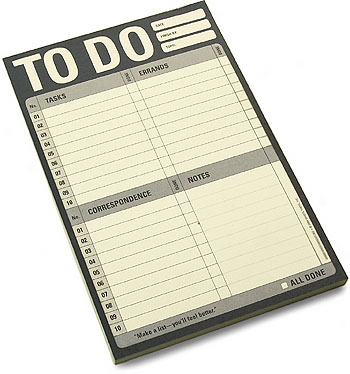
When I first started my woodworking business, I had a real hard time managing my time in the shop. As a former hobbyist, I was accustomed to thinking in terms of 1-2 hour shop sessions. So I had this misconception locked in my little brain that a “day” in the shop consisted of about 1-2 hours worth of work. Obviously, if I wanted to stay in business, this wasn’t going to fly. Thanks to a suggestion and a smack upside the head from Nicole, I started breaking my projects down into a simple list of steps. So instead of feeling overwhelmed by the distance between the start and finish, I am focusing on simply finishing the next step. As a goal-oriented person, it feels good to have a to-do list, and scratch those items off my list at the end of the day. For me, it was just a big change in my mentality and approach. And breaking a project down into smaller more manageable goals was the most satisfying and efficient way to reach the seemingly distant finish line.
So lets say we are making a table. On Day 1 we’ll layout the parts on the rough lumber and then mill the lumber to rough size. On Day 2 we’ll mill the parts down to final size and layout/cut the joinery. On Day 3 we’ll finish sand and assemble. On Day 4, we’ll apply the finish. Now, of course, you’ll have to adjust these daily goals to fit your actual time-frame and work style, but you get the general idea.
So with that in mind, write yourself a schedule at the beginning of every project. Chances are you won’t follow it exactly but you’ll get more accurate with every project. The sense of structure will help you feel like you are actually making progress even if you only have a few hours a day in the shop. Hope that helps.



I’ve faced this exact same problem in the past as well. I’d walk into the shop knowing I have an hour or two, look around at all the unfinished tasks and essentially over think myself into not accomplishing anything.
I agree completely with Marc on the idea of breaking it down into much more manageable tasks instead of looking at the big picture. So put on those blinders and focus on one thing at a time. Even doing that I still have problems when the tasks are broken down into the smallest logical chunks and even then they require more time to complete than I typically get in a single shop session.
If you are a hobby woodworker keep in mind that the Break Out List is not meant to be a timeline or a Must Do. It is just a way to have some focus so that when shop time presents itself you can jump in on the next step. I don’t handle/accept assignments very well (at all), but I do get great satisfaction of checking off Steps. For us hobbyist types the end result, while most satisfying, is not the point, it is the process. So savor the long projects, but don’t get hung up on the completion.
When I was a young sprout working in a FordMoCo factory (building early Mustangs!) I found that being efficient or productive was not moving faster. It was making the transitions smoother. A Step by Step list lets you jump in efficiently and confidently and also to then move to the next step if you are still hungry.
I work in my driveway, or in the garage with everything rolled out of the garage so I am mostly a daylight woodworker. When I first began this wood business a few years ago instead of reading Sports Illustrated I would work on my next days step by step list. Helps the visualization and enables me to use those precious daylight hours (especially in the winter).
Note: substitute “play” for the word “work” where ever you see it. That’s a rule of the good life. Enjoy.
While the advice given in respond to the Jay’s question is sound, it seems to me that it ignores much of the context Jay included in his question. Is Jay’s question really about motivation. Perhaps closer look at his text will reveal other ‘issues’ Jay needs to come to terms with in order to more fully enjoy his woodworking.
“When I see a piece of wood I think to myself ?what a waste”, so I store scraps and miscellaneous sized pieces.”
This is a classic hoarding issue that all woodworkers have to one degree or another. It creates the problem of storage (“my shop is full of wood”) but in Jay’s case it also seems to create the problem of pressure to do something (anything), so all his scraps wood aren’t “a waste”. There is no inherent connection between lots of wood and a desire to work it, (just ask someone who runs a sawmill). Perhaps Jay needs to rethink what the shop full of wood scraps really means. If he is having so much trouble making things, how are all these scraps being generated?
“Yet when I get into the shop, I have no idea where to start even though I have plenty of vision.”
While at some basic level a ‘vision’ is required (even if its only a vision to reproduce someone else’s vision), vision by itself is completely inadequate in the quest to be ‘productive’. Productivity requires, among other things, work (most times hard work), discipline, risk and a willingness to fail (see The Nature of Workmanship by David Pye for more this subject). It is not uncommon for people with vision to struggle with the other skills required to bring a ‘vision’ to fruition. The general underdevelopment of these skills can be be misinterpreted as a lack of motivation, ie. ‘if only I was motivated enough I could complete this’. Woodworking isn’t completely about the end but its also (to some even principally) about the means. The claim of “I have no idea where to start” seems intellectally dishonest, does Jay really not know how to start a project (you know select some rough wood of an appropriate size and begin to mill it) or does Jay really need to ask himself if he simply doesn’t like the process required to build a multi-stepped (day) project. Understanding this could provide the solution to his frustration.
“How do you jump into starting a project? I have problems starting if I know Im not going to have time to finish it that day, which is why I have recently only been turning pens.”
There really is no magic to jump starting a project. When people speak of jump starting something what they really mean is they plan on devoting enough time and effort (see above) to get a project somewhere beyond the starting line. The ‘finish it that day’ comment seems quite revealing. There is nothing wrong (bad) about ‘day’ projects. There many one day projects, beyond pens, things like spinning tops, small bowls, letter openers and picture frames immediately come to mind. All people, when given a choice, tend to do what they enjoy and avoid things they don’t enjoy. Recognizing your own preferences and developing them is a surer path to an enjoyable experience in woodworking (as well as life).
Sort of along the same line of question. Maybe better suited for the forum but I am going to post anyway. Once you get started and motivated, how do you decide how much to charge for a project? Boy did I just open a door or can or whatever? Is there a standard or median hourly rate? Profit on the wood or just labor? Factor in machine, blade, bit wear? Or do you just look at a project and say I want this much for it? I was looking at Jeff Lohr’s site. $3500 for an end table??? Don’t get me wrong it is very very nice. How many does he actually sell?
Wow that is a can of worms. Probably a little heavy of a topic for this comment thread. Absolutely feel free to start a new forum thread. I would love to hear other people’s opinions.
A long time ago on the first episode of Wood Talk, I gave a brief run down of how I price out my work.
http://www.thewoodwhisperer.co.....episode-1/
My method is pretty simple and allows for a lot of build in fudging. I never broke things down to the wear and tear and all that jazz. But I am sure many people do.
But once people are willing to pay more than the simple “cost” of building the project, the sky is the limit. Its essentially worth what someone is willing to pay for it. Hence a $3500 end table.
SOOOO! True! I can not count how may times I have really messed up a project because I wanted to rush it. Now when I feel I had enough of one task I take this has a cue to STOP
Marc,
Your right. Planning is the number one task, however you didn’t address the part of the question about all the scrap wood in his shop. I have all kinds of small or short pieces of wood under my table saw, radial arm saw, work bench and outside in bins. I could use it for firewood, but again what a waste.
What is your comment on not wasting scrap wood?
Well that’s simple. Use it, or stop collecting it, lol. If you have lots of space, collect all the scrap you can. After all, someday you really might find a use for it. But most of us value our space too much to have small bits and pieces of wood laying around forever. So what I do with scraps is save the stuff I know I am likely to use. A large amount of domestic scrap is set aside for use in my smoker. And in the past, the smaller exotic pieces that I didn’t want to keep went to friends who are turners.
I honestly didn’t think that the collection of scrap was part of Jay’s immediate issue. It certainly could become a problem as he builds more projects and generates more scrap. But if he starts building and actually using some of these odd-sized pieces, it can become much easier to justify having this stash of scrap in the first place.
It’s remarkable how similar we all are in our goals, triumphs, and challenges. I’ve been reading many of the posts from the past several months (I’m a newbie here….and a bit OCD) and when there is a post like this one, many of us can truly identify with each other.
I’m a beginner who has stumbled upon a unique situation. I was left a full workshop in a will last year and have been obsessed with it ever since. Since I don’t really have a main focus in woodworking, I tend to start several kinds of projects all at once. I can acquaint myself with the steps and be comfortable with taking them. The only problem is, when you have a shallow relief carving, three turning projects, tool restoration, and shop furniture working it becomes a bit of a struggle to decide which project should take precedence.
Since I am a compulsive list-maker, I tend to make very long and detailed lists of the projects I am working on, the importance of each project, and if one project will affect another project (tool restoration).
All in all, and to make a short story longer, I agree with everyone above. Make lists and try to follow them. Checking things off at the end of the day really makes me feel like I’ve accomplished something.
I am also a compulsive list maker. I have lists of lists. I have also taken note of how I tend to work. I am more focused and motivated at the beginning and end of a project. Whether I am sewing a garment, reading a book, or building a project the middle section is always where I struggle to keep going. Lists help to break things into parts that often can be done in only a few minutes. As long as I keep doing those I get past the mid-section and eventually finish.
I also don’t have long stretches of time to work on things. I always try to have a plan of what I need to do next before I even go into the shop. That way I can begin immediately.
This topic got my attention because I think Jay is having trouble with “ideas”! As an artist, I come across this all the time and best advice I can give is to take some Candidates (scraps), lay them out in front of you, go back to your roots and play with the blocks! Cut some wood in a way you might not normally (they are only scrap). Give that band saw a test with free form and add a branch or log from your back yard. Once you get your project in mind, you’ll have no problem with how long it takes to complete!
I kinda feel the same way, I have wood in the shop, but I dont seem to have much time, and I dont have any big projects in the works. So when I find a couple hours I feel like I want to go into the shop, and do something, ANYTHING, so I usually end up cleaning up, and sharpening tools. Maybe I just need some small project ideas that would give me something to work on.
I draw things out with SketchUp first. I get all of my measurements from here and even show my wife what the thing will look like (and get her approval) before I ever buy the wood. I already know that the joints work with what’s next to it and am able to pre-think the tough parts. Once I buy the wood, the steps all seem pretty obvious since I’m so familiar with what it’s going to look like. Hope this helps!
Oh, and on each project, I learn something that I DON’T want to do next time. After enough projects (and mistakes) I’m more efficient, whatever.
Im sure I’ve been vague but I don’t intend to. Hopefully, I dont seem on the offensive either, but truly big ideas are created in very simply ways. Lets throw the scraps on the table, think a bit, find the idea, and it will be a project dear to you and well worked. Try it, you will suprise yourself!
I’m always scared to start a big project. Not that I’ve done anything really big so far, but I did just start a big one today. Making those first cuts always makes me nervous. I always get the feeling that the cut I’m making or the one I just made is going to screw something up down the line. But I double checked everything this time, so I should be alright. That method hasn’t been perfect so far though, hopefully things work out differently this time. If not, I have an excuse to buy more lumber.
So, despite my nerves I tend to just jump into a project. I do try to make a rough cut list of some sort to get started, but after that I just try to work on things in a logical order and get as much done as I can each time I work.
Zach
One of the best advice I was given with woodworking was – it’s only wood. So don’t be afrraid to make that first cut – as you said you can always buy more lumber and even if you ruin a piece – seldom is it ruined completly – meaining it can easily be used for something else. If you approach woodworking this way you will relax a lot more. (and I know it isnt easy – I sometimes hate to start a project out of fear myself – but I just tell myself – it’s only wood) oh and it was David Marks who gave me that advice.
I can walk through a selection of lumber, and I can see the project that that piece is destined to become. My particular problem is a lack of confidence in my skills, to bring it to the beauty I see in my head.
This may be a part of Jay’s problem.
Sometimes, it’s not the vision for the big projects that gets in the way, its the “now how do I get there from here?” stage. lists are wonderful. I have three clipboards around the shop, two with projects (“Wood projects” and “combined projects – eventually”), and a third with the day’s to do list. (laundry always seems to come before “true up end table”…)
As for scraps, I like to save as much as I can. (packrat is in my blood…) But the smaller scraps can be cut into slivers, or small squares, and turned into game pieces, laminated into something larger (pen stock, or cutting boards, for example) and can be used for little things. (like the pulls on the gadget station.)
What seems to help me the most is the old adage: “start with a clear workspace.” When you can see everything, and do not have “stuff” cluttering up your area, it feels like the ideas and confidence turn from a trickle into the roaring Niagara.
I think you have some great ingredients: plenty of scrap wood and some ideas. Release yourself to use that scrap wood for prototypes or to learn other techniques. Hand cut dovetails, working out an angled mortise, edge profiling, or finally making that shop mallet with the funky dovetail joint.
Nothing paralyzes me as much as wanting perfection — not starting anything until everything is decided; not wanting to waste any wood, etc. Sadly, this gives poor results when I finally do get off my duff and try to finish everything.
Matt
Marc,
Thanks for the idea. I get very little time to work in the shop and it may be days apart. I often feel as if I can’t start larger projects. Breaking them down on a to-do list will certianly help!
-Brian