This article was inspired by a question from. He writes:
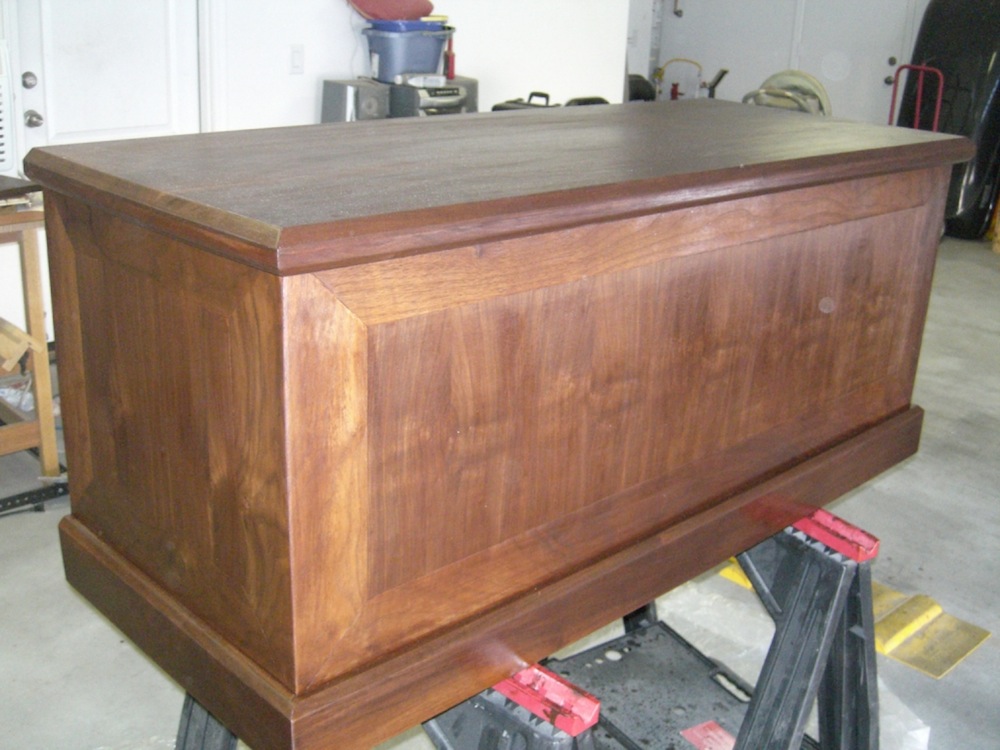
I have just finished assembling my first big project: a walnut blanket chest for my wife. I did make mistakes but as of now I am somewhat pleased. Since I jumped in full force for the piece I decided to do the same with the finishing. I derived my finishing from a recipe from a book called Foolproof Wood Finishing by Teri Masaschi. I decided to stray a little from the recipe in the book because when I practiced on scrap I wasn’t happy with a few details.
Sanded to 180 grit, wash coat of 1 lb cut shellac, 320 scuff, Behlen’s burnt umber glaze, shellac wash coat, 320 scuff, general finish oil base mahogany wood stain, and then Minwax Dark Walnut Oil Base Wood Stain. Now here is where my question is. I was planning on top coating with 3 layers of General Finishes Arm-R-Seal Oil and Urethane Topcoat (Semi-Gloss). The books I have don’t give much detail on really making a topcoat work well.
So do you think this topcoat is a good one? Do you see any problems that I may have? If I don’t like the Semi-Gloss after 3 layers and want more gloss can I do a 4th layer of High Gloss? What kind of Gloss does a blanket chest usually have? Have I gone too far and does finishing really have to be this complex to get a piece to look better than amateur? Any and all feedback will be well-received. Be brutal.
The FoolProof Folly
“Fool-Proof Finish” eh? Well, that’s just one of those silly terms publishers like to use to sell books and magazines. No finish is foolproof, but it sure as heck doesn’t need to be all that difficult either. In fact, the regimen you described sounds anything BUT foolproof to me. The reality is somewhere in the middle. Let me address a few of your questions first.
I see no problem top-coating with Arm-R-Seal semi gloss. In fact, that would be my recommendation. I’m not a fan of super high gloss so I think you are on the right track. And after several coats of semi-gloss, adding a coat of gloss can make the surface look a little odd. It wont really look like gloss again, so much as a glossy layer over a semi-gloss surface. Like I said, a little odd.
Worth the Effort?
Now for the criticism. Finishing can be as simple or as complex as you want it to be. I haven’t read Teri’s book so I don’t know how closely you followed the recipe. But, when you have that many ingredients and steps in a finishing regimen, there are plenty of opportunities for things to go south. Before I go any further, I would like to say the construction, design and craftsmanship on the chest look great. If that’s your first big project, then you certainly have bright woodworking future ahead of you!
So here’s my perspective on the finish (a combination of biased opinions and fact). That regimen isn’t exactly appropriate for walnut. You paid good money for that wood, and with that finish, you could have purchased alder at 1/4 the price and the final result would be nearly identical. Personally, I think its a darn shame to put layers of color on top of a naturally-beautiful wood. The most I would do to walnut is maybe hit it with a walnut dye or stain to enhance the color or even out some lighter sapwood. But that’s a very rare occurrence in my shop. From what I see in the photo, the finish appears to be a slightly muddy and it obscures what would have been beautiful grain. Several coats of Arm-R-Seal alone would have given you a beautiful protective finish that enhances the grain and really lets the wood’s natural beauty shine. It also lets people know that this piece is real walnut and not just layers of color on top of a cheaper piece of wood.
Critiquing The Recipe
Now lets say you did use a less expensive wood and you wanted to make it look like walnut. How would this finish regimen stack up? Honestly, not too well. By sealing with shellac twice, before we even add the oil based stain, we can’t expect there to be too much of a color shift. In order for these stains to work properly, they need to absorb into the raw wood. The shellac is going to prevent that from happening to some extent. Also, its a little unusual to apply the glaze before the stain. Most times, a glaze is applied as a final color effect once you already have the base color you are looking for. You would then add your final clear coats over top of the glaze. Generally speaking, with a little rearrangement and simplification, this finish regimen would work quite well.
Finishing is a lot like cooking: the more crap you throw in, the less you can discern and appreciate the individual ingredients. And when it comes to finishing, there is a lot of confusing info out there. As a person who spends a great deal of time trying to show people that this woodworking/finishing stuff is NOT as hard as it seems, its upsetting to me to see you go through all these extra steps. But hopefully this clears things up a bit and you’ll be better prepared for your next creation.
And just an FYI, three authors that have never steered me wrong are Bob Flexner, Jeff Jewitt, and Michael Dresdner. This is not a knock on Teri Masachi’s work by any means. I just haven’t had the pleasure of reading her book so I can’t make a personal recommendation on it.



Marc, I always like what you said in one of your earlier videos–keep it simple. Don’t worry about mixing this and that. Real good advice. Unless, you have to get some special effect that the wood you want won’t provide (like my customer who wants to hide the oak grain and make it look like dark mahogany). Besides, it makes going back to buy more color much much much easier.
Coming from a background of finishing front doors on houses, I like to use high gloss for the first coats of finish (even if a softer final coat is desired). Actually high gloss is the best final finish for the exterior door of a building, especially if it’s high quality PAINT and not just a varnish. Even on a piece of furniture, high gloss can always be buffed down with steel wool, pumice, rottenstone, or whatever, and that look can be far nicer than a semi-gloss or satin finish to begin with (with which to begin). And, since a pure gloss has no filler to soften the sheen, it’s more protection and durable. Top it off with your final sheen.
Mark and Chris, I’m with Mark. Walnut is a beautiful wood and does not need all the steps that you are going through. I finished my coffee table by sanding to 200 then used a coat of Bullseye dewaxed shellac, sanded to 220, another coat of Bullseye, applied crystalac (Rockler) grain filler, sanded to 320, applied Minwax wipe on semigloss poly, sanded to 400, then coats of the wipe on with 000 steel wool between coats until the desired finish. The photo does not do the finish justice. I’m a firm believer that finishing that you have to “build” a finish just like building a project and that it should take almost as much time as the project to do.
Sorry for rambling, to me, walnut is just too beautiful to cover up.
Mark you are the best and Chris, I wish you the best.
Later,
Doug
a.k.a. the woodguy
My “fool proof finish” (I realize it isn’t actually fool proof) is to use wipe-on products: Tung oil (3 layers), and wipe-on varnish (3 more layers), with light touch of 0000 steel wool inbetween to get rid of dust. I smooth the final layer with a brown paper sandwich bag (but I take out the sandwich first).
It takes longer with all those thin layers, but it sure is simpler than spraying. More and thinner layers should give a stronger finish too.
I try not to use stains for the same reasons as Marc unless I have to match something, or maybe if it’s a dye to enhance bird’s eye maple. This used to be my biggest gripe with Norm – that he stained everything he built.
IMHO when it comes to any finish on hard woods KISS theory applies(Keep It Simple Stupid) and backs up your advice to Chris. Nature is indeed beautiful don’t mask it, enhance it. Noodles
Marc – THANK YOU for making finishing simple for us “simple” folks. :-)
As someone with little experience, I love how you give simple finish advice that is easy to follow and gives good results. I find it funny how many of the “experts” make the finishing so much more complicated than it needs to be. I think that is the most daunting task for most novice woodworkers. You spend weeks, months, years on a project and the last thing you want to do is ruin it with the finish.
Thanks for giving such great advice that is practical and easy to understand. Kudos to you!
If you are looking for a good book on finishing, I have been very impressed with Bob Flexnerâ
I had to laugh aloud while reading the original fool-proof finishing recipe because I bet I’d get lost halfway through it. I agree that letting the wood stand on its own is the best, although that’s a personal choice.
I second TWW’s author suggestions. Based on his recommendations, I bought books from all three and all three were very well done. Sure, some repeated basic material, but each has a great take on how best to use each product and different tips to help novices like me keep the project out of the smoker.
Very nice project, though. Reminds me to get off my butt and do something more complicated next ;-)
Rats, I knew I had something else to add…
When I first read Chris’ email, I was thinking that 3 coats of semi-gloss Arm-R-Seal would be muddy due to the flatteners. Fred eluded to the solution without calling out the problem. If you want to end up with a semi-gloss coat without dulling the sheen mechanically, use gloss for all but the last topcoat so they stay clear and put the semi-gloss topcoat last since the flatteners there will give the desired sheen. If all 3 coats were with semi-gloss, you’d have more flatteners than you need.
Damn nice project Chris, and Marc I believe is dead on, Walnut is almost exclusively what I build with b/c of how beautiful it is, and only finish with tung oil so it brings the natural beauty through, listen to Marc and you can’t go wrong!
I cant agree more with the keeping it simple, especially for new woodworkers. My first real project (just completed) was built with solid cherry. For the finish, I used a complex recipe from a book that involved a dye stain and then glazing. In the end, the project looked really great. However the beautiful cherry wood was totally masked by all the color that was put on top of it.
I agree, to let the wood do as much as it can. Finishing with tung oil is wonderful. Instead of stains, which can obscure the wood, try liquids like ammonia, vinegar, intense tea, boiled onion skins or nutshells. More exotic chemicals, like potassium dichromate, yield even more extraordinary reults and, in fact, were used on mahogany in the old days. Experiment, bring those “eyes” out on birdseye maple, finish simply, wax well, and you’ll love what you get. I have restored antiques for 36 years. I am still learning. Good luck. jason stillwater
Ran across a back-issue of Wood magazine, that had a recipie included for a “black oak stain.”
(I blew past it during the initial read because I was more interested in the articles bigger than one page…)
Don’t remember the quantities, but I do remember it involves vinegar, steel wool, and (I believe) mineral spirits. Basic process is that you strip the oil/protectant off the steel wool, then rinse it, then soak it in Vinegar until you like the resulting stain. Remove the steel wool, and start staining.
(Haven’t tried it yet, though. Planning a project that will involve it. It’s number 371 on the list….today.)
Aren’t you being a little harsh on a book you haven’t read? In addition, the poster had already done the finishing steps he outlined. There was no going back for him, so what’s with the gratuitous criticism? Why would you want to make a person feel bad about a project of which he was so proud?
Hey RFS. I was getting ready to post a full reply and explanation, but I decided to re-read the original question and my response. I am wondering if you actually read everything? I think your concerns were adequately addressed in my reply to Chris.