This question comes from Michael who asks:
I know this has got to be the dumbest question. I have a right tilt table saw. Where do you put the fence when you make a 45 cut? Please don’t laugh too loud.
And my response:
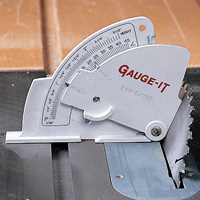
Well, I did laugh out loud Michael. But only because you told me not to. :) The truth is its not a dumb question at all. In fact, its a very good question that more folks should be asking themselves when they own a right tilt saw. The reality is that most people will cut their bevels with the fence on the right side of the blade. The problem with this is the fact that the workpiece is then trapped under the blade and has a higher chance of kicking back. It also means that you have less room for error, because if the piece lifts up at all, you will remove some extra material and likely have some burning to deal with.
So one alternative is to cut with the fence on the left side of the blade, but obviously you are limited in the amount of room you have to work with. So I would say if you are comfortable using the saw in this manner and your saw is capable of a left-side rip, go ahead and do it for the smaller pieces that will fit. When cutting larger pieces, you just won’t have much of a choice if you want to use the tablesaw for the angled cut. Its just the nature of the beast.



The question I’ve always had is why they make right-tilt table saws in the first place? The saw practically invites a dangerous cut. Is it somehow easier or cheaper to manufacture this way? Seems like the right tilt table saw was thought up by the same guy that invented the radial arm saw.
It is important to point out to the questioner that when you do make your cuts with the fence moved over to the left side of the blade you will need to reverse your hands, feet and body positions when making the cuts. That is you will be standing to the right of the blade, your right foot will be forward, you will hold the stock against the fence with your right hand and you will feed the stock/use a push stick with your left hand. Easy enough for us left-hand dominants as we adapt to the right-handed world already. It’s time for right-handers to know how we feel.
A method I use to make angled cuts and keep the fence to the right side of the blade is to use a sacrificial fence raised above the table surface so that the offcut is not trapped.
I thought a quick web search would find plenty of examples but I was wrong. Apparantly this technique is little documented in the web world. I did find one page: http://www.cjohnhebert.com/Bed.htm
I find, though, that he and others make the mistake of burying the blade into the face of the fence. You can actually bury it into the bottom so that the plane of the fence’s face meets the plane of the left side of the blade. The blade can then be raised into the bottom of the fence to a reasonable height (just don’t raise it too high or you’ll embed it into your real fence!)
The bottom of the false fence needs to be set just below the thickness of the stock to be mitred (say one ply if cutting plywood). Also, the fence needs to be at least as thick if not thicker than the stock you are cutting. Also, you will test the setup on a scrap piece before committing the real material?
The side benefit of this set up is that you can, say, mitre all four edges of a rectangular board with one set up and with no measuring! The pieces can be cut to actual size and then be mitred.
Generally the offcuts will either gently expel themselves or will be pushed through to the outfeed end by the next cut. Sometimes they might do neither and will clog up under the fence and will need to be manually cleared.
Hope this helps.
I forgot to mention that the sacrificial fence method is best suited to panels. Trying to mitre the long edge of a six foot 1×3 with this method would be sketchy at best.
My Jet cabinet tablesaw is a right tilt model. I got a deal on it because the store ordered it in and nobody will buy a right tilt. The left tilt models are definitely preferable for the majority of people.
I place the fence on the left side of the blade when cutting a bevel. This is important for me because I like the way the blade approaches the material.
Most don’t realize that if you plan on adding a sliding table to your saw, a right tilt will have the advantage.
It is a good question indeed. I’m a professionnal cabinet maker and I use 45 degree miters in a lot of projects. I now have a sliding table saw combined with a shaper, so that operation is really a breeze (look at the felder KF700). When I had my right tilt unisaw, I cut my pieces to the exact size with square cuts and the use an auxiliairy l-shaped fence over the blade so that my piece would be cut as if it was a left-tilt saw. You simply your angle and blade height so that it cuts trough the wooden fence at your material thickness and voil
Sorry, the drawing with letters got mixed up…
Hi,
I used to do exactly as Steven Hall describes above. I now have a sliding table saw (A beautiful Felder KF700, simply magical) and a CNC for these operations..
Marc-Andr
The big advantage of right-tilt saw is that the fence measurement stays valid, even when the blade is tilted.
As for increasing the danger of kickback, I’m in the camp this is urban legend, promulgated by those that don’t understand what happens when kickback occurs. Kickback occurs when the workpiece is lifted off the table surface and comes in contact with the blade at its apex, which then shoots the board back at the operator at high speed. Given the geometry of the situation, this is less likely to occur with a right-tilt, not more. With both blade and splitter on top of the board, it is much more difficult for the board to lift off.
Now if an operator modifies the tool by removing manufacturer-installed safety equipment (like the splitter), he can hardly blame the tool for such a “Darwin Award” stunt.
When I had my right tilt the only way I would do it and feel safe is to move the fence to the left side. BarryO if you feel safe go right ahead, but I do not recomend it. Any shift it the work peice and you have a projectile-and this can still happen before you reach the splitter. Yes the splitter and guard are there, but I feel it is only there for the chance of a mishap and not to rely upon. Not telling you what to do and mean no disrespect here Barry but I think it is a bit risky. Michael, if you need a 45 degree another suggestion would be a 45 degree chamfer bit for the router. I have done this many times before my new saw on the router table. If you don’t have a router table you could always hot glue a scrap onto your work peice so that your bearing has something to follow and use your router. Hope this helps some.
Nate
BarryO is correct about the fence measurement staying valid. This occurs not only when the blade is tilted but if you use blades that are different thickness. On a left tilt if you change blades that are different thickness you should re-calibrate the scale on the fence. On a right tilt you donâ
My uncle lost his index finger on a right tilt table saw because he was ripping I think it was a 2×6 for an out feed table. Some how is hand slipped and it was like 11:00 pm he had been working all day and wasnt paying attention and look what happened
“As for increasing the danger of kickback, Iâ
First of all, the article I posted on my site id foolproof. In that one can make precision miters without messing it up and have to resort having a left tilt saw. The only material left on thew right side of the blade and is trapped is waste. With 3/4″ stock, the only piece is a chamfer strip approximately 3/4″ in diameter. This strip wobbles around and eventually wants to be pulled back but in most cases it’s a gentle pull back. I never stand in it’s way anyhow as my concentration is keeping the piece to be cut against the fence rather than left it drift away from the blade.
There’s no chance of lifting due to the the stop piece above the blade. Also, the blade isn’t buried in the fence per say, just just the top edge of the cutting teeth are barely into the sacrificial fence. I have used this system for my entire professional career with no injury. I did have a few pieces hit a back wall (drywall) with hardly any damage. In fact the waste never stuck into the drywall, but broke in 2 or 3 pieces (plywood).
This system may not work for everybody, but I can’t why not, but rather than hand down information with others view point, I thought I’ll reply straight from the horses mouth! Try it, you might like it ;-)