This article was inspired by a question from Jeff. He writes:
“I am using Helmsman Spar Urethane to refinish the front door of our house. It’s a one piece flat door — no recessed panels. I am applying it with a quality brush but I still get brush marks and hi-low points, also tried a sponge brush with same results. I know it’s barely noticeable but I absolutely abhor brush marks. After 4 coats, I have managed to sand it down fairly flat. Is it possible to thin Helmsman and spray it with an HVLP gun? There is a Helmsman spray can available but I have so much Urethane left over. To thin or not to thin?”
The Power of Dilution
Polyurethane, whether its an outdoor or indoor formula, takes a little finesse to apply without bubbles or brush strokes. You need to use the right brush and it takes a little practice to get the technique right. Sponge brushes are certainly another option, but the results are not always a significant improvement. Most of the trouble comes from the fact that the urethane solution is so thick. It can be like trying to lay down an even coat of corn syrup. So one way to significantly improve the workability of your urethane is to thin it with mineral spirits. Thinning by about 10-20% will make brushing significantly easier. And thinning even further would allow you to spray via HVLP, but that’s definitely not my favorite way to apply an oil-based varnish. Thinning allows the finish to self-level a little better, and ultimately that will help you avoid brush marks. The only disadvantage is you need to apply more coats to get the desired film thickness you are after. But if the payoff is a smooth finish with no brush strokes, who cares, right?
The Wiping Method
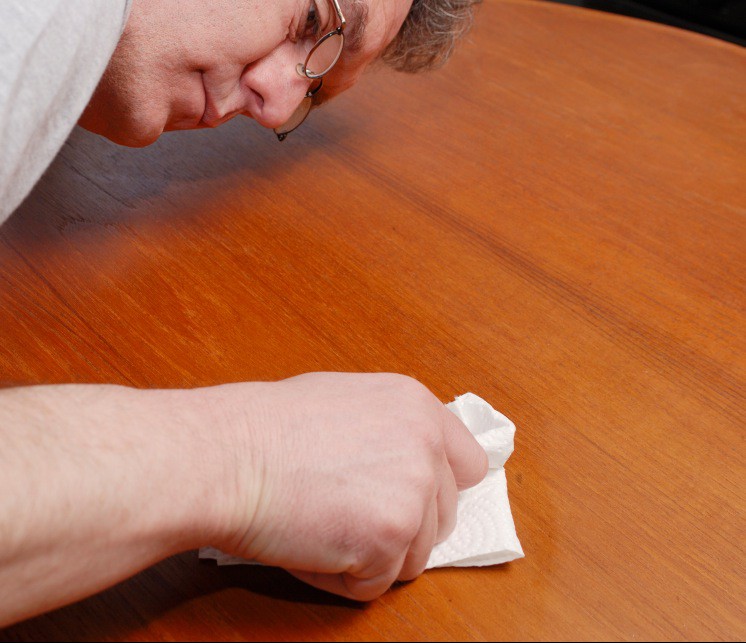
Now there is yet another way to apply polyurethane that I feel is the easiest, beginner-friendly method. And frankly, its the method I still use. It involves abandoning brushes all together. Here’s what you do. Thin the varnish 50% with mineral spirits, paint thinner, or naptha. Then get yourself a clean cotton rag (old t-shirt material works great), and fold it into a nice square applicator pad. I like it to be palm-sized. Wet the applicator with your thinner and then dip it into your diluted finish. Wipe on smooth thin coats, overlapping the previous stroke with each pass by about half. This method will result in a super smooth finish with no bubbles and no brush strokes. But remember, you will need to apply twice as many coats to get to your desired film thickness. Because you are actually applying less material to the surface, the dry time is significantly decreased as well. So in some climates (hot and dry), you’ll be able to apply as many as three coats per day. Just remember that when you use a wipe-on urethane, you aren’t trying to flooding on a real thick layer. You are just coating the surface evenly with a thin wet film.
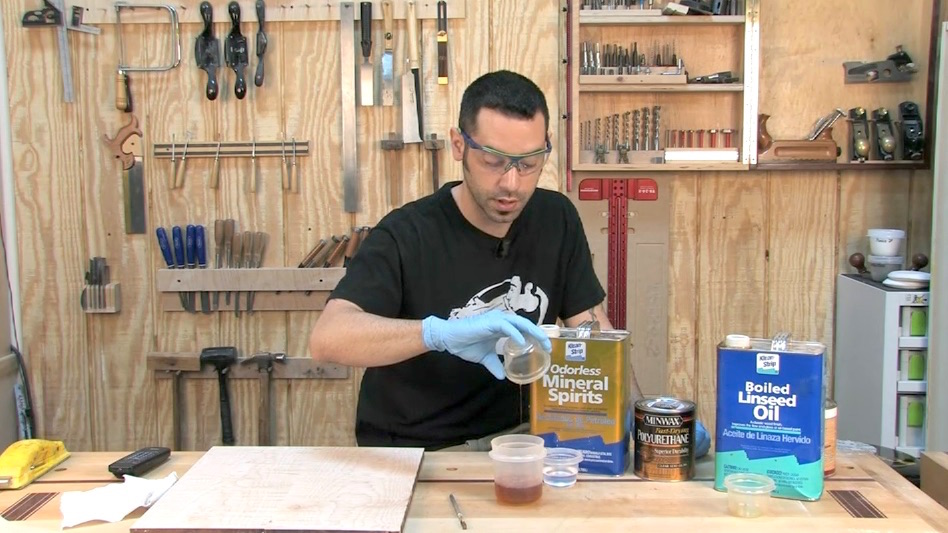
If you want to learn more about my particular finishing method, you should check out my DVD, A Simple Varnish Finish. My goal with the DVD was to demystify finishing by going over each and every step of the wiping varnish process. Even someone new to the world of finishing can create a show-stopping finish if they follow the methods outlined in the DVD. So check it out! And for those that are wondering what my preferred outdoor varnish is, its Epifanes Marine Varnish.



I am making my kitchen countertop out if Birchwood, i bought spar urethane to put on it. Bought a clear gloss can this be used over a stain or just used alone. And to protect my countertop how many layers should i use. I have worked with stain with polyurethane and i used urethane on my kitchen table. If i live the wood natural coler would it darken it some. Thank you for your time.
Just wanted to say, this article has been very helpful. A few weeks back, I finally found myself some Mockernut hickory suitable for making a walking stick. I’m talking chin high walking stick, mind you, not refined walking cane. I stained it ebony (which is odd and possibly stupid for a white wood), and I’m going to be varnishing it soon. I’m hoping the combination of flexibility and outdoor protection will be suitable, and plan to use Epifane’s clear for it. Do you think that would work well for the task of protecting a walking stick from the occasional elements? It won’t be left outside, but it’s going outside with me whenever I do.
I imagine it should hold up quite well.
Hi, great site, I am building an outdoor bar and I would like to get a thick glass look to the wood top of the bar, I was thinking of having the outside edge of the flat bartop come about an 1/8th of an inch higher than the bartop and then after 1 regular coat of varnish (type yet to be decided) I would simply pour the varnish onto the bartop, it would self level and without brush marks and air bulbs. Is this doable? My only fear is that the thickness of the pour would not dry thru.
Your answer would be muchly appreciated.
thanks
Don
It’s probably doable, but why not look into the products that are intended to be used that way, such as the bar top epoxies?
I’ve got an exterior Mahagony door that is finished with Spar Varnish (not sure which brand). After 5 years in the Florida sun, it’s looking a little dull.
Can I just wipe on a few coats of Spar Varnish (thinking Epifanes), or do I need to strip off the existing spar varnish?
Would light sanding for adhesion be necessary?
I had just installed a new doors to my sweet home. I want my front door look beautiful, I was little bit confused how to make that door look so natural, while search for that i found your website. I got the good ideas and details from your website, will try to check your DVD also. thanks
Hi,
I’m actually using Spar exterior water base gloss, by Old Master. Can I use the wiping method? Should I cut the urethan with water? I’m using it to cover a sign and I keep getting tiny bubbles. It’s like I’m painting with soap. I’m so frustrated!
Hope you can help>
Mary
On a small project, you can probably get away with wiping. But water-based finishes, traditionally, don’t wipe well. So it make take some practice to get it to work right, but on a small-scale project it is possible. If you need to dilute, you can use water. But don’t dilute more than maybe 10% or so.
This site is AWESOME! Thanks for being here!
I am using Man-O-War Marine Spar Varnish for some outdoor picnic table tops and bench seats. The table frame is steel. The tops and bench seats are reclaimed doug fir. I’ve sanded off the old finish to bare wood and am getting ready to finish them.
My question is about the wipe-on method. After doing a few coats with the wipe-on method to get the spar varnish to really seep into the wood, what are your thoughts on using a brush to finish with a few thicker coats? Should I work my ratios of spar to thinner from 50/50 to 100/0?
I look forward to your reply.
If you want a really thick coat, I’d say go for the brush from the beginning. Wiping will just delay you. While I suppose one might argue that a 50/50 thinned finish does absorb deeper than a full strength coat, I’d have to imagine the actual impact is negligible. So think about how many coats you want to apply and how fast you want to get it done. And if you’re comfortable with brushing, go with the brush.
I’m using the 50/50 cut of spar-urathane and mineral spirits but see uneven spots where some parts are glossy and others dull. Also, when whipping on, the product gets milky. Is the what you would expect?
Hey Jake. The uneven spots might just go away as you apply more coats. Just make sure the finish is drying completely between coats. As for milkiness, that doesn’t sound normal. What specific product are you using?
We are staining a new bar top for one of our customers we applied helmsman spar urethane to our finish. We are having problems with bubbling, and product not hardening. After researching your forum here we have now realized that we have used the wrong product on our bar top due to the fact we want a hard finish. if we sand the finish down to get rid of the bubbles, can we apply the Behlens rock hard table top varnish over the remaining urethane or would it be best to try your 50/50 mix
It’s all oil-based finish so they should be compatible. If you can sand down and get the surface looking good, go ahead and switch over to Behlens. You shouldn’t have any adhesion issues.
This is a great thread as I need to do my door tomorrow. Would you still recommend spreading per above even if the door is horizontal. Are brush marks as big of problem if applied thinly on a horizontal door? So to thin based on the guidance it would be 50/50 spar urethane and mineral spirits?
Thanks
picnic tables for wedding–we’ve been lucky to have 8 tables custom built, each 8 feet long and 32 inches wide, for daughter’s wedding–milled out of 60 year old pine trees, cut down on a friend’s property. We’ve finished them in a dark walnut that was thinned 2 to 1 with mineral spirits. The finish is perfect–it gives the old look that is dark but still shows the grain through evenly. Now we need to protect these outdoor tables from the elements, food and drinks. What do we use that won’t give any shine? Daughter wants them to look old and not glossy. (We even used the bark of the trees on the edges of the tables). Any advice is much appreciated! If we use the Spar Urethane and thin with mineral spirits will this give enough protection without the gloss? Thank you!
The only way to get rid of the gloss is to use a matte/satin formula or apply a gloss and then abrade the surface to a matte finish. One thing to keep in mind is that even a matte finish, when part of a few layers of film finish, may still look a little glossy to the average person. You’re putting a film on the surface so there will be at least some reflection. There are other lighter duty finishes you can use, such as outdoor danish oils and General Finishes Outdoor Oil, which will provide a very natural close to the wood look. But they aren’t quite as protective as a nice thick film and will likely require more maintenance over time. So there’s really no perfect solution since outdoor furniture takes a beating. Well, I take that back. The best solution is a cover. If you cover the pieces to protect them from the elements, you can be a little more flexible with the finish.
Hi! I am learning a lot from this page. I recently refinished the top of a buffet built in 1947. I used Minwax Wood stain and got a really nice match to the cherry finish on the front and sides. I am going to convert it into a vanity with two sinks. In reading the comments above, I am wondering if the spar varnish I bought is the right thing. I figured if spar varnish was good for boats, it would be good in a bathroom, too.
How you would recommend I should finish the top. Is spar varnish (not water based) the right method? Will it change the color? How many coats should I apply? Sanding after the second coat? I’m a little bit apprehensive, but it has to get done.
Thank you so much for sharing your expertise. :)
Many folks don’t like using spar varnish for interior furniture. It tends to be softer and more flexible, as it needs to be to survive outdoors. You might be best off with a good quality interior polyurethane. Perhaps something like Behlens Rock Hard Table Top Varnish. The high solids content of that finish is great for high wear surfaces. Follow the manufacturer’s insstructions for application. Sanding between coats is usually good idea.
And pretty much any oil-based finish will change the surface color to some extend. Tends to bring an amber/yellow color to the party.
Thank you so much!
Hi! So we are building a bar…. we got four coats of stain on it, and it looked great. We waited a week to start the spar urethane. After the first coat, it had some werid spots, only in some areas on the top. Before even sanding it looked almost like the stain got lighter in those areas. I just sanded with 220 grit lightly, and sure enough those spots the stain is way lighter . Should I continue with more coats?!?! Or do I need to sand everything off and start all over? HELP :)
Sounds like the stain is lifting when the finish is applied. Problem is that’s really tough to fix at this point. Keep in mind that most oil-based stains are in a boiled linseed oil base, so they take a long time to cure. When you layer multiple coats of stain you can actually make it take even longer to cure. So if the stain isn’t completely cure when you add a topcoat, you can get this kind of problem. My suggestion would indeed be to start over, but do what you can to avoid having to apply so much stain. Perhaps try a different product. And to ensure success, you might try sealing the stain with a light coat of shellac prior to using your varnish product.
I applied Gloss Helmsman Spar Urethane on a project of laminated ply. Now finished it is appropriately sealed however it is more glossy than I wish. Any suggestions to de-gloss the gloss on this thing? I was considering sanding lightly with a very fine grain (600 or 1200?) sandpaper to see how it looks or potentially re-coat with a final product that will be less glossy. Any thoughts?
Thanks for the cool forum.
tony
FYI I used a cheap brush .99 and a medium cheap brush $6 and found with the $6 brush if I worked quickly by brush strokes nearly evened out.
You actually answered your own question. :) Either apply a satin or semi-gloss variety of your finish or simply rub out to the desired sheen using high grit sandpaper or steel wool. I’d lubricate with mineral spirits while you do this as it tends to promote a more even scratch pattern and less friction.
I have a bit of a problem I need some advice on. We recently bought a new unfinished knotty alder front door and because I have a track record for making bad decisions, I let the install guy stain and finish the door. Well, I came home from work the other night, saw the door and almost cried it looked so terrible. He used satin spar urethane to seal it and it dried cloudy with brush marks and huge drips everywhere and tons of white dried in all the knots. He left the door vertical while applying and didn’t even remove the hinges so it’s obvious to me he didn’t really know what he was doing. I don’t want him making it worse so I’m going to try and fix it myself.
How should I proceed? I was planning on chemically stripping it to get back to bare wood but I’m concerned I won’t be able to get all the Varathane out of the knots and crevasses. Do you think I need to have it dipped?
I forgot to mention that the spar urethane was oil-based from Rustoleom and the stain underneath was Minwax Wood Finish.
Hello – I have two questions. One has been asked but I just wanted to make sure if I am reading it correctly. I am doing a bar top. It is 72 X 27. I used 1X4′s and created a design. It is attached to 3/8 plywood. I am using Minwax Helmsman Spar Urethane with the 50/50 mineral spirits. Should I put on three coats this way before I start sanding? Or should I sand after the first coat? My second question has to do with gaps. I have a couple of gaps between the 1X4′s. They are less that 1/8th. Should I fill those gaps with the spar up to the top of the 1X4? So the spar would settle on the 3/8 plywood then I would need the spar to reach the top of the 1/X4′s. I would assume the dry time on that would be a while. Is this how you would handle it? Thanks for your time!
I usually start sanding after about two coats. But if there is no stain involved, there’s no reason you can’t give the surface a light sanding after the first coat. And no I wouldn’t rely on the finish to fill those gaps. It can be done, but it’s probably going to take a lot of coats before you achieve a flat surface. You might consider, instead, an epoxy coating. You need something much thicker than will fill and span those gaps easily. Especially if you dilute 50%, you are going to be there for quite some time.
Now one thing from your description that sends up a red flag is that your 1 x 4′s are attached to the plywood underlayment. Did you allow for movement? If you are looking to have your finish fill those gaps and essentially lock the boards in place, so I’m assuming the wood is already securely attached. If that’s the case, you may have some issues in the future as the wood expands and contracts and the plywood doesn’t. Problems, meaning cracks, buckling, and warping. Just thought I’d mention that before you go any further.
I’ve been applying spar urethane to a bar top for my basement (Miniwax Helmsman gloss). The top is a eucalyptus veneer (pressed on MDF) with a cherry rail. Coat after coat, I’ve still been getting brush strokes. I started with new, pro Purdy bristle brushes, then went to foam brushes, but it continues to show brush strokes and appears to lay on in uneven coats. Some areas are noticeable “dry” looking with brush strokes long after it dries. I have been sanding in between coats with 220, then 320 paper. I would like to try your wipe on method, but I had a few questions about your technique. How saturated is your cloth? How much pressure to you use to apply it? Do you rub / scrub it on, or do you lightly wipe it on with little downward pressure? Thank you. I look forward to your response.
I usually only put enough finish on the applicator to allow for a smooth wet stroke. If you put too much, the finish will pool in areas. The thing to remember is you aren’t laying down a super thick film. In other words, you aren’t brushing. So wiping just applies enough to make the surface evenly wet. I apply a fairly small amount of pressure. Too much pressure and your fingers will leave marks and the finish will come out streaky. I do not rub/scrub.
Spar will be the finishing coat on my longboard I am making out of a stunning piece of barkpocket maple. It is crucial that every layer of a flexible longboard flex/act the same. I plan on finishing this piece similar to that of an exotic burl guitar finish. If I apply a few layers of tru-oil over the water based stain, and then finish with several layers of Spar, will there be flex issues? Does tru-oil have flex – 1, 3, 5 layers of it? Love what you have done in this thread over the past few years. What patients!
Well Tru-oil seems to be a polymerized linseed oil. So even after several coats you won’t have much in the way of film. So it should be plenty flexible. And spar varnishes, in general, are quite flexible. They have to be to work outdoors as the wood expands and contracts. So get yourself a high quality marine varnish and you should be in good shape. Also, do yourself a favor and do a few quick tests. Try a piece of scrap with and without the Tru Oil. You might find that you don’t need it. Once you coat it with spar varnish, you are essentially negating it’s presence and slowing down your cure time while increasing the overal time invested in the project. Good luck!
I’m using Old Masters waterbased exterior spar urethane and I’ll brush on a run and when I re-dip the brush and go to poly back into existing run, that run is drying already and raises up BAD!! I cut it with some water and it still does it… Any suggestions? Thanks.
That’s exactly why I don’t like brushing water-based finishes. They dry so quickly. If the piece is small, it can be pretty easy to brush on if you work quickly. But on larger pieces, this can be quite a challenge. I wish I could give you better advice than to simply say, “try HVLP”. But that’s what I do.
Hi there, Wood Whisperer. I’m really glad to have found your site! I’m attempting my first home project – revamping wooden bar stools from a flat dark brown to a high gloss white finish. I used Rustoleum High Lustre Coating Lacquer (2 coats) on the stools and the white color looks great. The problem is that there really isn’t any shine. You’ve mentioned marine spar varnish quite a bit in your posts. Is this something I can use over lacquer? Thanks for your help!
You can, but I probably wouldn’t. Oil-based varnishes have a natural amber color to them. It will make your beautiful white stools a nice urine-like yellow color. Mmm…:) So what I would recommend is you get yourself a couple of cans of high gloss clear lacquer. That will allow you to build up several more coats and give the finish more depth and shine. It also puts a nice layer of protection between your color coat and the outside world.
I recently a lightly weathered bench and sprayed it with spar urethane. Unfortunately the sanding left a lighter uneven color than I wanted so I’d like to give the bench a new finish. How do you recommend I proceed? Should I resand the bench again, lightly apply some mineral spirits to the bench, or just add the finish directly then follow with the urethane.
I also got some spar urethane on the metal arms of the bench which now have yellowish splotches. Is there a way to get those off? Any advice tips will be appreciated!
Once you have poly on the surface, you can’t really do much about uneven color. They do make poly with color in it, but those can be very fussy. So if you need to even things out, I would strip the wood down and have a “do-over”. And its a good idea to wipe the surface down with mineral spirits prior to finishing so you can get an idea of what the surface will looking like with finish on it. You can then correct anything that might need some work. As for the poly on the metal, I would just try to scrape it off. Problem is you will likely scratch the metal in the process. I’m not quite sure how you’d get around this. Even if you used a chemical stripper you would pull off any paint that might be on the metal. If it is bare metal you will likely stain it. So that’s a bit tricky.
Walnut counter top and bar w/ 2 coats of BLO thinned 50% w/ mineral spirits. How long would you let the BLO dry before spar poly? Indoors @ about 60 degrees in a Vermont winter so the humidity is low.
I would give it at least a week. But I can only roughly guesstimate. Always safer to wait longer since the oil takes quite a while to fully cure.
Hello – love the site, I used your technique to refinish my 1920′s pine front door. After 2 years the southern exposure has wore down the finish a bit (I have a glass storm door to protect it from the weather) I was about to lightly sand and reapply the poly when I noticed that the finish appears to be splitting a bit with the grain. The splits (for a lack of a better word) are with the grain and just enough that you can get part of a finger nail into the split area and its rough to the touch. I am hoping that the poly I add to the door will fill in these spots and leave me with a nice smooth finish. Thanks so much!
It should help fill the gaps. Just apply a nice heavy coat, let it cure completely, and see where you’re at. You have to be careful with poly finish because you don’t want any moisture to get under the finish as peeling will be the next step. But hopefully you got to it soon enough that the subsequent topcoats will buy you at least a few more years.
Hi I am new the the site tickled to death I found it I wad wondering what the best finish would be for a set of cornhole boards they are a gift for my son I am using cabinet grade plywood oak to be exact after painting and staining them and mind you the abuse they will suffer along with outdoor exposer what would be the best or ideal for a deep glassy finish thanks so much in advance nathan
An exterior polyurethane would certainly be a decent choice considering the conditions. Should stand up to a good amount of abuse.
Hi – I’ve just done the same. I used birch plywood + a tung oil stain. I was going to apply Minwax Spray Gloss Spar Urethane as the final coat. Do you think this finish will be too soft?
Thanks!
No I think it will be fine. Just apply a 3-4 coats so you get a decent build.
Question: Can I apply touch-up stain over Polyurethane and not regret it? I have 2 situations, one on exterior door moldings that have been finished with Helmsman Spar Urethane, and the other on interior wood finished with a water-based polyurethane. Problem is that nail holes were filled with putty that initially matched but turned white as it dried, so now every nail hole is extra obvious, as is the putty that smudged into wood around each hole. Looks like fingerprints of white all over the dark wood. I tried using the stain touch-up kit from my kitchen cabinets over the a few spots, and it seemed to work very well. But will I be sorry down the line – will it peel or discolor or dull out and then be just as obvious? Thank you for your fantastic web site!
Hi Susan. If the putty is under the film finish, which it sounds like it is, then the stain isn’t going to be very effective long term. That poly layer really doesn’t want anything on top of it, and most stain will just make a mess and never really cure properly. Now there are things like gel stains which contain some poly that will cure on the surface. But I don’t know how this will look in terms of hiding a flaw. It just might make things even worse. One of the big drawbacks of a polyurethane finish is that it isn’t easily repairable. So doing little touchups like this can be very difficult. Even if it looks good today, it might not look very good a year from now. But never say never. If you like the results, give it a shot. But just know that that the answer to your question is no, you generally don’t want to put touch up color on top of poly.
Thank you for your wonderful website! I have a client that has an exterior wood front door that faces north (in Texas). The door developed a “clouded up” look, so they polyurethaned it (without sanding, etc.) and it looked fine after doing so. This cloud-like appearance has come back. Would you please advise on what caused this to cloud up again so soon, and what we can do and/or use to keep this from reoccurring?
FYI, the door is somewhat protected from the sun with a covered porch area, but we do experience excessive heat here during the summer.
Thank you so much for your help!?
http://img837.imageshack.us/im.....g40572.jpg
Hi Diane. Usually cloudiness is the result of trapped moisture. This can happen when applying finish during really humid times. Not sure what the weather was like at the time of the application but that could very well be the problem. My advice would be to refinish the door during warm/dry weather using high quality materials, like my go-to Epifanes marine varnish. I know it is a lot of work, but that’s one big drawback of polyurethane: it isn’t easily repairable. And once damaged, it is usually best to remove it completely otherwise you are just delaying more problems.
Great site, have learned alot.
I am looking to seal the decking on my boat and cannot afford to use the proper sealants (big $$$$$) to-do-so. I used 3/4 plywood (untreated) for the deck, and am wondering what type of Spar (does the finish mean anything to my case, satin, gloss, etc.) to use to get approximately 5 years of use? Also, the plywood will have carpet on it. Within the next 5-10 years I am planning to re-do the carpet, and at that time I will hopefully be able to use the proper sealants to finish sealing the PW. Any thoughts?
Thanks.
Hey Scubby. Unfortunately, most marine are pretty expensive. And sometimes (not always) in the finishing world, you get what you pay for. So I don’t really know if there is an inexpensive solution that will do exactly what you want to do. Boats are definitely a little outside of my area of expertise so I would recommend contacting the folks over at Jamestown Distributors. And also check in some of the boating forums out there. I am sure there are other options out there that I am unaware of and the folks who use them routinely would be the best to ask for advice.
Great site, accurate info, not pretensious.
My issue: I teach middle school Wood Working and have found wipe on poly (Minwax)as the nicest easy finish. The problem is the cost of a quart. So, am I correct in assuming that if I get a gallon of quality poly and dilute it 20-50% with mineral spirits/thinner, I will have something close to what I’m paying $15/qt for now? If so, Yippie!
Thanks,
Ben
You got it! We pay extra money for them to just add extra mineral spirits. :)
Hi – We have just purchased a beautiful California Claro Walnut slab with live edges that we’ll use as an outdoor table on a southwest-facing patio. It will be covered with a tarp when not in use, but it will outdoors in Southern California all year. I have some finishing experience, but never anything exterior. The slab is bare at the moment, sanded to 220 …
We’re looking for a natural finish (no paint!), not glossy, that will stand up to the sun (and rain) of Los Angeles, and not need to be refinished every few weeks (I’m exaggerating). Every source I’m checked for advice on how to finish this gorgeous (and expensive) piece of wood declares that their unique method is the best and everyone else’s won’t work. Even Epifanes web sites don’t help much – the non-gloss products I found seem to say “interior” …
Bottom line – I’m confused … what sequence of steps with what products would you recommend …? And thanks for this web site, it’s terrific …
Thanks Bob. Of course every manufacturer thinks their product is the best, right? We just have to see through the marketing jargon to figure out what we actually have to work with. Now there is one truth you can bank on: a film finish is more protective than a non-film finish. And I assume when you say glossy, you are not only talking about true gloss finishes, but also the plastic look you get from building up coats of satin and semi-gloss finishes. The truth of the matter is a natural-looking finish is one that doesn’t have much protecting it. So there are certainly options such as Teak Oil, Outdoor Danish Oil, or even an oil/varnish blend of your own design using a spar varnish. All will produce low-lustre finishes that will probably look very nice. But they will also require regular maintenance. With a cover though, you probably won’t need to worry about it more than once every few years. I just used Teak Oil on a mahogany Adirondack chair which I also keep covered. Its a very natural looking finish without a thick film and it seems to be holding up quite well. That might be a way for you to go.
Bob – I know this is probably too late, but if you used teak oil, you likely have to address the issue again by now. At least that’s what I found with my outdoor furniture. Last year, I applied a product made by Epifanes called Rapid Clear Matte which is nothing short of amazing. The color and finish still look fantastic after a year of heavy UV and torrential rains by my pool. With teak oil, I found I had to reapply frequently.
I am using the same stuff but for a picnic table and benches. Should I apply the spar urethane to all sides before i assemble the tables and benches or just put it together and coat the accessible wood then? Just curious to see what some with experience would reccomend. Thank you
Hello, nice site and great help!
So I hired someone to refinish my wood exterior door, and the problem I’m having is best shown on the following picture:
http://www.imgplace.com/viewimg205/6624/46door.jpg
See those raised blotches in the horizontal part between the indented squares? Blotches like that are on various parts of the door.
There is no varnish on the door at this point. The coating you see in the picture is three coats of Minwax gel stain applied to partially sanded door.
While I think the blotches are from a bad sand job (finish not completely removed in places where the raised blotches appear), the person who tried to refinish the door claims that the old finish “just wouldn’t come off.”
Anyway, now I am stuck trying to figure out what to do with this door. So to my questions…
Is there any type of varnish that will fill-in/float-out these raised blotches so you don’t see them? Or should this door be sanded again? If so, that would bee this door third sand. Is that too many?
Thank in advance for answering.
Unfortunately, if it were my door, I would sand it back down. It is important to get as much of that finish off the surface as possible for not only appearance, but bonding. So that little patch could very well create even bigger problems in the future. It might not…..but it might… Either way, varnish isn’t really going to completely cover that up at all so it really should be corrected. But, the varnish could very well make it a little less noticeable. So it might be worth a try to simply add one coat and see what it looks like.
Hello,
I want to start buy saying this website is awesome!
I am making a basement bar out of Hard Maple(i have the bar top done, so the question only applies to the skin and the trim…all is Maple). I wanted a Natural look, so i applied Watco Danish Oils instead of a stain. I looks really good so far. I noticed that you advise wiping the Poly with a 50/50 mineral spirts mix.
Will it be OK to mix Varathane (Oil Based/Interior) Polyurethane at a 50/50 mix with Mineral Spirts and apply a few coats over the Danish Oil? If it is, do i apply it in circle motion and rub it in using very thin coats? or do i drag it in straight overlapping line similar like brushing it on? I am confused on the applying technique.
Thank you a ton!
Ryan
Hey Ryan. You should be fine diluting Varathane with mineral spirits and then topcoating danish oil. They are all compatible finishes. Just give the Danish oil a day or two to cure up. Keep in mind that this mix has no raw oil in it, so it will tack up faster than something like Danish oil. You can certainly flood the surface and then wipe off the excess, but I personally like to wipe it on with a folded rag. And like you mentioned, it is similar to the actions when you use a brush (overlapping strokes). This is actually a technique that I cover in detail in my DVD (also available as a digital download): http://twwstore.com/techniques.....inish-dvd/
OK. I will check out that video.
Thank you Sir!